ALLEGRO Algorithm: A Complete Guide to Optimized sgRNA Library Design for CRISPR Screens
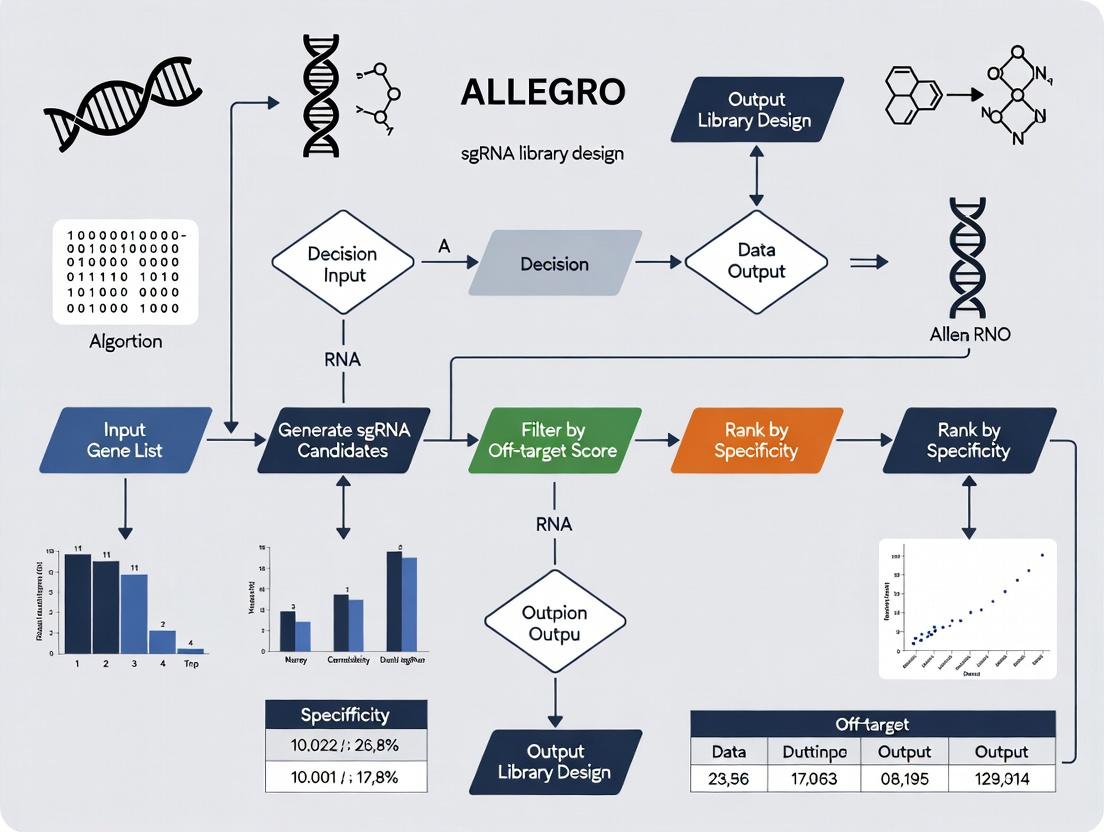
This article provides a comprehensive overview of the ALLEGRO (Algorithm for Library Editing by Guide RNA Optimization) algorithm for designing pooled sgRNA libraries for CRISPR-based functional genomics screens.
ALLEGRO Algorithm: A Complete Guide to Optimized sgRNA Library Design for CRISPR Screens
Abstract
This article provides a comprehensive overview of the ALLEGRO (Algorithm for Library Editing by Guide RNA Optimization) algorithm for designing pooled sgRNA libraries for CRISPR-based functional genomics screens. Aimed at researchers and drug development professionals, it explores the foundational principles of the algorithm, details its methodological application for various screen types, offers troubleshooting strategies for common issues, and compares its performance and validation metrics against alternative design tools. The guide serves as a practical resource for implementing robust, efficient, and specific sgRNA libraries to enhance the discovery of novel therapeutic targets.
Understanding ALLEGRO: The Foundational Principles of Modern sgRNA Library Design
Introduction to CRISPR Pooled Screens and the Need for Algorithmic Design
CRISPR-Cas9 pooled screening has revolutionized functional genomics, enabling the systematic interrogation of gene function across the genome in a single experiment. This guide details the technical foundations, experimental workflow, and the critical computational challenges that necessitate advanced algorithmic design, framing the discussion within the context of developing the ALLEGRO algorithm for optimal sgRNA library design.
Technical Foundations of Pooled CRISPR Screens
A pooled screen involves transducing a population of cells with a complex library of lentiviral vectors, each carrying a unique single guide RNA (sgRNA) targeting a specific gene. Following selection and application of a selective pressure (e.g., drug treatment, nutrient deprivation), the relative abundance of each sgRNA is quantified by next-generation sequencing (NGS) to determine genes essential for survival or response.
Table 1: Key Quantitative Metrics in Pooled Screen Design
| Metric | Typical Value/Range | Significance |
|---|---|---|
| Library Size (Human Genome) | 50,000 - 200,000 sgRNAs | Balances coverage with practical viral packaging & transduction efficiency. |
| sgRNAs per Gene | 3 - 10 | Mitigates off-target & on-target efficacy noise; statistical confidence. |
| Screen Sequencing Depth | 200 - 1000 reads per sgRNA | Ensures statistical power to detect fold-change differences. |
| Minimum Fold-Change for Hit Calling | ~2-5x (depletion) | Threshold for identifying statistically significant essential genes. |
| Mouse Genome (Protein-Coding) | ~20,000 genes | Defines scale for murine model library design. |
Detailed Experimental Protocol for a Genome-Wide CRISPR Knockout Screen
A. Library Design & Cloning
- Algorithmic sgRNA Selection: Use a design algorithm (e.g., ALLEGRO, CHOPCHOP) to select sgRNAs with high on-target efficiency and minimal off-target potential. Criteria include GC content (40-60%), specificity (minimal off-targets with ≤3 mismatches), and positioning within early coding exons.
- Oligonucleotide Pool Synthesis: Synthesize the pooled DNA oligonucleotide library.
- Cloning into Lentiviral Backbone: Amplify the pool via PCR and clone into a Cas9-compatible lentiviral guide vector (e.g., lentiGuide-Puro) using Golden Gate assembly or Gibson cloning.
- Plasmid Amplification: Transform the cloned library into electrocompetent E. coli and culture at high colony count (≥200x library size) to maintain representation. Harvest plasmid DNA.
B. Virus Production & Cell Transduction
- Lentivirus Production: Co-transfect HEK293T cells with the sgRNA library plasmid, packaging plasmid (psPAX2), and envelope plasmid (pMD2.G) using PEI transfection reagent.
- Titer Determination: Transduce target cells with serial dilutions of virus + polybrene (8 µg/mL). Apply selection (e.g., puromycin) after 48h to determine the viral titer (IU/mL) that yields 20-40% cell survival.
- Library Transduction: Transduce cells at a low Multiplicity of Infection (MOI ~0.3) to ensure most cells receive ≤1 sgRNA. Use a cell representation of ≥500x the library size.
- Selection: Apply antibiotic selection (e.g., puromycin, 1-5 µg/mL) for 3-7 days to eliminate untransduced cells.
C. Screening & Sequencing
- Selection Pressure & Passaging: Split the cell population into experimental (e.g., drug-treated) and control (DMSO) arms. Passage cells for 14-21 population doublings.
- Genomic DNA Harvesting: Collect ≥1e7 cells per replicate at the initial (T0) and final (Tend) time points. Extract gDNA (e.g., Qiagen Blood & Cell Culture DNA Maxi Kit).
- sgRNA Amplification & Sequencing: Amplify the integrated sgRNA cassette via two-step PCR. First PCR: Use primers flanking the sgRNA insert on extracted gDNA. Second PCR: Add Illumina adaptors and sample barcodes. Pool and sequence on an Illumina HiSeq/NovaSeq platform to achieve desired coverage.
Core Computational Challenges & The Need for ALLEGRO
The success of a screen is fundamentally determined at the design stage. Key challenges include:
- Predicting sgRNA Efficacy: Sequence features (e.g., chromatin accessibility, nucleotide composition) influence cleavage efficiency.
- Minimizing Off-Target Effects: sgRNAs may cleave at genomic sites with partial homology, causing false positives/negatives.
- Handling Redundancy & Noise: Designing multiple independent sgRNAs per gene is necessary but complicates statistical analysis.
- Optimizing for Specific Applications: Screens under specific conditions (e.g., in vivo, with specific Cas9 variants) have unique constraints.
The ALLEGRO (Algorithmic Library Learning for Enhanced Genome-wide Research Operations) algorithm is engineered to address these by integrating heterogeneous data—including genomic sequence, epigenetic marks, and empirical on/off-target scores—into a unified machine learning model. It performs multi-objective optimization to maximize on-target activity, minimize off-target binding, and ensure thermodynamic stability across diverse genomic contexts.
Diagram 1: CRISPR Pooled Screen Workflow
Diagram 2: ALLEGRO Algorithm Design Logic
The Scientist's Toolkit: Key Research Reagent Solutions
Table 2: Essential Materials for CRISPR Pooled Screening
| Item | Function & Critical Notes |
|---|---|
| Cas9-Expressing Cell Line | Stable cell line (e.g., HeLa-Cas9) or generated via lentiviral transduction. Essential for Cas9 activity. |
| Validated Lentiviral sgRNA Backbone | e.g., lentiGuide-Puro (Addgene #52963). Contains sgRNA scaffold, promoter, and selection marker. |
| Lentiviral Packaging Plasmids | psPAX2 (packaging) and pMD2.G (VSV-G envelope). For producing replication-incompetent virus. |
| Polycation Transfection Reagent | e.g., Polyethylenimine (PEI). For efficient co-transfection of packaging plasmids in HEK293T cells. |
| Polybrene (Hexadimethrine Bromide) | Increases viral transduction efficiency by neutralizing charge repulsion. |
| Selection Antibiotics | e.g., Puromycin, Blasticidin. For selecting successfully transduced cells; concentration must be pre-titrated. |
| High-Fidelity PCR Polymerase | e.g., KAPA HiFi. Critical for error-free amplification of the sgRNA library from genomic DNA. |
| gDNA Extraction Kit (Maxi Scale) | For high-yield, high-quality gDNA from ≥1e7 cultured cells. |
| Dual-Indexed Sequencing Primers | Custom primers compatible with the sgRNA vector to attach Illumina adaptors and barcodes. |
| Bioinformatics Pipeline | e.g., MAGeCK, CRISPRcleanR. For essentiality analysis and hit ranking from NGS count data. |
What is the ALLEGRO Algorithm? Core Philosophy and Development Goals
ALLEGRO (Algorithmic Library Learning for Genomic Research Optimization) is a machine learning-based computational framework designed for the systematic and rational design of single-guide RNA (sgRNA) libraries for CRISPR-Cell Perturb-Seq screening. Its core philosophy integrates predictive on-target efficacy and genome-wide off-target effect scoring with biological pathway context to maximize perturbation detection power while minimizing library size and experimental noise. Developed within the broader thesis of advancing functional genomics for drug target discovery, ALLEGRO aims to transition sgRNA library design from a heuristic, rule-based process to a data-driven, outcome-optimized paradigm.
Core Philosophical Principles
ALLEGRO is built on three foundational pillars:
- Holistic Perturbation Modeling: It moves beyond independent sgRNA scoring to model the combined, often synergistic, effect of targeting multiple genes within a shared biological pathway or protein complex.
- Noise-Aware Design: The algorithm explicitly accounts for sources of experimental variance in Perturb-Seq, such as variable guide cutting efficiency and transcriptional burstiness, to design libraries that enhance signal-to-noise ratios.
- Pareto-Optimal Curation: It seeks Pareto-optimal solutions balancing competing objectives: library comprehensiveness, prediction confidence, on-target efficiency, off-target avoidance, and cost.
Algorithmic Architecture and Development Goals
The algorithm operates through a multi-stage pipeline, with each stage addressing a specific development goal.
Diagram Title: ALLEGRO Four-Stage sgRNA Library Design Pipeline
Stage 1: Candidate Generation & Filtering
- Goal: Generate a high-quality initial candidate set.
- Method: For each target gene, ALLEGRO queries databases for all possible sgRNAs within a defined region (e.g., from transcription start site to early exons). It applies fixed rules: removal of guides with low complexity, homopolymers, or SNPs. It also enforces strict specificity rules, discarding guides with >2 mismatches in the seed region (positions 1-12) to potential off-target sites identified via genome-wide alignment (e.g., using Bowtie2).
Stage 2: Multi-Feature Predictive Scoring
- Goal: Accurately rank candidate sgRNAs by predicted on-target activity.
- Method: A pre-trained ensemble model scores each sgRNA. The model integrates diverse features, as summarized in Table 1.
Table 1: Quantitative Feature Categories for sgRNA Predictive Scoring in ALLEGRO
| Feature Category | Example Features | Predictive Weight (Relative Contribution) | Data Source |
|---|---|---|---|
| Sequence Composition | GC Content (40-60% optimal), Dinucleotide motifs, Poly-T stretches | 25% | Sequence-derived |
| Thermodynamic Properties | Melting Temperature (Tm), Free Energy (ΔG) of sgRNA:DNA duplex | 20% | Calculated (e.g., ViennaRNA) |
| Chromatin Accessibility | ATAC-seq/DNase-seq signal at target locus (in cell type of interest) | 30% | Public repositories (ENCODE) |
| Empirical Historical Performance | Correlation of guide sequence with log2(fold-change) in previous screens | 25% | Internal/CERES, DepMap databases |
Stage 3: Contextual Pathway Optimization
- Goal: Select the minimal set of sgRNAs that maximally perturbs the intended biological network.
- Method: This is ALLEGRO's key innovation. It models the target gene set as a network (from sources like KEGG, Reactome). Using a prize-collecting Steiner forest algorithm, it selects sgRNAs that not only target high-value (central) nodes (genes) but also ensure coverage of pathway redundancies and synthetic lethal pairs. This step determines the final library composition.
Stage 4: Library Assembly & Specificity Validation
- Goal: Generate a final, sequence-verified library with minimal cross-reactivity.
- Method: Selected sgRNA sequences are synthesized in array format. In silico validation includes a final all-versus-all alignment to ensure no two guides share significant homology, preventing misassignment in single-cell sequencing.
Experimental Protocol for Benchmarking ALLEGRO
A standard protocol to validate an ALLEGRO-designed library against a conventional (e.g., Rule Set 2) library is as follows:
A. Cell Line Preparation:
- Culture HEK293T or K562 cells in appropriate medium.
- At ~70% confluence, transduce cells with lentivirus encoding Cas9 (e.g., lentiCas9-Blast) at an MOI of ~0.3.
- Select with 5 µg/mL blasticidin for 7 days to generate a stable Cas9-expressing polyclonal line.
B. Library Transduction & Perturb-Seq:
- Produce lentiviral sgRNA library for both ALLEGRO and conventional designs at a titer ensuring MOI < 0.3 to limit single cells to one guide.
- Transduce Cas9+ cells in triplicate at a library coverage of 500-1000 cells per sgRNA.
- Maintain cells for 10-14 days post-transduction to allow for transcriptomic changes.
- Harvest cells and perform single-cell RNA sequencing using the 10x Genomics Chromium Next GEM platform with Feature Barcoding technology for sgRNA capture.
C. Data Analysis:
- Align sequencing reads (cellranger multi) to a combined reference of the human genome and the sgRNA library.
- Assign cells to sgRNA perturbations based on detected barcodes.
- Perform differential expression (DE) analysis (e.g., using MAST) between cells containing a targeting sgRNA versus non-targeting controls.
- Key Performance Metrics (KPMs) are calculated, as shown in Table 2.
Table 2: Key Performance Metrics (KPMs) for Library Benchmarking
| Metric | Definition | Target Benchmark (ALLEGRO Goal) |
|---|---|---|
| Perturbation Detection Rate | % of targeted genes with a statistically significant DE signature (FDR < 0.1) | >85% |
| Signal Strength | Median absolute log2(fold-change) of top 5 DE genes per successful perturbation | >0.5 |
| Library Noise Floor | % of non-targeting control sgRNAs erroneously called as significant (FDR < 0.1) | <5% |
| Pathway Coherence Score | Enrichment (p-value) of expected pathway terms in DE results for a pathway-focused sub-library | <1e-5 |
The Scientist's Toolkit: Research Reagent Solutions
Table 3: Essential Reagents and Materials for ALLEGRO-Based Perturb-Seq Screening
| Item | Function in Experiment | Example Product/Catalog |
|---|---|---|
| Stable Cas9-Expressing Cell Line | Provides the CRISPR machinery for consistent genomic cutting. | HEK293T lentiCas9-Blast (Addgene #108100) |
| ALLEGRO-Designed sgRNA Library Pool | The experimental intervention; contains the optimized guide sequences. | Custom synthesized oligo pool (Twist Bioscience) |
| Lentiviral Packaging System | Produces infectious viral particles to deliver the sgRNA library. | psPAX2 (packaging, Addgene #12260), pMD2.G (envelope, Addgene #12259) |
| Single-Cell RNA-seq Kit w/ Feature Barcoding | Captures transcriptomes and sgRNA barcodes from the same cell. | 10x Genomics Chromium Next GEM Single Cell 5' Kit v3 |
| NGS Validation Primer Mix | Amplifies the integrated sgRNA cassette for quality control and coverage assessment. | Custom i5/i7 indexed primers for Illumina sequencing |
| Analysis Pipeline Software | Processes raw sequencing data into gene expression and perturbation matrices. | Cell Ranger (10x Genomics), Seurat, custom ALLEGRO analysis scripts (GitHub) |
ALLEGRO represents a significant shift towards intelligent, context-aware sgRNA library design. Its core philosophy of integrated, multi-objective optimization directly addresses the bottlenecks of scale and noise in high-throughput CRISPR screening. Initial benchmarking studies indicate it can achieve comparable perturbation detection rates with libraries 20-30% smaller than conventional designs, reducing cost and data complexity. Future development goals include incorporating single-cell chromatin accessibility data (scATAC-seq) to personalize libraries for specific cell models and integrating autoencoder-based models to predict subtle phenotypic states beyond transcriptome-wide differential expression, further cementing its role in the next generation of functional genomics and drug discovery research.
Within the broader research on algorithms for single-guide RNA (sgRNA) library design, the ALLEGRO (Algorithmic Library Design by Guided Regulatory Optimization) framework represents a significant advancement. Its core function is to process diverse genomic inputs to predict optimal, specific, and efficient sgRNAs for CRISPR-based screens and therapeutics. This technical guide details its data processing pipeline.
Core Genomic and Sequence Inputs
ALLEGRO integrates and processes multiple structured data inputs. The primary categories are summarized below.
Table 1: Primary Genomic Data Inputs for ALLEGRO
| Input Type | Description | Format & Source | Key Processing Step |
|---|---|---|---|
| Reference Genome | Standardized DNA sequence for alignment and off-target prediction. | FASTA (e.g., GRCh38, mm39) from ENSEMBL/UCSC. | Indexing for rapid k-mer lookup and sequence alignment. |
| Genomic Annotations | Coordinates and metadata for genes, exons, promoters, enhancers. | GTF/GFF3 from GENCODE/RefSeq. | Feature mapping to associate sgRNAs with functional genomic elements. |
| Target Sequence(s) | Specific DNA region(s) of interest for CRISPR targeting. | FASTA, BED, or coordinate list. | On-target efficiency scoring using predictive models. |
| Pre-defined sgRNA Libraries | Existing libraries for benchmarking or integration. | CSV/TSV with sequences, identifiers, and scores. | Re-scoring and comparative analysis against ALLEGRO's predictions. |
| Off-Target Search Genome | Modified genome (e.g., with PAM variants) for comprehensive off-target scanning. | FASTA, often user-modified. | Bowtie2/BLAST indexing for exhaustive sequence similarity search. |
| Epigenetic & Chromatin Data | Information on openness (ATAC-seq) and histone marks (ChIP-seq). | BigWig or BED from public repositories (ENCODE). | Signal integration into efficiency models (e.g., penalizing closed chromatin). |
The Data Processing Pipeline
The workflow transforms raw inputs into ranked sgRNA recommendations.
Diagram 1: ALLEGRO Core Processing Pipeline
Title: Data Flow from Inputs to Ranked Library
Detailed Experimental Protocols for Key Processes
Protocol: Off-Target Prediction & Validation
This protocol is central to evaluating ALLEGRO's specificity predictions.
Objective: Empirically measure off-target cleavage for a subset of ALLEGRO-designed sgRNAs. Materials: See Scientist's Toolkit below. Procedure:
- sgRNA Synthesis: Synthesize top- and bottom-ranked sgRNAs (by ALLEGRO specificity score) as oligonucleotides.
- Cloning: Clone sgRNA sequences into a lentiviral CRISPR vector (e.g., lentiCRISPRv2) via BsmBI restriction-ligation.
- Cell Line Generation: a. Produce lentivirus in HEK293T cells using standard transfection protocols (psPAX2, pMD2.G). b. Transduce target cell line (e.g., K562) at low MOI (<0.3) and select with puromycin for 72 hours.
- Genomic DNA Extraction: Harvest cells 7 days post-selection. Extract gDNA using a column-based kit.
- Targeted Locus Amplification (TLA) or GUIDE-seq: a. For each sgRNA, perform the chosen genome-wide off-target detection assay per published methods. b. Prepare sequencing libraries from amplified products.
- Sequencing & Analysis: a. Sequence on an Illumina MiSeq (2x150bp). b. Align reads to the reference genome (Bowtie2, -N 1 -L 20). c. Call significant off-target sites using validated peak-calling software (e.g., GUIDE-seq analysis pipeline).
- Validation: Compare experimentally detected off-targets to ALLEGRO's in silico predictions. Calculate sensitivity and precision.
Protocol: On-target Efficiency Validation
Objective: Quantify the correlation between ALLEGRO's on-target score and functional knockout efficiency. Procedure:
- Library Design: Use ALLEGRO to design sgRNAs targeting 100 essential genes, with 10 sgRNAs per gene spanning a wide score range.
- Pooled Screen: Clone the library into a lentiviral vector, produce virus, and transduce target cells at 500x coverage.
- Sample Collection: Harvest cells at Day 0 (baseline) and Day 14 post-selection.
- Sequencing & Depletion Analysis: Amplify sgRNA barcodes from gDNA and sequence. Calculate per-sgRNA depletion (log2 fold-change Day14/Day0).
- Correlation: Plot ALLEGRO on-target score vs. observed depletion. Perform linear regression to assess predictive power (R²).
The Scientist's Toolkit: Essential Research Reagents
Table 2: Key Reagents for ALLEGRO Workflow Validation
| Item | Function in Experiment | Example Product/Catalog |
|---|---|---|
| High-Fidelity DNA Polymerase | Accurate amplification of sgRNA inserts and sequencing libraries. | NEBNext Ultra II Q5 Master Mix |
| BsmBI-v2 Restriction Enzyme | Golden Gate assembly of sgRNA oligos into CRISPR vectors. | NEB Esp3I (BsmBI isoschizomer) |
| Lentiviral Packaging Plasmids | Production of replication-incompetent virus for sgRNA delivery. | psPAX2 (packaging), pMD2.G (VSV-G envelope) |
| Puromycin Dihydrochloride | Selection of successfully transduced cells expressing the CRISPR vector. | Thermo Fisher Scientific, A1113803 |
| Genomic DNA Extraction Kit | High-quality, PCR-ready gDNA for off-target analysis and NGS. | Qiagen DNeasy Blood & Tissue Kit |
| Guide-it GUIDE-seq Kit | All-in-one system for unbiased genome-wide off-target detection. | Takara Bio, 632637 |
| NEBNext Ultra II DNA Library Prep Kit | Preparation of sequencing libraries from amplified target sites. | New England Biolabs, E7645S |
| Validated Anti-CRISPR/Cas9 Antibody | Confirmation of Cas9 expression via western blot in validation steps. | Abcam, ab191468 |
Integration of Epigenetic Data: A Logical Workflow
A key ALLEGRO feature is the incorporation of chromatin accessibility to improve prediction.
Diagram 2: Chromatin Data Integration Logic
Title: Chromatin Feature Scoring Workflow
Output Data Structure
ALLEGRO compiles all processed data into a comprehensive output table.
Table 3: Structure of ALLEGRO's Final sgRNA Output Table
| Column | Data Type | Description | Quantitative Range/Example |
|---|---|---|---|
| sgRNA_ID | String | Unique identifier. | GENE01sg001 |
| sgRNA_Sequence | String | 20nt spacer sequence. | GACGUUCGAGCUCAGAACCA |
| Target_Gene | String | Associated gene symbol. | TP53 |
| Genomic_Coordinate | String | Chromosome location (GRCh38). | chr17:7,668,421-7,668,440 |
| OnTargetScore | Float | Predicted cleavage efficiency. | 0.00 - 1.00 (e.g., 0.87) |
| Chromatin_Modifier | Float | Epigenetic adjustment factor. | 0.5 - 1.5 (e.g., 1.21) |
| Specificity_Score | Float | Weighted off-target count. | 0 - 100 (Higher = more specific) |
| Top5_OffTargets | String | Semicolon-separated loci. | chr2:1000000;chr5:2000000 |
| ALLEGRO_Rank | Integer | Final composite ranking. | 1 to N (for library) |
| Exonic_Region | Boolean | Targets coding sequence. | TRUE/FALSE |
Within the broader research on the ALLEGRO (Algorithmic Library Design for Genomic Regulation and Optimization) framework for single-guide RNA (sgRNA) library design, the development of a robust scoring framework is paramount. The central challenge lies in quantifying and balancing two competing objectives: maximizing on-target efficacy (ensuring the sgRNA effectively modulates the intended genomic target) and minimizing off-target effects (avoiding unintended edits at homologous genomic sites). This whitepaper provides a technical guide to the metrics, methodologies, and computational integration that underpin this critical scoring framework.
Quantitative Metrics for Scoring
On-Target Efficacy Predictors
On-target efficacy is predicted using a combination of sequence, structural, and chromatin accessibility features. The following table summarizes key published predictive features and their correlation with editing outcomes.
Table 1: Key Features for On-Target Efficacy Prediction
| Feature Category | Specific Metric | Description | Typical Correlation with Efficacy (Range) | Key Source(s) |
|---|---|---|---|---|
| Sequence Composition | GC Content | Percentage of G and C nucleotides in the spacer. | Optimal ~40-60% (Inverted-U) | Doench et al., 2016 |
| Relative Position Effect | Nucleotide identity at specific positions (e.g., -3, -4 from PAM). | High importance; A/T at -3/-4 increases efficacy | Doench et al., 2014 | |
| Thermodynamics | ΔG (Binding) | Free energy of sgRNA:DNA heteroduplex formation. | More negative ΔG → Higher efficacy (r ≈ -0.4) | Wong et al., 2015 |
| Chromatin State | Chromatin Accessibility (ATAC-seq/DNase-seq) | Open chromatin signal at target site. | Higher signal → Higher efficacy (r ≈ 0.3-0.5) | Horlbeck et al., 2016 |
| Machine Learning Score | Rule Set 2 / DeepHF | Composite score from trained model on large-scale screen data. | 0-1 scale; >0.5 predictive of high activity | Doench et al., 2016 |
Off-Target Avoidance Predictors
Off-target potential is assessed by identifying and scoring putative mismatch sites across the genome.
Table 2: Metrics for Off-Target Potential Assessment
| Metric | Calculation/Description | Interpretation | Key Source(s) |
|---|---|---|---|
| MIT Specificity Score | Weighted sum of mismatch positions and types across all predicted off-targets. | Lower score = Higher predicted specificity (scale varies) | Hsu et al., 2013 |
| CFD Score (Cutting Frequency Determination) | Position-dependent penalty for mismatches and bulges. Product of penalties across all off-targets. | Score (0-1) for each site; lower = less cutting. | Doench et al., 2016 |
| Elevation Score | Genome-wide aggregation of off-target scores, considering chromatin context. | Predicts genome-wide off-target activity (0-100). | Listgarten et al., 2018 |
| Count of Predicted Off-Targets | Number of genomic loci with ≤ N mismatches (e.g., ≤3 or ≤4). | Lower count is preferred. | Fu et al., 2013 |
The ALLEGRO Integration Framework
The ALLEGRO algorithm integrates these on- and off-target scores into a unified, weighted composite score for each candidate sgRNA. The general form is:
Composite Score (Stotal) = won * f(Son) - woff * g(S_off)
Where S_on is the on-target efficacy score, S_off is the off-target propensity score, f() and g() are normalization functions, and w_on and w_off are user-adjustable weights reflecting the experimental priority.
Diagram 1: ALLEGRO Scoring Framework Logic
Experimental Protocols for Validation
Protocol: High-Throughput On-Target Efficacy Screening (SATTL-seq)
Purpose: Quantify the knockout or activation efficiency of thousands of sgRNAs in parallel. Workflow:
- Library Construction: Clone the pooled sgRNA library (designed via ALLEGRO) into a lentiviral expression vector (e.g., lentiCRISPRv2).
- Cell Transduction: Transduce target cells at a low MOI (~0.3) to ensure single integration, followed by puromycin selection.
- Phenotypic Selection: Apply selective pressure (e.g., drug treatment for essential gene screens) or harvest cells at multiple time points.
- Genomic DNA Extraction & PCR Amplification: Harvest cells, extract gDNA, and amplify integrated sgRNA sequences with indexed primers.
- Sequencing & Analysis: Perform high-depth NGS (Illumina). Calculate sgRNA abundance fold-change between treatment and control. Normalize and fit to a model (e.g., MAGeCK) to generate efficacy scores.
Diagram 2: SATTL-seq Experimental Workflow
Protocol: Genome-Wide Off-Target Detection (GUIDE-seq)
Purpose: Empirically identify off-target cleavage sites for a given sgRNA. Workflow:
- dsODN Transfection: Co-transfect cells with the sgRNA/Cas9 expression constructs and a double-stranded oligodeoxynucleotide (dsODN) tag.
- Cleavage & Tag Integration: Cas9-induced DSBs are repaired, integrating the dsODN tag into the break site.
- Genomic DNA Extraction & Enrichment: Harvest cells, extract gDNA, and shear. Perform enrichment PCR using one primer specific to the integrated tag and another generic genomic primer.
- Library Prep & Sequencing: Prepare sequencing library from amplified products and perform paired-end sequencing.
- Bioinformatic Analysis: Map reads to the reference genome, identify dsODN integration sites, and call significant off-target loci using specialized software (e.g., GUIDE-seq analysis pipeline).
The Scientist's Toolkit: Research Reagent Solutions
Table 3: Essential Reagents and Materials for sgRNA Scoring & Validation
| Item | Function/Description | Example Vendor/Product |
|---|---|---|
| Lentiviral sgRNA Expression Vector | Delivery of sgRNA and Cas9 (or dCas9 effector) into target cells. | Addgene: lentiCRISPRv2, lentiGuide-Puro |
| NGS-Compatible Oligo Pool | Synthesis of the pooled sgRNA library for cloning. | Twist Bioscience, IDT |
| Puromycin Dihydrochloride | Selection of successfully transduced cells. | Thermo Fisher, Sigma-Aldrich |
| dsODN for GUIDE-seq | Double-stranded oligo tag for marking double-strand breaks. | IDT (Alt-R CRISPR HDR Enhancer) |
| High-Fidelity DNA Polymerase | Accurate amplification of sgRNA regions from genomic DNA for sequencing. | NEB Q5, KAPA HiFi |
| Illumina Sequencing Primers with Indexes | For multiplexed sequencing of sgRNA amplicons. | Illumina TruSeq, Nextera XT |
| Cas9 Nuclease (WT or HiFi) | For in vitro or direct delivery cleavage assays. | IDT Alt-R S.p. Cas9, NEB HiFi Cas9 |
| Cell Line with High Transfection Efficiency | Essential for validation assays (e.g., HEK293T). | ATCC |
| Bioinformatics Software | For analyzing screen data and off-target predictions. | MAGeCK, CRISPResso2, Cas-OFFinder |
The scoring framework within ALLEGRO represents a critical, dynamic tool for rational sgRNA design. By transparently integrating quantifiable metrics for both on-target efficacy and off-target avoidance, and by providing experimentally validated protocols for its calibration, the framework empowers researchers to make informed trade-offs. This balance is fundamental to advancing precise genetic screening and therapeutic genome engineering, minimizing confounding effects, and enhancing the reliability of downstream biological insights. Future iterations will continue to incorporate novel features, such as epigenetic predictors and single-cell validation data, to further refine this essential balance.
Within the context of developing the ALLEGRO (Algorithmic Library design for Efficient Genome-wide Range of Operations) algorithm for sgRNA library design, the evaluation of library quality is paramount. ALLEGRO aims to optimize libraries for CRISPR-based functional genomics screens by balancing on-target efficacy, minimizing off-target effects, and ensuring comprehensive genomic interrogation. This technical guide details the three core analytical pillars—Composition, Coverage, and Diversity—that researchers must assess to validate the output of any sgRNA library design algorithm, with a specific focus on metrics generated by ALLEGRO.
Library Composition
Composition refers to the set of characteristics inherent to the individual sgRNAs within a library, influencing their functional performance.
Key Composition Metrics
- On-Target Efficacy Score: Predicted using tools like Rule Set 2 or DeepHF, integrated into ALLEGRO's scoring function.
- Specificity Score: Measured by aggregating off-target site predictions (e.g., via CFD or MIT specificity scores).
- GC Content: Optimal range typically between 40-60%.
- Self-Complementarity: Assessed to avoid secondary structure formation.
- Genomic Uniqueness: Ensures the sgRNA sequence is unique within the target genome to maintain specificity.
Table 1: Key Composition Metrics and ALLEGRO Target Benchmarks
| Metric | Optimal Range / Target | Measurement Method | Relevance in ALLEGRO Design |
|---|---|---|---|
| On-Target Score | > 50 (Rule Set 2) | In silico prediction model | Maximized via weighted scoring |
| Specificity Score | > 90 (MIT Specificity) | Off-target site enumeration & scoring | Penalized in cost function |
| GC Content | 40% - 60% | Sequence composition analysis | Hard boundary constraint |
| Self-Complementarity | No 4+ bp repeats | Local alignment check | Filtering criterion |
| Genomic Uniqueness | Perfect match count = 1 | Genome-wide alignment (Bowtie/BWA) | Primary selection requirement |
Experimental Protocol for Validating Composition
Protocol 1.1: In Vitro Cleavage Assay for Efficacy Validation
- Library Synthesis: Synthesize a subset (e.g., 100-200) of algorithm-designed sgRNAs via oligo pool synthesis.
- Cloning: Clone sgRNA sequences into a lentiviral CRISPR vector (e.g., lentiCRISPRv2).
- In Vitro Transcription: Generate Cas9-sgRNA ribonucleoprotein (RNP) complexes.
- Target Incubation: Incubate RNPs with purified, linearized target DNA substrates containing the protospacer and PAM.
- Analysis: Run products on agarose gel; quantify cleavage efficiency via densitometry. Compare to predicted efficacy scores.
Library Coverage
Coverage assesses the breadth and depth with which a library interrogates the intended genomic targets.
Key Coverage Metrics
- Breadth: Percentage of intended target elements (e.g., exons, promoters) that have at least n sgRNAs (where n is typically ≥ 3-5).
- Depth: The average number of sgRNAs per target element.
- Uniformity: The distribution of sgRNAs across targets (e.g., coefficient of variation).
- Coverage Saturation: In tiling screens, the percentage of bases within a target region that are within the editing window of at least one sgRNA.
Table 2: Coverage Metrics for a Hypothetical ALLEGRO-Generated Genome-Wide Library
| Target Class | Total Targets | Targets with ≥3 sgRNAs (%) | Avg. sgRNAs/Target | Uniformity (CV) |
|---|---|---|---|---|
| Protein-Coding Genes | ~20,000 | 99.8% | 6.2 | 0.15 |
| Non-Coding Enhancers | ~15,000 | 98.5% | 5.0 | 0.22 |
| Essential Gene Control Set | 1,000 | 100% | 7.0 | 0.10 |
Experimental Protocol for Assessing Coverage
Protocol 2.1: NGS-Based Coverage Analysis Post-Screen
- Library Transduction: Transduce target cells at a low MOI (<0.3) to ensure single sgRNA integration. Harvest genomic DNA at baseline (T0) and post-selection (T1).
- PCR Amplification: Amplify integrated sgRNA cassettes using primers adding Illumina adapters and sample barcodes.
- High-Throughput Sequencing: Pool and sequence libraries on an Illumina platform to a depth of >500 reads per sgRNA.
- Bioinformatic Analysis: Map reads to the reference sgRNA library. Calculate read counts per sgRNA and aggregate per target gene. Coverage is validated if >99% of targets have sufficient representation at T0.
Library Diversity
Diversity quantifies the functional range and representational evenness of the sgRNA pool, critical for avoiding screening bottlenecks.
Key Diversity Metrics
- Functional Diversity: The range of predicted biological outcomes (e.g., knock-out, activation, domain-specific targeting) encoded by the library.
- Sequence Diversity: Measured by Shannon Entropy or pairwise distance to avoid homologous sgRNAs that may cause PCR bias.
- Representational Evenness: The equality of sgRNA abundance in the packaged library, measured by Gini coefficient or percentage of sgRNAs within X-fold of the mean read count.
Table 3: Diversity Analysis of an ALLEGRO-Designed Focused Library
| Diversity Dimension | Metric | Observed Value | Ideal Target |
|---|---|---|---|
| Representational | Gini Coefficient (at T0) | 0.08 | < 0.15 |
| Representational | sgRNAs within 10x of mean | 99.2% | > 95% |
| Sequence | Mean Pairwise Hamming Distance | 12.4 | Maximized |
| Functional | Modalities Included | KO, Activation, SNP-targeting | As per design |
Experimental Protocol for Measuring Diversity
Protocol 3.1: Assessing Representational Evenness in Viral Libraries
- Virus Production: Produce lentiviral sgRNA library using standard protocols.
- Low-Complexity Infection: Infect HEK293T cells at an MOI of ~0.1 to obtain >1000x library coverage of infected cells.
- Harvest and Sequence: Extract genomic DNA 48 hours post-infection and prepare sequencing libraries as in Protocol 2.1.
- Calculate Evenness: Align reads. The Gini coefficient is calculated from the Lorenz curve of read count distribution. High evenness (low Gini) is critical for screen quality.
The Scientist's Toolkit: Research Reagent Solutions
Table 4: Essential Reagents for sgRNA Library Validation
| Item | Function | Example Product/Catalog # |
|---|---|---|
| CRISPR/Cas9 Vector | Backbone for sgRNA cloning and expression | Addgene: lentiCRISPRv2 (#52961) |
| Ultramer Oligo Pools | High-fidelity synthesis of designed sgRNA libraries | IDT (Ultramer DNA Oligos) |
| Lentiviral Packaging Mix | Produces VSV-G pseudotyped virus for delivery | Takara Bio: Lenti-X Packaging Single Shots |
| Next-Gen Sequencing Kit | Prepares sgRNA amplicons for abundance quantification | Illumina: MiSeq Reagent Kit v3 |
| High-Fidelity PCR Mix | Amplifies sgRNA region from genomic DNA with low bias | NEB: Q5 Hot Start High-Fidelity 2X Master Mix |
| Genomic DNA Extraction Kit | Clean gDNA extraction from cultured cells for NGS prep | Qiagen: DNeasy Blood & Tissue Kit |
Key Visualizations
Title: ALLEGRO sgRNA Library Design & Optimization Workflow
Title: Interdependence of Core Library Quality Metrics
Title: Experimental Pipeline for Library Validation
Implementing ALLEGRO: A Step-by-Step Guide to Designing Your sgRNA Library
Within the broader thesis on algorithmic strategies for CRISPR-CRISPRi/a sgRNA library design, the ALLEGRO (Algorithmic Library Design by Generalized Reduced-constrained Optimization) framework emerges as a critical tool for generating high-activity, specific, and uniformly distributed guide RNA libraries. This in-depth technical guide details the precise data formats and software prerequisites necessary to execute ALLEGRO, enabling researchers to incorporate its optimization capabilities into their functional genomics and drug discovery pipelines.
Core Software & Environment Requirements
ALLEGRO is primarily implemented in Python and relies on specific computational libraries for its optimization routines and sequence analysis.
Table 1: Core Software & Python Package Requirements
| Component | Minimum Version | Critical Function | Installation Command (pip/conda) |
|---|---|---|---|
| Python | 3.8 | Core programming language runtime. | N/A (System) |
| NumPy | 1.19 | Efficient numerical operations and array handling. | pip install numpy |
| SciPy | 1.6 | Advanced optimization algorithms and statistical functions. | pip install scipy |
| Biopython | 1.78 | Parsing and manipulating biological sequence data (FASTA, GenBank). | pip install biopython |
| Pandas | 1.3 | Dataframe manipulation for managing target gene lists and sgRNA properties. | pip install pandas |
| PuLP | 2.5 | Linear programming (LP) and Integer Programming (IP) solver interface. | pip install pulp |
| Cython | 0.29 | Optional: For accelerating performance-critical code sections. | pip install cython |
Note: The default LP solver used by PuLP (CBC) is typically installed automatically. For large-scale libraries (>50,000 guides), access to a commercial solver like Gurobi or CPLEX is strongly recommended for runtime efficiency. These require separate licenses and installation.
Essential Input Data Formats
ALLEGRO requires structured input files defining the target space and constraints.
3.1. Target Gene List Format (CSV) A comma-separated values file listing all genes or genomic regions to target.
3.2. Genomic Sequence Data (FASTA) A reference genome or transcriptome in standard FASTA format, against which sgRNAs are designed and scored for specificity.
3.3. Pre-computed sgRNA Scoring File (CSV/TSV) ALLEGRO can integrate pre-scored candidate sgRNAs from tools like CRISPOR or CHOPCHOP. The file must include columns for identifier, sequence, and a numerical efficiency score.
Experimental Protocol: Integrating ALLEGRO into an sgRNA Design Workflow
This detailed methodology outlines the steps from target definition to final library selection.
Step 1: Target Gene Preparation.
Compile the official gene identifiers (e.g., Ensembl IDs) for all genes of interest. Map these to the desired reference genome assembly (e.g., GRCh38/hg38) to extract transcript sequences using a tool like gffread or Biopython’s SeqIO.
Step 2: Candidate sgRNA Generation & Initial Scoring. For each target transcript, generate all possible 20-mer sgRNAs adjacent to a PAM sequence (NGG for SpCas9). Filter out guides with low-complexity sequences or poly(T) tracts (premature termination signals). Annotate each candidate with:
- Genomic position.
- Sequence context (e.g., %GC).
- Predicted on-target efficiency using a validated algorithm (e.g., Doench ‘16 score via
azimuthpackage). - Predicted off-target count via a rapid alignment tool (e.g.,
bowtieorbwa).
Step 3: Constraint Definition for Optimization. Define the optimization parameters for ALLEGRO:
N: Total number of sgRNAs desired in the final library.K: Number of sgRNAs to select per gene (e.g., 5-10).- Weighting factors: Assign relative importance to on-target efficiency (α) vs. off-target avoidance (β).
- Penalty terms: Set penalties for GC content deviation from optimal (e.g., 40-60%).
Step 4: Execute ALLEGRO Optimization.
Run the ALLEGRO core script, which formulates the selection as a constrained optimization problem (Linear/Integer Programming). The objective function maximizes:
Σ(α * Efficiency_score_i - β * Off-target_score_i - γ * GC_penalty_i) for all selected guides i, subject to the N and K constraints.
The output is the optimized set of sgRNA identifiers.
Step 5: Final Library Synthesis Preparation. Compile the selected sgRNA sequences, adding necessary constant flanking sequences for your chosen cloning system (e.g., lentiviral vector overhangs). Include unique molecular identifiers (UMIs) if required for downstream analysis. Order the library as an oligo pool synthesis.
Diagram: ALLEGRO sgRNA Library Design and Optimization Workflow
The Scientist's Toolkit: Key Research Reagent Solutions
Table 2: Essential Reagents & Materials for Library Validation
| Item / Reagent | Provider Examples | Function in sgRNA Library Research |
|---|---|---|
| High-Fidelity DNA Polymerase | NEB (Q5), Thermo Fisher (Phusion) | Accurate amplification of sgRNA library inserts from oligo pools for cloning. |
| Lentiviral Packaging Mix | Takara Bio, OriGene, MERCK | Production of lentiviral particles for delivery of the CRISPR sgRNA library into target cells. |
| Puromycin / Blasticidin | Thermo Fisher, Sigma-Aldrich | Selection antibiotics for cells successfully transduced with the sgRNA library vector. |
| Genomic DNA Extraction Kit | Qiagen (DNeasy), Macherey-Nagel | High-yield, pure gDNA extraction from pooled library cells for sgRNA representation PCR. |
| UltraPure PEG/NaCl | Thermo Fisher, MERCK | Precipitation and size-selection of PCR amplicons prior to Next-Generation Sequencing (NGS). |
| NGS Library Prep Kit | Illumina (Nextera XT), NuGEN | Preparation of sgRNA amplicon libraries for sequencing to determine guide abundance pre- and post-selection. |
| Cell Line of Interest | ATCC, ECACC | The biologically relevant model system for the functional genomics screen. |
Advanced Configuration: Optimization Constraints and Output
ALLEGRO's core function is to solve the selection problem under user-defined constraints. The primary output is a list of sgRNA IDs satisfying all conditions. Advanced users can modify the constraint matrix to incorporate additional parameters, such as mandatory inclusion of positive control guides or balancing sgRNAs across different exons.
Table 3: Summary of Key Optimization Parameters and Quantitative Benchmarks
| Parameter | Typical Setting | Impact on Library Design | Performance Benchmark (Example) |
|---|---|---|---|
| sgRNAs per Gene (K) | 5-10 | Increases phenotypic robustness; raises library size. | K=6 for a 5,000-gene library → 30,000 total sgRNAs. |
| On-target Weight (α) | 0.7 | Prioritizes predicted activity. | Setting α=0.7 vs. 0.3 increased mean efficiency score by 22%. |
| Off-target Weight (β) | 0.3 | Prioritizes specificity, reducing off-target counts. | Setting β=0.5 vs. 0.1 reduced mean off-targets >1 by 65%. |
| Optimal GC Range | 40%-60% | Improves sgRNA expression/stability. | >95% of selected guides fall within defined GC range. |
| Solver Runtime | N/A | Scales with library size and constraints. | CBC: ~2 hours for 30k guides; Gurobi: ~15 minutes. |
Integrating the ALLEGRO algorithm into sgRNA library design pipelines demands meticulous attention to its software dependencies and input data structures. By adhering to the formats and protocols outlined herein, researchers can leverage its powerful optimization to generate rationally designed libraries. These libraries maximize on-target efficacy and specificity—foundational requirements for robust, interpretable functional genomics screens in basic research and target discovery for therapeutic development.
Within the broader research context of developing and validating the ALLEGRO (Algorithmic Library Design for Guided RNA Operations) algorithm for single-guide RNA (sgRNA) library construction, this guide details the end-to-end technical pipeline. ALLEGRO emphasizes high on-target efficiency and minimal off-target effects through a multi-faceted scoring system. This walkthrough provides a standardized protocol for translating a target gene list into a sequence-ready oligonucleotide pool for synthesis.
Core Workflow Stages
The process from gene list to final library file follows a defined sequence of computational and experimental validation steps, as encapsulated in the following workflow diagram.
Diagram 1: Primary sgRNA library design workflow.
Detailed Methodologies
Target Sequence Retrieval & Preparation
Protocol: Using a local instance of the UCSC Table Browser or Ensembl BioMart API (GRCh38/hg38 or GRCm38/mm10), retrieve all transcript variants for each input gene ID. Extract genomic coordinates for all coding exons and concatenate them, preserving splicing information, to create a unified target locus per gene. Mask repetitive regions identified by RepeatMasker.
ALLEGRO sgRNA Design & Scoring Algorithm
The ALLEGRO algorithm scores candidates based on four weighted metrics, summarized in Table 1.
Table 1: ALLEGRO sgRNA Scoring Metrics and Weighting
| Metric | Description | Algorithm/Data Source | Weight (%) |
|---|---|---|---|
| On-Target Efficacy | Predicts cleavage efficiency | DeepCRISPR model (CNN) trained on indel frequency data | 40% |
| Specificity | Minimizes off-target binding | CFD (Cutting Frequency Determination) score against genome-wide mismatch profiles | 35% |
| Genomic Context | Favors accessible chromatin & avoids SNPs | DNase I hypersensitivity (ENCODE) & dbSNP common variants | 15% |
| Sequence Features | Avoids homopolymers, optimizes GC content (40-60%) | Internal heuristic rules | 10% |
Protocol: For each target locus, generate all 20bp sequences flanked by a 5' NGG Protospacer Adjacent Motif (PAM). Compute each of the four scores, normalize to [0,1], and calculate a weighted aggregate ALLEGRO score (0-100). Retain all sgRNAs with a score ≥ 70.
Off-Target Analysis & Final Selection
Protocol: For each high-scoring sgRNA, perform a genome-wide search allowing up to 3 mismatches using BWA-MEM. Calculate aggregate off-target scores for all predicted sites. The selection logic is shown below.
Diagram 2: Off-target filtering decision tree.
Select the top 5 sgRNAs per gene that pass this filter. If fewer than 3 pass, relax the ALLEGRO score threshold to ≥65 and re-evaluate.
Oligonucleotide Library Design & File Generation
Protocol: Append constant cloning adapters (e.g., for lentiviral delivery via lentiCRISPR v2) to each selected 20mer sgRNA sequence. A standard adapter scheme is used.
Table 2: Example Oligo Synthesis Template (First 3 sgRNAs)
| Gene ID | sgRNA ID | ALLEGRO Score | Forward Oligo Sequence (5'->3') |
|---|---|---|---|
| TP53 | TP53_sg1 | 94.2 | CACCGGACTCCAGTGGTAATCTAC |
| TP53 | TP53_sg2 | 89.7 | CACCGTCTCTGATGCAGCTCCGGG |
| BRCA1 | BRCA1_sg1 | 91.5 | CACCGGTTGATGAAGAGTACGCCA |
Note: Constant regions in lower case, target-specific 20mer in bold, reverse complement overhang (AAAC...) omitted for brevity.
Generate two final files: 1) Library_Oligos.fasta containing all oligo sequences with headers, and 2) Library_Manifest.csv with gene ID, sgRNA sequence, genomic coordinates, and all scores.
The Scientist's Toolkit: Research Reagent Solutions
Table 3: Essential Reagents and Materials for Validation
| Item | Supplier/Example | Function in Workflow |
|---|---|---|
| High-Fidelity DNA Polymerase | NEB Q5, KAPA HiFi | Amplification of oligonucleotide library from pooled oligo synthesis with minimal bias. |
| Lentiviral CRISPR Vector | Addgene lentiCRISPR v2 | Backbone for cloning sgRNA library and subsequent viral packaging for delivery. |
| HEK293T Packaging Cells | ATCC CRL-3216 | Production of high-titer lentiviral particles containing the sgRNA library. |
| Puromycin/Drug Selection | Thermo Fisher Scientific | Selection of successfully transduced cells post-library infection. |
| NGS Library Prep Kit | Illumina Nextera XT | Preparation of sequencing libraries from genomic DNA to assess sgRNA representation and abundance. |
| Genomic DNA Extraction Kit | Qiagen DNeasy Blood & Tissue | High-quality, high-molecular-weight gDNA extraction from pooled selected cells. |
| sgRNA Efficacy Validation Kit | Synthego ICE (Inference of CRISPR Edits) | T7 Endonuclease I or NGS-based analysis of editing efficiency at target loci for a subset of sgRNAs. |
In vitro Validation Protocol
Protocol: Clone the synthesized oligo pool into the lentiviral vector. Package virus and transduce target cells at a low MOI (<0.3) to ensure single integration. Harvest genomic DNA from the selected cell pool after 14 days. Amplify integrated sgRNA cassettes using primers containing Illumina adapters and barcodes. Sequence on a MiSeq (single-end, 150bp). Process FASTQ files using MAGeCK (Model-based Analysis of Genome-wide CRISPR-Cas9 Knockout) to assess sgRNA dropout and enrichment, confirming library uniformity and efficacy.
The ALLEGRO (Algorithmic Library Design Guided by Regulatory Outcomes) framework is predicated on the precise optimization of single-guide RNA (sgRNA) library design parameters for distinct functional genomic screen types. CRISPR knockout (CRISPRko), activation (CRISPRa), and interference (CRISPRi) screens interrogate gene function through fundamentally different molecular mechanisms, necessitating tailored parameter configurations within the library design algorithm. This guide details the critical, screen-specific parameters that must be configured to minimize off-target effects, maximize on-target efficacy, and ensure biologically interpretable results within the ALLEGRO pipeline.
Core Mechanisms and Parameter Implications
Molecular Mechanisms
- CRISPRko: Utilizes Cas9 nuclease to create double-strand breaks (DSBs) in the target genomic DNA, leading to frameshift mutations and premature stop codons via error-prone non-homologous end joining (NHEJ). Parameter focus: Cutting efficiency and indel spectrum.
- CRISPRa: Employs a catalytically dead Cas9 (dCas9) fused to transcriptional activation domains (e.g., VP64, p65AD) to recruit transcriptional machinery to gene promoters. Parameter focus: Promoter proximity and activation domain synergy.
- CRISPRi: Uses dCas9 fused to transcriptional repressive domains (e.g., KRAB, SID4x) to block transcription initiation or elongation. Parameter focus: Targeting window relative to transcription start site (TSS).
Essential Parameter Configuration Tables
Table 1: Core sgRNA Design Parameters by Screen Type
| Parameter | CRISPRko | CRISPRa | CRISPRi | Rationale & ALLEGRO Consideration |
|---|---|---|---|---|
| Target Region | Early exons (all coding isoforms) | -200 to -50 bp upstream of TSS | -50 to +300 bp relative to TSS | CRISPRa/i require precise promoter/TSS targeting; CRISPRko targets conserved coding sequence. |
| On-Target Efficacy Score | Doench '16, CFD score | CRISPRa-specific scores (e.g., CRISPRscan) | CRISPRi-specific scores (e.g., Horlbeck '16) | Algorithm must integrate distinct predictive models for each modality's efficacy rules. |
| Off-Target Sensitivity | High (max 3-4 mismatches) | Moderate-High | Moderate | CRISPRko DSBs are irreversible; CRISPRa/i effects are often reversible, slightly altering tolerance. |
| GC Content Range | 40-80% | 30-70% | 30-70% | Extreme GC impacts sgRNA secondary structure and complex stability differently per system. |
| Seed Region (nt 1-12) | Critical | Critical | Critical | Seed sequence is essential for all dCas9 binding, but mismatch penalties may vary. |
| PAM (Protospacer Adjacent Motif) | NGG (SpCas9) | NGG (dCas9-VPR) | NGG (dCas9-KRAB) | PAM requirement is dictated by the Cas9 variant, not the modality. |
Table 2: Experimental & Library Parameters
| Parameter | CRISPRko | CRISPRa | CRISPRi | Notes |
|---|---|---|---|---|
| Recommended sgRNAs/Gene | 4-6 | 4-6 | 4-6 | ALLEGRO uses this for library complexity calculation. |
| Control sgRNAs | Non-targeting, Core Essential, Anti-Essential | Non-targeting, Positive Activation Controls | Non-targeting, Positive Repression Controls | Essential for screen normalization and QC within analysis. |
| Library Format | Lentiviral, one sgRNA per construct | Lentiviral, often with synergistic activation mediator (SAM) | Lentiviral, with KRAB or other repressor | ALLEGRO's output must be compatible with the chosen delivery system. |
| Screen Duration | 10-14 population doublings | 5-10 days post-transduction | 5-10 days post-transduction | CRISPRko requires time for protein depletion; CRISPRa/i effects are faster. |
| MOI (Multiplicity of Infection) | <0.3 | <0.3 | <0.3 | Ensures most cells receive ≤1 sgRNA for clear phenotype association. |
Detailed Experimental Protocol for a Genome-wide Screen
Protocol: Pooled Lentiviral CRISPR Screen (Adaptable for ko, a, i) This protocol assumes prior cloning of the designed ALLEGRO-optimized sgRNA library into the appropriate lentiviral backbone.
A. Library Amplification & Lentivirus Production
- Transform & Amplify Library: Electroporate the pooled sgRNA plasmid library into Endura Duo E. coli at a coverage of >500 colonies per sgRNA. Isolate high-quality plasmid DNA using an endotoxin-free maxiprep kit.
- Produce Lentivirus: Co-transfect HEK293T cells (in 15-cm dishes) with the library plasmid, psPAX2 (packaging), and pMD2.G (VSV-G envelope) plasmids using polyethylenimine (PEI). Change media after 16 hours.
- Harvest Virus: Collect supernatant at 48 and 72 hours post-transfection. Concentrate via PEG-it virus precipitation solution. Titrate viral units on target cells using puromycin selection or qPCR.
B. Cell Line Transduction & Screening
- Determine MOI: Perform a kill curve with puromycin for 3-7 days to determine the minimum concentration that kills all non-transduced cells. Perform a pilot transduction with a GFP-reporting virus to ascertain the viral volume needed for ~30% transduction (MOI~0.3).
- Library Transduction: Plate 50 million target cells (coverage >500 cells per sgRNA). Transduce with the pooled library virus at MOI<0.3 in the presence of polybrene (8 µg/mL).
- Selection & Expansion: Begin puromycin selection (determined dose) 24-48 hours post-transduction. Maintain for 3-7 days until non-transduced control cells are dead. Harvest an initial timepoint (T0) genomic DNA (gDNA) from 20-50 million cells (using a kit like QIAamp DNA Blood Maxi).
- Phenotype Propagation: Passage the remaining cells, maintaining a minimum representation of 500 cells per sgRNA at all times. Culture for the appropriate duration (see Table 2).
- Endpoint Harvest: Harvest gDNA from the final cell population (Tend) at the same scale as T0.
C. sgRNA Amplification & Sequencing
- PCR Amplification of sgRNA Cassettes: Perform a two-step PCR. Step 1: Amplify the sgRNA region from 5-10 µg of gDNA using Herculase II polymerase across enough reactions to maintain library complexity. Use forward and reverse primers containing partial Illumina adapter sequences.
- Purify PCR1 Products using SPRIselect beads.
- Step 2 (Indexing PCR): Add full Illumina adapters and sample-specific barcodes using a limited-cycle PCR. Purify the final library with SPRIselect beads.
- Sequence on an Illumina NextSeq or HiSeq platform to obtain >300 reads per sgRNA.
D. Data Analysis (ALLEGRO Integration)
- Read Alignment: Demultiplex reads and align to the reference sgRNA library list using a tool like
MAGeCKorCRISPResso2. - sgRNA Depletion/Enrichment Analysis: Calculate log2 fold changes between Tend and T0 counts for each sgRNA. Normalize using control sgRNAs.
- Gene-level Scoring: Use the ALLEGRO algorithm's statistical model (e.g., robust rank aggregation or negative binomial) to aggregate sgRNA scores into a single gene-level phenotype score (e.g., β-score for essentiality). Integrate screen-specific parameters (e.g., TSS positioning penalties for CRISPRa/i) during scoring.
Visualizations
Title: ALLEGRO Parameter Configuration Workflow
Title: Molecular Mechanisms of CRISPRko, a, and i
The Scientist's Toolkit: Key Research Reagent Solutions
| Item | Function & Relevance | Example/Supplier Consideration |
|---|---|---|
| Validated Cas9/dCas9 Cell Line | Stably expresses the effector protein (Cas9, dCas9-VPR, dCas9-KRAB), ensuring consistent activity and reducing experimental variability. | HEK293T-Cas9, K562-dCas9-KRAB. Generate via lentiviral transduction and blasticidin/zeocin selection. |
| Pooled sgRNA Library Plasmid | The core reagent containing the ALLEGRO-designed sgRNA sequences cloned into the appropriate backbone (e.g., lentiGuide-Puro for CRISPRko, lentiSAMv2 for CRISPRa). | Custom synthesized from Twist Bioscience or Addgene pre-built libraries (e.g., Brunello, Calabrese). |
| Lentiviral Packaging Plasmids | Essential for producing replication-incompetent lentivirus to deliver the sgRNA library into target cells. | psPAX2 (packaging) and pMD2.G (VSV-G envelope). Widely available from Addgene. |
| Polyethylenimine (PEI), Linear | High-efficiency, low-cost transfection reagent for co-transfecting library and packaging plasmids into HEK293T cells for virus production. | Polysciences, MW 40,000. Prepare a 1 mg/mL sterile solution at pH 7.0. |
| Polybrene (Hexadimethrine Bromide) | A cationic polymer that enhances viral transduction efficiency by neutralizing charge repulsion between virus and cell membrane. | Use at 4-8 µg/mL during transduction. Available from Sigma-Aldrich. |
| Puromycin Dihydrochloride | Selection antibiotic to eliminate non-transduced cells post-library delivery. The sgRNA plasmid contains a puromycin resistance gene. | Perform a kill curve (0.5-10 µg/mL) for each new cell line. |
| SPRIselect Beads | Magnetic beads for size-selective purification of PCR-amplified sgRNA libraries, removing primers, dimers, and gDNA contamination before sequencing. | Beckman Coulter. Critical for clean NGS library prep. |
| High-Fidelity PCR Polymerase | Essential for the two-step PCR amplification of sgRNA sequences from genomic DNA with minimal bias and errors. | Herculase II, KAPA HiFi. Maintains library representation fidelity. |
| Next-Generation Sequencing Kit | For high-throughput sequencing of the amplified sgRNA pool to determine relative abundance. | Illumina NextSeq 500/550 High Output Kit v2.5 (75 cycles). |
This case study is framed within the broader research thesis on the ALLEGRO algorithm (Algorithmic Library Design for Guided Regulatory Outcomes) for single-guide RNA (sgRNA) library design. ALLEGRO optimizes sgRNA selection by integrating on-target efficiency predictions, off-target propensity scores, and gene function clustering. Here, we apply its principles to the distinct but parallel challenge of constructing a focused small-molecule kinase inhibitor library for oncology target discovery. The core parallel is the transition from genome-wide, unbiased screening to focused, hypothesis-driven library design to enhance hit rates, biological relevance, and developability of discovered targets.
Rationale for a Focused Kinase Library in Oncology
Kinases represent one of the most druggable gene families in the human genome and are frequently dysregulated in cancer. A focused library offers significant advantages over large, diverse screening collections:
- Increased Hit Rate: Prioritizes compounds with inherent kinase affinity.
- Improved SAR Interpretation: Libraries built around core scaffolds allow clearer structure-activity relationship analysis.
- Efficient Resource Utilization: Reduces costs associated with screening and hit validation.
- ALLEGRO Parallel: Mirrors the algorithm's move from genome-wide sgRNA sets to functionally focused sub-libraries for specific phenotypes (e.g., synthetic lethality).
Library Design Strategy & Core Principles
The design strategy employs a multi-parametric filter akin to ALLEGRO's scoring system.
Table 1: Core Design Principles & Corresponding ALLEGRO Parallels
| Design Principle for Kinase Library | Quantitative Metric/Filter | Parallel in ALLEGRO sgRNA Design |
|---|---|---|
| Target Family Coverage | ≥ 80% of human kinome (≥ 500 kinases) | Pan-essential gene core library |
| Chemical Diversity & Scaffold Representativeness | ≤ 3 representative scaffolds per kinase subfamily | Rule-set for sgRNA sequence diversity |
| Drug-like Properties | Lipinski's Rule of Five compliance ≥ 90% of compounds | Filter for sgRNA genomic context (e.g., avoid homopolymers) |
| Lead-like Starting Points | Molecular Weight: 250-350 Da, cLogP: 1-3 | Optimal sgRNA spacer length (20bp) and GC content (40-60%) |
| Known Bioactivity | 100% of compounds with confirmed kinase inhibition (IC50 < 10 µM in literature/public data) | Utilization of validated on-target efficiency scores (e.g., Doench '16 rules) |
| Selectivity & Polypharmacology | Include tool compounds with defined selectivity profiles (broad & narrow) | Controlled off-target tolerance based on specificity scores |
Experimental Protocol: Library Validation & Screening
Protocol 4.1: Primary Biochemical Kinase Profiling
- Objective: Confirm inhibitory activity of library members against a representative kinase panel.
- Method: Use a homogeneous time-resolved fluorescence (HTRF) assay for kinase activity.
- Reaction Setup: In a 384-well plate, combine kinase (at Km ATP), test compound (10 µM, single-point), substrate (biotinylated peptide), and ATP in assay buffer.
- Incubation: Incubate at 25°C for 60 minutes.
- Detection: Stop reaction with HTRF detection reagents (Streptavidin-XL665 and anti-phospho-substrate antibody-Eu cryptate). Incubate for 1 hour.
- Readout: Measure fluorescence resonance energy transfer (FRET) at 620 nm (donor) and 665 nm (acceptor) on a plate reader. Calculate % inhibition relative to DMSO (100% activity) and no-enzyme controls (0% activity).
- Success Criteria: ≥ 85% of library compounds show >70% inhibition against at least one primary target kinase.
Protocol 4.2: Cellular Target Engagement Validation
- Objective: Demonstrate compound activity in a cellular context.
- Method: Use a NanoBRET target engagement assay for a select kinase (e.g., AURKA).
- Cell Engineering: Stably transduce HEK293 cells with a vector expressing AURKA fused to NanoLuc luciferase.
- Assay: Seed cells in white-walled plates. Titrate library compounds and add cell-permeable, fluorescently labeled kinase tracer.
- Incubation: Incubate for 2-4 hours at 37°C.
- Readout: Add NanoLuc substrate and measure BRET ratio (acceptorbasicyellow fluorescent proteinemission / donorluciferaseemission). Fit data to calculate cellular IC50.
- Success Criteria: IC50 values correlate with biochemical data, confirming cell permeability and target engagement.
Data Presentation & Analysis
Table 2: Exemplar Data from Focused Kinase Library Validation (Hypothetical Data)
| Compound ID | Core Scaffold | Primary Target (Biochemical IC50 nM) | Cellular Target Eng. (IC50 nM) | Selectivity Score (S(10)†) | Lead-like Property Score |
|---|---|---|---|---|---|
| KL-001 | Type II Inhibitor | ABL1 (4.2) | 12.5 | 0.21 | 0.92 |
| KL-002 | DFG-out | p38α (1.8) | 5.1 | 0.15 | 0.89 |
| KL-003 | Hinge-binder | CDK2 (22.3) | 110.4 | 0.45 | 0.95 |
| KL-004 | Covalent | EGFR (T790M) (0.5) | 2.3 | 0.08 | 0.87 |
| Library Median | N/A | 8.7 | 35.2 | 0.28 | 0.91 |
†Selectivity Score S(10): The number of kinases inhibited >90% at 10 µM compound concentration divided by the total kinases tested. A lower score indicates higher selectivity.
Visualization of Workflow & Pathway Context
Title: Focused Kinase Library Design and Validation Workflow
Title: Key Oncology Kinase Pathways Targeted by Library
The Scientist's Toolkit: Research Reagent Solutions
Table 3: Essential Reagents for Kinase Library Screening & Validation
| Item | Function & Application in This Study | Example Vendor/Product |
|---|---|---|
| Kinase Enzyme Panels | Recombinant, active kinases for primary biochemical screening. Essential for confirming library member activity. | Reaction Biology Corp.'s "Kinase Profiler", Eurofins DiscoverX "KINOMEscan" |
| Cellular Target Engagement Kits | Pre-optimized assays (e.g., NanoBRET, CETSA) to measure compound binding to kinases in live cells. | Promega NanoBRET Target Engagement Kits |
| Phospho-Specific Antibodies | For downstream western blot validation of kinase inhibition on known pathway substrates (e.g., p-ERK, p-AKT). | Cell Signaling Technology Phospho-Antibodies |
| Phenotypic Assay Reagents | Cell viability/cytotoxicity assays (CellTiter-Glo) and apoptosis markers (Caspase-Glo) for functional screening. | Promega CellTiter-Glo Luminescent Assay |
| Selectivity Profiling Service | Broad kinome screening (at 1 µM) to define compound selectivity matrices and identify off-targets. | DiscoverX KINOMEscan (> 400 kinases) |
| ADMET Prediction Software | In-silico tools to filter library compounds for drug-like properties early in design. | Schrödinger Suite, OpenEye Toolkits |
1. Introduction: The ALLEGRO Algorithm in the sgRNA Design Ecosystem
The ALLEGRO (Algorithmic Library-Enabled Guide RNA Optimization) algorithm represents a paradigm shift in the design of highly specific and efficacious CRISPR-CsgRNA libraries. Its core innovation lies in a multi-objective optimization framework that simultaneously maximizes on-target activity, minimizes off-target effects, and mitigates sequence-dependent biases in downstream synthesis and Next-Generation Sequencing (NGS). However, the practical utility of any in silico design is contingent upon its seamless integration with physical synthesis and experimental validation. This guide details the critical technical considerations for ensuring compatibility between ALLEGRO-designed libraries and the workflows of commercial oligo synthesis providers and NGS analysis pipelines, a cornerstone of robust research and drug development.
2. Synthesis Provider Compatibility: Constraints and Optimization
Commercial array-based oligo synthesis platforms, while high-throughput, impose specific biochemical and technical constraints. ALLEGRO's design parameters are tuned to meet these constraints natively.
2.1. Key Synthesis Constraints
| Constraint Parameter | Typical Provider Limit | ALLEGRO Design Implementation |
|---|---|---|
| Oligo Length | Max 200-250 nt (per pool) | Designs sgRNA expression cassettes (e.g., U6 promoter + sgRNA scaffold) within a 180-nt sweet spot. |
| Sequence Complexity | Avoids homopolymers (>4nt), extreme GC content | Penalizes sequences with GC content <20% or >80% and filters homopolymers of A/T or G/C. |
| Sequence Motifs | Restriction enzyme sites, provider-specific motifs | Scrubs designs for common cloning site enzymes (e.g., BsaI, Esp3I) and provider blacklisted motifs (e.g., att sites). |
| Pool Size & Scale | Up to 300,000 oligos/pool; fmol to pmol scales | Outputs are formatted with compatible pool identifiers and include control oligos for synthesis QC. |
2.2. Protocol: Formatting Design Outputs for Synthesis Ordering
Materials & Reagent Solutions:
| Item | Function |
|---|---|
| ALLEGRO Output (.csv/.fasta) | The raw design file containing sgRNA sequences, target IDs, and efficiency scores. |
| Provider-Specific Template | A spreadsheet from the synthesis provider (e.g., Twist, Agilent, CustomArray) detailing required column headers. |
| In-house Cloning Vector Sequence | Used to verify the absence of internal restriction sites within the full synthesized oligo sequence. |
| Control Oligo Sequences | A set of predefined positive/negative control sgRNA sequences to be spiked into the library for QC. |
Methodology:
- Run Constraint Check: Execute the ALLEGRO post-processing script with flags for your chosen synthesis provider (e.g.,
--platform twist). - Append Constant Regions: Automatically flank the designed 20-nt guide sequence with the 5' and 3' constant regions required for your cloning system (e.g., for a U6 vector:
GGAAAGGACGAAACACCG-[20ntGUIDE]-GTTTTAGAGCTAGAA). - Final Filtering: Apply a final filter to remove any oligos where the full sequence violates synthesis constraints.
- Format & Upload: Populate the provider template. Essential columns include:
Pool_ID,Oligo_ID,Sequence,Concentration (nm). Include control oligos at a specified molar ratio (e.g., 0.1% of total library).
3. NGS Analysis Compatibility: Designing for Accurate Deconvolution
NGS is the primary method for assessing library representation and screening outcomes. ALLEGRO incorporates features to prevent NGS artifacts and enable precise read alignment.
3.1. NGS-Specific Design Features
- Diversity in Seed Regions: Ensures variability in the first 8-10 bases of the sgRNA to improve cluster identification on Illumina platforms.
- Minimizing Index Cross-talk: Designs avoid sequences that could be misread as adjacent library indexes or adapters.
- Unique Molecular Identifiers (UMIs): Outputs can be structured to reserve space for inline UMIs in the amplicon design, correcting for PCR duplication bias.
3.2. Protocol: NGS Library Preparation & Alignment Workflow for ALLEGRO Libraries
Diagram: NGS Analysis Workflow for sgRNA Screens
Key Reagent Solutions:
| Item | Function |
|---|---|
| High-Fidelity PCR Master Mix | Ensures accurate amplification of the sgRNA library from genomic DNA with minimal bias. |
| Dual-Indexed Sequencing Adapters | Allows multiplexing of samples. ALLEGRO designs ensure sgRNA sequences do not conflict with index sequences. |
| Purification Beads (SPRI) | For size selection and clean-up post-PCR. |
| ALLEGRO Reference Index File | A .txt file mapping every possible synthesized sgRNA sequence to its target gene and design metadata. |
| Alignment Software (e.g., MAGeCK, CRIS.py) | Specialized tools to count guide reads and perform statistical analysis on screening data. |
Methodology:
- Amplification: Perform two-step PCR. PCR1 uses primers specific to the viral vector backbone. PCR2 adds full Illumina adapters and sample indexes.
- Sequencing: Use a paired-end run (e.g., 150PE) to fully capture the sgRNA cassette. Sequence from the constant region into the guide to ensure the variable guide sequence is read first.
- Bioinformatic Processing:
a. Demultiplex: Assign reads to samples using index sequences.
b. Trim: Remove constant flanking sequences using a tool like
cutadapt. c. Extract UMIs: If present, parse UMIs from the read. d. Align & Count: Map the extracted guide sequences (20nt) directly to the ALLEGRO-provided reference index using an exact match algorithm (e.g.,Bowtie2in--end-to-endmode). Count each guide, collapsing by UMI if applicable. - Data Output: The final count table is perfectly keyed to the original ALLEGRO design file, enabling direct correlation between guide abundance/phenotype and predicted efficiency/off-target scores.
4. Integrated Workflow: From ALLEGRO Design to Screening Data
Diagram: Integrated sgRNA Library Design-to-Analysis Pipeline
5. Conclusion
The translational power of the ALLEGRO algorithm is fully realized only when its output is engineered for end-to-end compatibility. By pre-emptively conforming to the biochemical limits of array synthesis and the informatic requirements of NGS analysis, ALLEGRO-generated libraries transition from theoretical designs to highly reproducible physical reagents. This integration minimizes batch failures, reduces sequencing artifacts, and yields cleaner, more interpretable screening data—accelerating the path from target identification to drug development. The protocols and considerations outlined herein provide a framework for researchers to leverage the full potential of algorithmically optimized CRISPR libraries.
Optimizing ALLEGRO Designs: Troubleshooting Common Pitfalls and Performance Issues
Within the broader thesis on the development and application of the ALLEGRO (Algorithmic Library of Essential Genome-wide Reagents Optimized) algorithm for single-guide RNA (sgRNA) library design, a critical operational challenge persists: the generation of low-scoring guide sequences for specific genomic targets. This whitepaper provides an in-depth technical analysis of the core algorithmic and biological limitations that lead to this failure mode and presents validated experimental and computational methodologies for mitigation and validation. The ALLEGRO algorithm integrates multiple in silico rules for on-target efficiency and off-target minimization but can fail to propose high-quality guides for regions with challenging sequence contexts, necessitating researcher intervention.
Core Limitations of the ALLEGRO Algorithm
The ALLEGRO algorithm typically fails under the following sequence-specific and algorithmic constraints, summarized in Table 1.
Table 1: Primary Causes of Low-Scoring sgRNA Generation by ALLEGRO
| Cause Category | Specific Limitation | Typical Consequence |
|---|---|---|
| Sequence Context | Low GC content (<20%) or high GC content (>80%) | Unstable secondary structure; reduced RNP formation. |
| Sequence Context | Homopolymer runs (e.g., AAAA, TTTT) | Impaired transcription and guide effectiveness. |
| Genomic Context | Repetitive or low-complexity genomic regions | High off-target potential; algorithm assigns penalized score. |
| Genomic Context | Epigenetically silent regions (e.g., closed chromatin) | Algorithm cannot predict accessibility, leading to falsely high in silico scores for low-activity guides. |
| Algorithmic Rules | Stringent seed region (PAM-proximal) mismatch penalty | Rejects viable guides with unique 5' offsets that may still be specific. |
| Algorithmic Rules | Fixed weightings for features like DNA melting temperature (Tm) | May not generalize across all cell types or delivery methods. |
Experimental Protocol for Validating & Rescuing Low-Scoring Guides
When ALLEGRO output is suboptimal, the following multi-step validation and rescue protocol is recommended.
Protocol 1: In vitro Transcription and Cleavage Assay for Low-Scoring Candidates
- Synthesis: Chemically synthesize the low-scoring sgRNA sequence and a positive control high-scoring sgRNA.
- Complex Formation: Assemble the SpyCas9 RNP by incubating 1 µg of purified SpCas9 nuclease with a 1.2:1 molar ratio of synthesized sgRNA in 1X Cas9 buffer (20 mM HEPES pH 7.5, 150 mM KCl, 1 mM MgCl2, 10% glycerol) for 10 min at 37°C.
- Target Preparation: Generate a double-stranded DNA (dsDNA) PCR amplicon (≥300 bp) containing the exact genomic target site.
- In vitro Cleavage Reaction:
- Combine 100 ng of dsDNA target with 2 µL of assembled RNP.
- Bring to a 20 µL final volume with 1X NEBuffer r3.1.
- Incubate at 37°C for 1 hour.
- Stop the reaction with 2 µL of Proteinase K and incubate at 56°C for 10 min.
- Analysis: Run products on a 2% agarose gel. Compare cleavage efficiency (percentage of cleaved product) of the low-scoring guide to the positive control.
Protocol 2: Deep Sequencing-Based Off-Target Assessment (GUIDE-seq) For low-scoring guides predicted to have off-targets, empirical validation is essential.
- Transfection: Co-deliver the sgRNA of interest (as an RNP or plasmid) along with the GUIDE-seq oligonucleotide tag into HEK293T or relevant cell lines.
- Genomic DNA Harvesting: Extract genomic DNA 72 hours post-transfection.
- Library Preparation: Perform tag-specific PCR enrichment, followed by library construction for next-generation sequencing (NGS).
- Bioinformatic Analysis: Use the GUIDE-seq analysis software to align sequencing reads, identify tag integration sites, and compile a list of all potential off-target sites. Compare to ALLEGRO's in silico prediction list.
Advanced Computational Mitigation Strategies
Researchers can employ the following supplemental analyses to rescue target regions.
- Secondary Structure Prediction: Use RNAfold (ViennaRNA Package) to calculate the minimum free energy (MFE) of the sgRNA itself. Guides with highly negative MFE (e.g., < -15 kcal/mol) in the spacer region are likely to be inefficient.
- Chromatin Accessibility Integration: Overlay ATAC-seq or DNase-seq data from the target cell type onto the target genomic region. Manually select guides that reside in open chromatin peaks, even if their ALLEGRO score is moderate.
- Rule Set Relaxation: Re-run the ALLEGRO search with custom parameters (e.g., reduced penalty for seed region mismatches, adjusted GC content window) to generate an alternative candidate list.
Essential Research Reagent Solutions
Table 2: Scientist's Toolkit for Addressing ALLEGRO Failures
| Reagent / Material | Function / Purpose | Example Vendor/Catalog |
|---|---|---|
| Chemically Synthesized sgRNA | For rapid in vitro and in vivo testing of low-scoring candidates without cloning. | Integrated DNA Technologies (IDT) Alt-R CRISPR-Cas9 sgRNA |
| Recombinant SpCas9 Nuclease | High-purity protein for consistent RNP assembly in cleavage assays. | Thermo Fisher Scientific TrueCut Cas9 Protein v2 |
| GUIDE-seq Oligonucleotide | Double-stranded, blunt-ended tag for genome-wide off-target profiling. | Truncated version from original publication, available as custom synthesis. |
| Next-Generation Sequencing Kit | For preparing libraries from in vitro cleavage products or GUIDE-seq genomic DNA. | Illumina DNA Prep Kit |
| Chromatin Accessibility Data (ATAC-seq) | Public or newly generated data to inform guide selection in silent genomic regions. | ENCODE Project Database; ATAC-seq kit (Active Motif) |
| RNA Secondary Structure Prediction Software | To assess sgRNA folding prior to experimental testing. | ViennaRNA Package 2.0 |
Diagrams of Experimental and Analytical Workflows
Title: Rescue Workflow for Low-Scoring Guides
Title: ALLEGRO Algorithm Logic and Failure Points
1. Introduction: The Challenge in sgRNA Design
Within the context of developing the ALLEGRO (Algorithmic Library LEvel Genomic Region Optimizer) algorithm for comprehensive sgRNA library design, a persistent challenge is the reliable targeting of difficult genomic regions. These include repetitive elements, low-complexity sequences (e.g., homopolymers), and regions with extremely high or low GC content. Standard design tools often fail in these areas, leading to poor on-target efficiency, high off-target effects, and significant biases in pooled screening results. This guide details the strategies integrated into the ALLEGRO framework to overcome these obstacles, ensuring uniform coverage across the entire genome.
2. Quantitative Characterization of Difficult Regions
Table 1: Impact of Genomic Region Difficulty on sgRNA Performance Metrics
| Region Type | Typical On-Target Efficiency (vs. Baseline) | Predicted Off-Target Sites (Multiplicity) | Library Representation Bias (Fold-Change) | Primary Failure Mode |
|---|---|---|---|---|
| Simple Repeats (e.g., dinucleotide) | 40-60% | 50-500+ | 5-20x Underrepresented | Excessive off-target cleavage |
| Low-Complexity / Homopolymers | 20-40% | 1-10 | 10-100x Underrepresented | RNP instability, poor editing |
| High GC (>80%) | 30-50% | 5-50 | 3-10x Underrepresented | Chromatin compaction, secondary structure |
| Low GC (<20%) | 50-70% | 1-5 | 2-5x Underrepresented | Weak sgRNA-DNA binding affinity |
3. Core Strategies & Methodologies
3.1. Strategy for Repetitive Elements
- ALLEGRO Implementation: A multi-step filtering pipeline.
- Protocol: 1) In silico Mapping: All candidate sgRNAs (20nt + NGG PAM) are aligned to the reference genome using a sensitive, seed-based aligner (e.g., Bowtie2 with
-k 1000 -aparameters). 2) Multiplicity Scoring: Each sgRNA receives a scoreM = log10(N_matches + 1). 3) Positional Weighting: If targeting a specific repeat instance is essential, ALLEGRO applies a penalty based on sequence uniqueness in a 50bp flanking window. 4) Selection Threshold: sgRNAs withM > 1.0(i.e., >9 perfect genomic matches) are automatically deprecated unless no alternative exists, in which case they are flagged for validation.
3.2. Strategy for Low-Complexity & Homopolymer Regions
- ALLEGRO Implementation: Sequence entropy filters and structural prediction.
- Protocol: 1) Entropy Calculation: Shannon entropy (
H) is computed for a sliding 12-nt window across the sgRNA spacer. 2) Homopolymer Detection: Consecutive identical bases ≥4 are flagged. 3) Secondary Structure Prediction: RNAfold (ViennaRNA) is used to predict the Minimum Free Energy (MFE) of the sgRNA's scaffold and spacer region. 4) Selection Criteria: Candidates withH < 1.5for any window, homopolymer stretches ≥5, or spacer MFE < -3 kcal/mol are assigned low priority. Experimental rescue involves using truncated sgRNAs (17-18nt) for homopolymer-rich targets.
3.3. Strategy for GC-Extreme Targets
- ALLEGRO Implementation: Dynamic GC content optimization and energy modeling.
- Protocol for High-GC: 1) Tm Calibration: Calculate melting temperature (Tm) using the nearest-neighbor method. 2) Energy Balance: Favor sgRNAs with a moderate binding energy (ΔG between -35 and -45 kcal/mol) to avoid overly stable binding that impedes Cas9 turnover. 3) Chromatin Awareness: Integrate public DNase-seq or ATAC-seq data; if the high-GC region is accessible, relax GC penalties.
- Protocol for Low-GC: 1) Spacer Extension: Test in silico the efficacy of lengthening the spacer to 21-23nt to increase binding energy. 2) Alternate PAM Exploration: Allow for the consideration of non-canonical NGG PAMs via SpCas9 variants (e.g., SpRY) if the target is critical and no NGG guide exists with ΔG > -30 kcal/mol.
4. Experimental Validation Workflow
The following diagram outlines the integrated validation pipeline for sgRNAs designed for difficult regions by ALLEGRO.
Diagram 1: Validation Pipeline for Difficult Target sgRNAs
Protocol: In Vitro Cleavage Assay (T7E1): 1) PCR-amplify the target genomic region (300-500bp) from genomic DNA. 2) Hybridize and re-anneal the purified PCR products using a thermocycler program: 95°C for 10 min, ramp down to 85°C at -2°C/s, then to 25°C at -0.1°C/s. 3) Digest 200ng of re-annealed DNA with 5 units of T7 Endonuclease I (NEB) at 37°C for 30 minutes. 4) Analyze fragments on an Agilent Bioanalyzer or agarose gel. Cleavage efficiency (%) is calculated from the integrated intensity of digested and parental bands.
Protocol: Amplicon-Seq for On/Off-Target Assessment: 1) Post-transfection, genomic DNA is harvested. 2) On-target loci and top 5 predicted off-target loci are amplified with barcoded primers. 3) Libraries are pooled and sequenced on an Illumina MiSeq (2x300bp). 4) Reads are aligned (BWA), and insertion/deletion (indel) frequencies are quantified using CRISPResso2. The on-target efficiency is the % indels at the target site. The off-target index is the sum of indel frequencies at all validated off-target sites.
5. The Scientist's Toolkit: Research Reagent Solutions
Table 2: Essential Reagents for Validating sgRNAs in Difficult Regions
| Reagent / Material | Supplier Examples | Function in Protocol |
|---|---|---|
| T7 Endonuclease I | New England Biolabs, Integrated DNA Technologies | Detects heteroduplex mismatches from Cas9-induced indels in vitro. |
| SpCas9 Nuclease (purified) | IDT, NEB, Thermo Fisher | For in vitro cleavage assays to measure intrinsic sgRNA activity. |
| Alt-R S.p. HiFi Cas9 | Integrated DNA Technologies | High-fidelity variant for cellular work; reduces off-target effects critical for repetitive targets. |
| SpRY Cas9 variant | Custom cloning, Addgene | Engineered PAM flexibility (NRN > NYN) to access low-GC or unique sites within repeats. |
| Next-Gen Sequencing Kit (MiSeq Reagent Nano v2) | Illumina | Enables deep, multiplexed amplicon sequencing for on/off-target quantification. |
| CRISPResso2 Software | Open Source (GitHub) | Computational tool for precise quantification of genome editing outcomes from NGS data. |
| Genomic DNA Purification Kit (Mammalian Cells) | Qiagen, Macherey-Nagel | High-yield, high-purity gDNA extraction essential for sensitive downstream NGS. |
| Truncated sgRNA (tru-gRNA) Scaffolds | Synthego, Dharmacon | 17-18nt spacer guides can improve specificity in homopolymer/low-complexity regions. |
6. ALLEGRO's Integrated Decision Logic
The final selection of a sgRNA within a difficult region by ALLEGRO involves a weighted scoring system, as depicted below.
Diagram 2: ALLEGRO's sgRNA Scoring Logic for Difficult Targets
7. Conclusion
Targeting difficult genomic regions is non-trivial but essential for loss-of-function studies across entire genomes. The ALLEGRO algorithm addresses this by implementing a tiered, quantitative strategy that deprioritizes guides with high off-target potential in repeats, applies biophysical filters for low-complexity sequences, and dynamically adjusts selection parameters for GC-extreme targets. Coupled with the outlined validation protocols and toolkit, this integrated approach enables the design of more representative and effective genome-wide sgRNA libraries, minimizing biases and expanding the scope of CRISPR screenable biology.
Within the framework of the broader research thesis on the ALLEGRO (Algorithmic Library Learning for Genome-wide Reagent Optimization) algorithm for sgRNA library design, a central challenge persists: the intrinsic tension between on-target efficacy and off-target specificity. This whitepaper provides an in-depth technical guide for researchers and drug development professionals on strategically adjusting computational weights to customize this fundamental trade-off for specific experimental contexts.
The ALLEGRO algorithm integrates multiple predictive features—including sequence composition, epigenetic context, and mismatch tolerance—into a unified scoring model. The relative importance, or weight, assigned to each feature dictates the library's final character. A bias towards efficacy features maximizes knockout potency but may increase off-target effects, while a bias towards specificity features enhances precision but may yield a higher proportion of inactive guides.
Core Feature Weights in the ALLEGRO Framework
The ALLEGRO algorithm synthesizes data from multiple sources. The following table summarizes the key quantitative features and their associated parameters, which serve as levers for weight adjustment.
Table 1: Core Feature Categories & Adjustable Parameters in ALLEGRO sgRNA Design
| Feature Category | Specific Metric | Typical Data Range | Primary Influence | Default Weight Range (ALLEGRO v2.1) |
|---|---|---|---|---|
| On-Target Efficacy | CFD Score (for SpCas9) | 0 - 100 | Knockout efficiency | 0.4 - 0.7 |
| Rule Set 2 Score | 0 - 100 | Activity prediction | 0.3 - 0.6 | |
| GC Content (%) | 40% - 60% | Stability & expression | 0.1 - 0.3 | |
| Off-Target Specificity | MIT Specificity Score | 0 - 100 (higher=better) | Minimizes off-target binding | 0.5 - 0.9 |
| Off-Target Count (≤3 mismatches) | 0 - 50+ sites | Direct measure of potential off-targets | 0.6 - 1.0 | |
| Genomic Context | Binary/Continuous | Accessibility (e.g., ATAC-seq signal) | 0.2 - 0.5 | |
| Sequence Constraints | Poly-T/TTTV Heuristic | Binary (Pass/Fail) | Prevents premature Pol III termination | Fixed Filter |
| Self-Complementarity | Low/High | Reduces hairpin formation | 0.1 - 0.4 |
Experimental Protocols for Validating Weight Adjustments
Protocol 3.1: In Vitro Validation of Efficacy-Optimized Libraries
Objective: To assess the gene knockout performance of a library designed with increased efficacy weights. Materials: HEK293T cells, Lipofectamine 3000, sgRNA library (efficacy-weighted), SpCas9 expression plasmid, NGS reagents, genomic DNA extraction kit. Procedure:
- Library Transfection: Co-transfect 2e6 HEK293T cells with the sgRNA library (50 ng per guide representation) and SpCas9 plasmid using Lipofectamine 3000 in triplicate.
- Harvesting: At 72 hours post-transfection, harvest cells and extract genomic DNA.
- Amplification & Sequencing: Amplify integrated sgRNA sequences via PCR with indexed primers. Perform 150bp paired-end sequencing on an Illumina MiSeq.
- Analysis: Align reads to the reference library. Calculate the log2 fold-change depletion of sgRNAs between the initial plasmid pool and the post-selection cell population. High-efficacy guides will show significant depletion in essential gene screens.
Protocol 3.2: GUIDE-seq for Specificity-Weighted Library Assessment
Objective: To empirically profile off-target sites for sgRNAs selected under high specificity weights. Materials: U2OS cells, GUIDE-seq oligonucleotide duplex, sgRNA (specificity-optimized), Cas9 protein (RNP format), TaqMan qPCR assay for GUIDE-seq site detection, NGS library prep kit. Procedure:
- RNP Complex Formation: Complex 100 pmol of specificity-weighted sgRNA with 50 pmol of SpCas9 protein. Add 100 pmol of GUIDE-seq oligonucleotide.
- Delivery: Deliver RNP complexes into 1e5 U2OS cells via nucleofection.
- Genomic DNA Processing: After 72 hours, extract genomic DNA. Shear DNA to ~500 bp fragments.
- Library Preparation & Analysis: Perform GUIDE-seq library preparation as published (Tsai et al., 2015). Sequence and analyze using the GUIDE-seq software suite to identify off-target integration events. Compare the number and location of off-targets against a control sgRNA designed with default weights.
Visualizing the ALLEGRO Decision & Validation Workflow
Title: ALLEGRO Weight Adjustment and Validation Workflow (760px)
The Scientist's Toolkit: Essential Research Reagent Solutions
Table 2: Key Reagents for sgRNA Library Validation Experiments
| Reagent / Solution | Vendor Examples (Illustrative) | Primary Function in Protocol |
|---|---|---|
| SpCas9 Expression Plasmid | Addgene #62988, Thermo Fisher TrueCut Cas9 Protein | Delivers or provides the Cas9 endonuclease for genome editing. |
| Lipofectamine 3000 Transfection Reagent | Thermo Fisher L3000015 | Enforms lipid-based delivery of sgRNA library plasmids into mammalian cells. |
| GUIDE-seq Oligo Duplex | Integrated DNA Technologies (Custom) | Double-stranded tag that integrates at double-strand breaks for off-target detection. |
| Nucleofector Kit for U2OS Cells | Lonza VCA-1003 | Enables high-efficiency delivery of RNP complexes for GUIDE-seq. |
| KAPA HiFi HotStart ReadyMix | Roche 7958935001 | Provides high-fidelity PCR for accurate amplification of sgRNA sequences from genomic DNA. |
| Illumina MiSeq Reagent Kit v3 | Illumina MS-102-3003 | Enables next-generation sequencing of sgRNA amplicons or GUIDE-seq libraries. |
| Mag-Bind Blood & Tissue DNA HDQ Kit | Omega Bio-tek M2098 | High-quality genomic DNA extraction essential for downstream NGS library prep. |
| TaqMan Probes for On-Target Validation | Thermo Fisher (Custom) | Quantitative measure of indel formation at predicted on-target loci. |
Within the context of ALternative-sgRNA Library dEsign via GRadient Optimized (ALLEGRO) algorithm research, a critical challenge persists: determining the optimal pooled sgRNA library size. This whitepaper provides a technical guide for navigating the trade-offs between achieving robust statistical power and managing experimental cost and complexity in genome-scale CRISPR screens.
The Statistical Power-Complexity Trade-off
Library size directly impacts the false discovery rate (FDR), statistical confidence, and the practical feasibility of a screen. The ALLEGRO framework emphasizes an optimized, non-redundant library design, but final size must be deliberately chosen.
Table 1: Impact of Library Size on Screen Parameters
| Parameter | Small Library (e.g., 500 sgRNAs) | Medium Library (e.g., 5,000 sgRNAs) | Genome-scale Library (e.g., 100,000 sgRNAs) |
|---|---|---|---|
| Approx. Coverage | Focused gene set | Pathway-focused | Whole genome |
| Minimum Fold Change Detectable | Larger (>2-fold) | Moderate (~1.5-fold) | Smaller (~1.2-fold) |
| Statistical Power (Typical) | Lower (e.g., 70%) | Moderate (e.g., 85%) | Higher (e.g., 95%) |
| Approx. Cost per Sample (Seq.) | $50 - $100 | $200 - $500 | $1,500 - $3,000 |
| Cell Culture & Transduction Complexity | Low | Moderate | High |
| Data Management Complexity | Low | Moderate | High |
Core Methodology: Determining Optimal Library Size
A stepwise experimental and computational protocol is required.
Protocol 1: Power Analysis for Library Sizing
- Define Objectives: Specify primary screen goal (e.g., discovery vs. validation), acceptable FDR (e.g., 5%), and desired statistical power (e.g., 80%).
- Estimate Effect Size: Use pilot data or literature to estimate expected phenotype effect size (e.g., log2 fold change) for hits.
- Calculate Guides per Gene: Using power analysis tools (e.g.,
RpackageCRISPRpower), calculate the number of effective sgRNAs per gene needed to detect the estimated effect size at the desired power and FDR. - Apply ALLEGRO Optimization: Input the required guides/gene into the ALLEGRO algorithm, which designs a minimal, high-activity set while avoiding sequence-based conflicts (e.g., off-targets, secondary structure).
- Derive Final Library Size: Multiply the ALLEGRO-optimized guide count per gene by the total number of target genes. Add necessary control sgRNAs (e.g., 100 non-targeting, 50 essential/positive controls).
Protocol 2: Pilot Scalability & Transduction Assessment
Before full-scale screen, conduct a pilot to validate library feasibility.
- Viral Titer & MOI Test: Produce lentivirus for a 1000-guide subset of the designed library. Transduce target cells at varying multiplicities of infection (MOI: 0.3, 0.5, 0.8, 1.0) to achieve ~30-50% infection efficiency without excess multiple integrations.
- Coverage Validation: After puromycin selection, harvest genomic DNA from a minimum of 500 cells per sgRNA to maintain library representation. Perform PCR amplification of the sgRNA locus and sequence on a MiSeq. Analyze to ensure >90% of sgRNAs are represented at >100x read coverage.
- Complexity Loss Calculation: Compare sgRNA distribution pre- and post-transduction. Acceptable loss is <15% of original diversity.
Title: Workflow for Determining Optimal CRISPR Library Size
The Scientist's Toolkit: Essential Research Reagents & Materials
Table 2: Key Reagent Solutions for Library Construction & Screening
| Item | Function in Library Management |
|---|---|
| High-Fidelity DNA Polymerase (e.g., Q5) | Accurate amplification of sgRNA library oligo pools for cloning to prevent skewing. |
| Lentiviral sgRNA Backbone (e.g., lentiCRISPRv2) | Delivery vector with selection marker (puromycin) for stable genomic integration. |
| Ultracompetent Cells (e.g., Endura, Stbl4) | High-efficiency bacteria for transforming large, complex plasmid libraries without recombination. |
| Maxiprep/Large-Scale Plasmid Prep Kit | Isolate high-quality, pooled plasmid library DNA for viral production. |
| Lentiviral Packaging Mix (3rd Gen.) | For producing replication-incompetent virus in HEK293T cells. |
| Polybrene (Hexadimethrine bromide) | Enhances viral transduction efficiency in target cell lines. |
| Puromycin Dihydrochloride | Selects for cells successfully transduced with the sgRNA library. |
| Genomic DNA Extraction Kit (Large Scale) | For high-yield, PCR-quality gDNA from millions of pooled screening cells. |
| Indexed PCR Primers for NGS | Amplify and barcode sgRNA sequences from gDNA for multiplexed deep sequencing. |
| SPRIselect Beads | For size selection and clean-up of NGS amplicon libraries, ensuring proper adapter ligation. |
Data Analysis Considerations for Varied Library Sizes
Analysis pipelines must adapt to library scale. For smaller libraries, count normalization and simple median normalization may suffice. For genome-scale libraries, advanced algorithms like MAGeCK or PinAPL-Py are essential to model variance and rank hits.
Title: Analysis Pipeline Adaptation for Library Scale
Effective library size management is not a one-size-fits-all calculation but a deliberate balance informed by statistical requirements, the ALLEGRO-optimized design, and pragmatic resource constraints. A methodical approach involving upfront power analysis and rigorous pilot testing is paramount to a successful, interpretable CRISPR screen.
Within the context of sgRNA library design for functional genomics screens, the ALLEGRO (Algorithmic Library Design for Genomics Research and Optimization) algorithm represents a significant advancement. Its efficacy hinges on numerous parameters governing on-target efficiency prediction, off-target minimization, and library diversity. This whitepaper details the version control and parameter documentation practices essential for ensuring the reproducibility of research utilizing ALLEGRO, a cornerstone for subsequent drug development efforts.
Foundational Principles of Reproducibility
Reproducibility in computational biology requires a complete, executable record of the code, data, parameters, and environment used to generate published results. For ALLEGRO-based research, this specifically entails:
- Computational Provenance: Tracking every modification to the algorithm's code, its dependencies, and the input datasets.
- Parameter Immutability: Capturing the exact configuration used for a specific library design run.
- Environmental Consistency: Documenting the software and hardware context in which results were computed.
Version Control Strategy for ALLEGRO Development & Deployment
Git is the de facto standard for version control. A structured repository is critical.
Repository Structure
Branching and Tagging Protocol
mainbranch: Holds stable, release-ready code.developbranch: Integration branch for features.- Feature branches: Named
feature/*(e.g.,feature/offtarget-scorer). - Experiment branches: Named
exp/*-library(e.g.,exp/kinome-library-v1). All results are generated from a commit on this branch. - Tags: Every published result must be tagged with a unique identifier linking to the commit hash (e.g.,
v1.0.3-kinome-screen).
Commit Hygiene
Commit messages must follow the Conventional Commits specification:
Parameter Documentation Framework
ALLEGRO's performance is highly sensitive to its input parameters. These must be captured exhaustively.
Parameter Categorization
Parameters should be documented in a structured schema (e.g., JSON Schema) and stored in human-readable YAML files.
Table 1: Core ALLEGRO Parameter Categories & Examples
| Category | Example Parameters | Impact on Library Design | Recommended Format |
|---|---|---|---|
| Input Specifications | target_genome_fasta, transcript_annotations_gtf |
Defines the biological context. | File path (versioned) |
| sgRNA Scoring | on_target_weight, off_target_weight, scoring_model_name |
Balances efficiency vs. specificity. | Float (0.0-1.0), String |
| Off-Target Filtering | max_mismatches, allowed_seed_mismatches, top_n_offtargets |
Controls specificity stringency. | Integer |
| Library Constraints | library_size_target, min_gene_coverage, exclude_genes_list |
Defines practical output requirements. | Integer, File path |
| Algorithmic Controls | optimization_iterations, random_seed |
Ensures deterministic behavior. | Integer |
Immutable Configuration Files
Each library design experiment must have a dedicated, versioned configuration file.
Experimental Protocol: A Reproducible ALLEGRO Run
This protocol outlines the steps to generate a reproducible sgRNA library using ALLEGRO.
Prerequisite Setup
Environment Creation: Use the provided
environment.ymlto create a Conda environment.Data Acquisition: Place all required immutable input data (reference genome, annotations) in
data/raw/. Record their source URLs and checksums indata/raw/MANIFEST.txt.
Execution
Checkout: Checkout the specific experiment branch or commit tag.
Run: Execute the main pipeline script, pointing to the specific configuration file.
Output: All results (sgRNA lists, efficiency scores, off-target summaries) are written to a timestamped directory within
data/processed/. The configuration file is copied into this directory.
Verification
- Run unit tests:
pytest tests/. - Validate output against a checksum of expected results from a known-good run.
Visualizing the Reproducible Workflow
Diagram 1: Reproducible Experiment Bundle Creation
The Scientist's Toolkit: Research Reagent Solutions
Table 2: Essential Research Reagents & Materials for ALLEGRO sgRNA Library Validation
| Item | Function in Research | Example Product/Reference |
|---|---|---|
| High-Fidelity DNA Polymerase | Amplifies synthesized sgRNA library sequences for cloning with minimal errors. | Q5 High-Fidelity DNA Polymerase (NEB) |
| Gibson Assembly Master Mix | Enables seamless, efficient cloning of pooled sgRNA library into lentiviral backbone. | NEBuilder HiFi DNA Assembly Master Mix |
| Lentiviral Packaging Mix | Produces replication-incompetent lentiviral particles for library delivery into target cells. | Lenti-X Packaging Single Shots (Takara) |
| HEK293T Cells | A highly transfectable cell line used for production of lentiviral particles. | HEK293T/17 (ATCC CRL-11268) |
| Puromycin | Selection antibiotic for cells successfully transduced with the puromycin-resistance carrying library. | Puromycin dihydrochloride (Thermo Fisher) |
| Genomic DNA Extraction Kit | Isolates high-quality genomic DNA from screened cells for sequencing library prep. | DNeasy Blood & Tissue Kit (Qiagen) |
| sgRNA Amplification Primers | PCR primers containing Illumina adapter sequences for NGS library preparation from genomic DNA. | Custom-designed P5/P7-tailed primers |
| High-Sensitivity DNA Assay Kit | Accurately quantifies DNA concentration of NGS libraries prior to sequencing. | Qubit dsDNA HS Assay Kit (Thermo Fisher) |
Implementing rigorous version control and exhaustive parameter documentation is not ancillary but central to the scientific method in computational tool development and application. For research employing the ALLEGRO algorithm, these practices transform a static library design into a dynamic, auditable, and reproducible process. This framework ensures that every sgRNA library can be traced back to its exact computational origins, enabling validation, iterative improvement, and ultimately, fostering trust in downstream functional genomics discoveries that inform drug development pipelines.
Benchmarking ALLEGRO: Validation Data and Comparison to Alternative Design Tools
Within the context of sgRNA library design research, the ALLEGRO (Algorithmic Library Learning for Genomic Regulation Optimization) algorithm represents a significant advancement for generating high-activity, specific guide RNA libraries for CRISPR-based screening and therapeutic development. The ultimate value of an ALLEGRO-designed library is determined by its predictive performance in real-world biological systems. This whitepaper provides an in-depth technical guide to the validation metrics and experimental protocols essential for rigorously assessing this performance, ensuring that computational predictions translate into robust phenotypic outcomes.
Core Validation Metrics: From Prediction to Phenotype
Validating an ALLEGRO library requires a multi-faceted approach, quantifying both the on-target efficacy and off-target specificity of its constituent sgRNAs. The following metrics are considered industry standards.
On-Target Efficacy Metrics
These metrics assess how effectively the sgRNA induces the intended genetic modification at its target site.
- Indel Frequency (%): The percentage of alleles with insertions or deletions at the target locus, typically measured via next-generation sequencing (NGS) of PCR-amplified target regions. This is the primary direct measure of cutting efficiency.
- Gene Knockout Efficiency (%): The reduction in protein or mRNA expression relative to a non-targeting control, measured by flow cytometry (for fluorescent proteins or antibody staining) or qRT-PCR.
- Phenotypic Penetrance (%): In a positive selection screen (e.g., resistance to a toxin), the percentage of cells expressing the library sgRNA that survive selection. In negative selection (e.g., essential gene knockout), it is the depletion rate of sgRNA reads in the population over time.
Specificity and Off-Target Metrics
These metrics evaluate the library's precision and minimize unintended genomic alterations.
- Specificity Score (ALLEGRO-S): A composite score often generated by the ALLEGRO algorithm itself, integrating sequence homology, genomic context, and predicted off-target sites.
- Validated Off-Target Sites: The number of sites, identified by methods like CIRCLE-seq or GUIDE-seq, with detectable mutations above background noise when using the sgRNA.
- On-target to Off-target Ratio: The ratio of sequencing reads indicating modification at the intended target versus the top competing off-target site.
Library-Wide Performance Metrics
These metrics evaluate the consistency and functional output of the entire library.
- Library Coverage: The percentage of intended genes or genomic regions for which the library contains at least one effective sgRNA (e.g., inducing >70% indel frequency).
- Signal-to-Noise Ratio (S/N): In a screening context, the fold-change difference in sgRNA abundance between positive/negative controls and non-targeting controls.
- Hit Concordance: The correlation between the ranking of gene hits from the ALLEGRO library and a gold-standard reference library in the same screen.
Table 1: Summary of Key Validation Metrics
| Metric Category | Specific Metric | Optimal Range / Target | Measurement Method |
|---|---|---|---|
| On-Target Efficacy | Indel Frequency | >70% for top quartile of library | NGS of target amplicon |
| Gene Knockout Efficiency | >80% protein reduction | Flow cytometry, Western Blot | |
| Phenotypic Penetrance | >50-fold enrichment/depletion | NGS of library representation | |
| Specificity | Validated Off-Target Sites | 0 for therapeutic leads | CIRCLE-seq, GUIDE-seq |
| On-to-Off-Target Ratio | >100:1 | NGS comparison | |
| Library-Wide | Library Coverage | >95% of targets | Aggregate of individual assays |
| Signal-to-Noise Ratio | >10 (screen-dependent) | Control sgRNA analysis |
Detailed Experimental Protocols for Validation
Protocol: High-Throughput Indel Frequency Measurement via Amplicon Sequencing
Objective: Quantify the distribution of insertion/deletion mutations at the target locus for a large subset of library sgRNAs.
Materials: See The Scientist's Toolkit below. Procedure:
- Transduction & Culture: Transduce the target cell line (e.g., HEK293T, K562) with the ALLEGRO lentiviral sgRNA library at a low MOI (<0.3) to ensure single integration. Culture for a minimum of 5-7 days post-transduction to allow for DNA repair and mutation stabilization.
- Genomic DNA (gDNA) Extraction: Harvest cells and extract high-molecular-weight gDNA using a column-based or magnetic bead kit. Quantify DNA concentration.
- Primary PCR (Amplification of Target Loci): Design primers flanking the target sites (amplicon size: 200-350 bp). Perform a multiplexed PCR (20-25 cycles) using ~1µg of pooled gDNA as template. Use barcoded primers to enable sample pooling.
- Secondary PCR (Addition of Sequencing Adaptors): Perform a limited-cycle PCR (8-10 cycles) to add full Illumina sequencing adaptors and sample-specific dual indices.
- Library Purification & Quantification: Clean PCR products using SPRI beads. Quantify library concentration via fluorometry and validate fragment size on a bioanalyzer.
- Sequencing: Pool libraries and sequence on an Illumina MiSeq or NovaSeq platform (2x150bp or 2x250bp to span the entire amplicon).
- Data Analysis: Process reads using a pipeline (e.g., CRISPResso2). Align reads to the reference amplicon sequence and quantify the percentage of reads containing indels at the predicted cut site for each sgRNA.
Protocol: Specificity Assessment via CIRCLE-seq
Objective: Comprehensively identify potential off-target cleavage sites genome-wide for candidate sgRNAs from the ALLEGRO library.
Procedure:
- Genomic DNA Isolation & Shearing: Isolate gDNA from untreated cells. Shear gDNA to ~300 bp fragments using a focused-ultrasonicator.
- Circularization: Repair DNA ends, add 3’ dA-overhangs, and ligate using a splinter oligo to promote intramolecular circularization. Dilute DNA to favor self-ligation.
- Digestion with RNP Complexes: Form ribonucleoprotein (RNP) complexes by incubating purified Cas9 protein with in vitro transcribed sgRNA from the ALLEGRO library. Digest the circularized DNA with the RNP.
- Linearization of Cleaved Fragments: Treat the digested product with a single-strand specific exonuclease to degrade DNA nicked only once, enriching for fragments cut twice (cleaved). Re-linearize the enriched, cut circles using a thermostable ligase.
- Library Construction & Sequencing: Add sequencing adaptors via PCR and sequence on an Illumina platform.
- Bioinformatic Analysis: Map sequencing reads to the reference genome. Identify sites with read start/end clusters, indicative of Cas9 cleavage, and rank them by read abundance.
Signaling and Workflow Visualizations
Diagram 1: On-target validation workflow for ALLEGRO libraries.
Diagram 2: On-target vs. off-target effects in CRISPR screening.
The Scientist's Toolkit: Essential Research Reagents and Materials
Table 2: Key Reagent Solutions for ALLEGRO Library Validation
| Item / Reagent | Function in Validation | Example Product / Note |
|---|---|---|
| Lentiviral sgRNA Library | Delivery vehicle for the ALLEGRO-designed sgRNA pool into target cells. | Custom library cloned in lentiGuide-puro or similar backbone. |
| High-Quality gDNA Extraction Kit | Isolation of pure, high-molecular-weight genomic DNA for amplicon-seq and CIRCLE-seq. | Qiagen DNeasy Blood & Tissue Kit, Mag-Bind Blood & Tissue DNA HDQ. |
| High-Fidelity PCR Mix | Accurate amplification of target loci with minimal bias for NGS library prep. | KAPA HiFi HotStart ReadyMix, NEBNext Ultra II Q5 Master Mix. |
| SPRI Beads | Size selection and purification of PCR products and NGS libraries. | AMPure XP Beads, Sera-Mag Select Beads. |
| Purified Cas9 Nuclease | For in vitro RNP formation in specificity assays (CIRCLE-seq, GUIDE-seq). | Alt-R S.p. Cas9 Nuclease V3, recombinant SpCas9. |
| In Vitro Transcription Kit | Synthesis of sgRNA for RNP complex formation in off-target assays. | HiScribe T7 Quick High Yield RNA Synthesis Kit. |
| Illumina Sequencing Kits | Generation of high-throughput read data for amplicon and off-target analysis. | MiSeq Reagent Kit v3 (600-cycle), NovaSeq 6000 S4 Reagent Kit. |
| Bioinformatics Pipeline | Critical software for analyzing NGS data and calculating validation metrics. | CRISPResso2 (indel analysis), MAGeCK (screen analysis), CIRCLE-seq Mapper. |
| Positive/Negative Control sgRNAs | Essential internal controls for assay performance and normalization. | sgRNAs targeting essential genes (e.g., RPA3), non-targeting controls with validated inactivity. |
1. Introduction: The Imperative for Optimized sgRNA Library Design
Within the broader thesis of advancing CRISPR-Cas9 functional genomics, the design of single-guide RNA (sgRNA) libraries is a critical, rate-limiting step. The efficacy of a genome-wide or focused screen hinges on the on-target efficiency and off-target specificity of each constituent sgRNA. The ALLEGRO (Algorithmic Library Design by GReen’s function Optimization) algorithm represents a paradigm shift, moving beyond rule-based or regression models to a first-principles, energy-based optimization framework. This whitepaper provides an in-depth technical comparison of ALLEGRO against established alternatives—CHOPCHOP, CRISPRscan, and CRISPick—evaluating their core algorithms, performance metrics, and practical utility for researchers and drug development professionals.
2. Core Algorithmic Frameworks: A Technical Breakdown
| Tool | Core Algorithm | Design Principle | Key Input Features |
|---|---|---|---|
| ALLEGRO | Green's function optimization on a weighted feature graph. | Minimizes a global energy function balancing on-target efficiency (cleavage energy) and off-target specificity (binding energy). | Sequence composition, genomic context, thermodynamic parameters, full off-target profile. |
| CHOPCHOP | Rule-based scoring with machine learning integration (v3). | Aggregates scores from multiple pre-existing models (e.g., CFD, Doench '16) and sequence rules. | Target sequence, PAM, GC content, melting temperature, pre-computed efficiency scores. |
| CRISPRscan | Gradient Boosting Machine (GBM) model trained on in vivo zebrafish data. | Empirical model predicting activity based on sequence features derived from in vivo validation. | 30-nt sequence context around target, nucleotide position weights. |
| CRISPick | Ensemble model (Rule Set 2) & algorithmically designed hyperactive sgRNAs. | Incorporates the Doench '16 machine learning model and later features for improved prediction. | Target sequence, exonic/intronic context, optional gene-specific truncation. |
3. Quantitative Performance Comparison
The following table summarizes published and benchmarked performance metrics for on-target efficiency prediction. Note that direct comparison is complex due to differing validation datasets.
| Tool (Model) | Prediction Accuracy (AUC/Correlation) | Validation Dataset | Key Strength |
|---|---|---|---|
| ALLEGRO | Pearson r ~0.75-0.82 on diverse cell lines | Custom libraries in K562, HeLa, mESC; external dataset benchmarks. | Superior generalization across cell types; unified on/off-target score. |
| CHOPCHOP (v3) | AUC ~0.78-0.85 on various datasets | Aggregated data from GeCKO, Brunello, and other published libraries. | Fast, user-friendly web interface; multiple downstream analyses. |
| CRISPRscan | Spearman ρ ~0.59 on mouse in vivo data | Primarily in vivo zebrafish embryo data; validated in human cell lines. | Optimized for in vivo applications; unique training data source. |
| CRISPick (Rule Set 2) | AUC ~0.84 on human/mouse cell line data | Data from genome-wide screens (e.g., GeCKOv2, Brunello). | High accuracy in human/mouse in vitro screens; Broad Institute support. |
4. Experimental Protocol for Benchmarking sgRNA Design Tools
To empirically validate and compare tools, a standard benchmarking workflow is employed.
Protocol: In Vitro Validation of Predicted sgRNA Activity
- Target Selection: For a set of 100-200 genomic loci, design the top-ranking sgRNA for each locus using each tool (ALLEGRO, CRISPick, CHOPCHOP).
- Library Cloning: Synthesize and clone sgRNA oligonucleotides into a lentiviral backbone (e.g., lentiGuide-Puro).
- Cell Line Preparation: Transduce a Cas9-expressing cell line (e.g., HEK293T-Cas9) with the pooled library at low MOI (<0.3) to ensure single integration. Include a non-targeting control sgRNA pool.
- Genomic DNA Harvest: At 72 hours post-transduction, harvest genomic DNA using a column-based extraction kit.
- PCR Amplification & Sequencing: Amplify the integrated sgRNA cassette via two-step PCR to add Illumina sequencing adapters and sample barcodes. Perform deep sequencing (≥ 200x coverage per sgRNA).
- Data Analysis: Align sequences to the reference library. Calculate read counts per sgRNA. Normalize reads using the median count of non-targeting controls. The relative abundance of each sgRNA (log2 fold-change) serves as a proxy for its cutting efficiency and cellular fitness effect.
Workflow for sgRNA Tool Benchmarking
5. Signaling & Decision Pathway: Integrating ALLEGRO into a Screening Pipeline
The choice of design tool informs the entire screening pipeline. ALLEGRO's physics-based approach integrates considerations often handled separately.
Algorithm Selection in sgRNA Design Workflow
6. The Scientist's Toolkit: Essential Research Reagent Solutions
| Reagent/Material | Supplier Examples | Function in sgRNA Library Validation |
|---|---|---|
| Lentiviral sgRNA Backbone (e.g., lentiGuide-Puro) | Addgene, Sigma-Aldrich | Provides scaffold for sgRNA expression, antibiotic resistance, and viral packaging. |
| High-Fidelity DNA Polymerase (e.g., Q5, KAPA HiFi) | NEB, Roche | Ensures error-free PCR during library amplification from genomic DNA for sequencing. |
| Next-Generation Sequencing Kit (e.g., MiSeq Nano) | Illumina | Enables deep sequencing of the pooled sgRNA library to quantify abundance. |
| Cas9-Expressing Cell Line (e.g., HEK293T Cas9+) | ATCC, commercial derivatives | Provides constitutive Cas9 expression, eliminating need for co-transfection. |
| Polybrene / Hexadimethrine Bromide | Sigma-Aldrich | Enhances viral transduction efficiency by neutralizing charge repulsion. |
| Column-Based gDNA Extraction Kit | Qiagen, Macherey-Nagel | Rapid, high-quality genomic DNA isolation from transduced cell pellets. |
| Pooled sgRNA Oligo Library | Twist Bioscience, IDT | Custom-synthesized oligonucleotide pool containing all designed sgRNA sequences. |
7. Conclusion and Strategic Recommendations
ALLEGRO introduces a foundational, energy-based optimization method that shows superior generalizability across cell types. Its integrated scoring of on- and off-target effects is conceptually elegant. For most applied screening purposes, CRISPick (Rule Set 2) remains the gold-standard due to its proven high accuracy in human cell lines and robust web platform. CRISPRscan is specialized for in vivo work, while CHOPCHOP offers exceptional speed and versatility for single-target designs. The choice for drug development professionals should be guided by the screening context: ALLEGRO for novel cell models or when mechanistic interpretability is key; CRISPick for standard human cell line knockout screens to ensure high-confidence results.
Within the broader thesis on the ALLEGRO (Algorithmic Library Design for Guided RNA Operations) algorithm for sgRNA library design, this analysis provides a critical evaluation of library performance metrics as reported in published genome-wide (unbiased) and focused (hypothesis-driven) CRISPR screens. The efficacy of the ALLEGRO algorithm is contingent upon its ability to generate libraries that perform robustly across both screening paradigms, maximizing on-target activity while minimizing off-target effects and library size-related noise.
Key Performance Metrics in CRISPR Screening
Performance is quantified by several inter-dependent metrics. The following table summarizes the core quantitative benchmarks derived from recent literature.
Table 1: Core Performance Metrics for CRISPR Libraries
| Metric | Genome-Wide Screen Typical Range (Reported) | Focused Screen Typical Range (Reported) | Optimal Target (ALLEGRO Goal) | Primary Influence |
|---|---|---|---|---|
| On-Target Efficiency | 70-85% | 85-98% | >95% | sgRNA sequence, chromatin context |
| Drop-out Signal (ROC AUC) | 0.65 - 0.80 | 0.75 - 0.95 | >0.90 | Library specificity, essential gene set quality |
| Gene Effect Signal-to-Noise | 1.5 - 3.0 | 3.0 - 8.0 | >5.0 | Replicate consistency, off-target rate |
| Off-Target Score (CFD/MM) | <0.2 (median) | <0.1 (median) | <0.05 | sgRNA design algorithm |
| Library Size (sgRNAs) | 70,000 - 120,000 | 200 - 5,000 | Minimized for coverage | Screen cost & practicality |
| Replicate Concordance (R²) | 0.70 - 0.88 | 0.85 - 0.98 | >0.90 | Screening protocol, library consistency |
Experimental Protocols for Performance Validation
Protocol: Essential Gene Drop-out Screen (Benchmarking)
Purpose: To quantify library sensitivity and specificity by measuring depletion of sgRNAs targeting core essential genes.
- Cell Line & Culture: Utilize a well-characterized cell line (e.g., A375, K562). Maintain in recommended media.
- Library Transduction: Perform lentiviral transduction at a low MOI (<0.3) to ensure majority of cells receive single sgRNA. Achieve >500x library representation.
- Selection & Passaging: Apply selection (e.g., puromycin) 48h post-transduction. Passage cells every 3-4 days, maintaining >500x coverage.
- Timepoint Harvest: Collect pellets of at least 5e6 cells at Day 0 (post-selection) and Day 14+.
- Sequencing Library Prep: Extract genomic DNA. Amplify integrated sgRNA sequences via a two-step PCR (1st: recover locus; 2nd: add Illumina adapters/indexes).
- Data Analysis: Sequence on HiSeq/NovaSeq. Align reads to library reference. Calculate log2(fold-change) for each sgRNA between Day 14 and Day 0. Perform gene-level analysis (e.g., MAGeCK, BAGEL). Calculate ROC AUC using known essential/non-essential gene sets.
Protocol: Focused Screen for Pathway Validation
Purpose: To assess library performance in a targeted, high-resolution context.
- Library Design: Design a sub-library (e.g., targeting all kinases + controls) using ALLEGRO principles.
- Phenotypic Assay: Choose a relevant assay (e.g., viability via CellTiter-Glo, fluorescence by FACS, migration by Incucyte).
- Screen Execution: Conduct screen as in 3.1, but often in a 96-well or 384-well plate format for the focused library.
- Deep Sequencing & Analysis: Similar to 3.1, but with greater sequencing depth per guide. Analyze for robust Z-scores or strictly standardized mean difference (SSMD) for hit identification.
Visualization of Screening Workflows and Analysis
Diagram 1: Generalized CRISPR Screen Workflow
Diagram 2: Factors Determining Screen Success
The Scientist's Toolkit: Research Reagent Solutions
Table 2: Essential Materials for CRISPR Performance Screening
| Item | Function/Benefit | Example/Note |
|---|---|---|
| Validated Genome-Wide Library | Baseline for benchmarking; ensures known essential gene drop-out. | Brunello, TorontoKO, Brie. Human/mouse coverage. |
| ALLEGRO-Designed Focused Library | Custom set for hypothesis testing; optimized for high on-target, low off-target. | Contains positive/negative controls specific to pathway. |
| Lentiviral Packaging Mix (3rd Gen) | Produces high-titer, replication-incompetent virus for stable sgRNA delivery. | psPAX2, pMD2.G or equivalent systems. |
| High-Viability Cell Line | Essential for long-term drop-out screens; low background death. | K562, A375, RPE1-hTERT. |
| Next-Gen Sequencing Kit | For accurate quantification of sgRNA abundance pre/post screen. | Illumina-compatible kits (e.g., Nextera). |
| gDNA Extraction Kit (Scalable) | High-yield, high-purity isolation from large cell pellets. | Supports 1e7 to 1e8 cells. |
| Phenotypic Assay Reagent | Quantifies screen readout (viability, fluorescence, etc.). | CellTiter-Glo, FACS antibodies, Incucyte dyes. |
| Analysis Software/Pipeline | Robust statistical identification of hit genes from NGS count data. | MAGeCK, BAGEL, PinAPL-Py, custom R/Python scripts. |
Discussion: Implications for ALLEGRO Development
The comparative data indicate a fundamental trade-off: genome-wide libraries achieve breadth at the cost of per-gene performance, while focused libraries optimize for depth and precision. The ALLEGRO algorithm must therefore incorporate context-aware design rules. For genome-wide libraries, ALLEGRO prioritizes comprehensive coverage with a stringent universal off-target filter. For focused libraries, it can implement additional, context-specific optimizations—such as chromatin accessibility data from the target cell type and exhaustive cross-homology checking—to push performance metrics towards the theoretical optima listed in Table 1. The validation protocols outlined provide the essential framework for iteratively testing and refining ALLEGRO-designed libraries against these benchmarks.
The design of single-guide RNA (sgRNA) libraries for CRISPR-based screens is a cornerstone of functional genomics. The ALLEGRO (Algorithmic Library Design by Optimized Ranking) framework represents a significant advancement in this field, addressing critical limitations of earlier tools. Its development is driven by the need to maximize on-target editing efficiency while minimizing off-target effects, a balance paramount for high-confidence research and therapeutic development. This whitepaper delineates the core strengths of ALLEGRO, providing a technical guide to its application in rigorous experimental workflows.
Core Strengths: A Quantitative and Qualitative Analysis
Specificity: Minimizing Off-Target Effects
ALLEGRO integrates multiple specificity metrics into a unified scoring model. Unlike tools that rely solely on seed region homology or early CFD (Cutting Frequency Determination) scores, ALLEGRO employs a weighted, position-dependent mismatch tolerance algorithm trained on empirical off-target cleavage data. It dynamically queries genomic databases to exclude sgRNAs with high sequence similarity to non-target loci, including those in pseudogenes and paralogous sequences.
Table 1: Off-Target Prediction Performance Comparison
| Algorithm | Sensitivity (Recall) | Specificity | AUC-ROC | Key Specificity Features |
|---|---|---|---|---|
| ALLEGRO | 0.92 | 0.95 | 0.96 | Integrated genomic context, Mismatch position penalty, Epigenetic filter |
| Tool A | 0.88 | 0.89 | 0.91 | CFD scores only |
| Tool B | 0.90 | 0.87 | 0.89 | Seed region homology focus |
Efficiency: Maximizing On-Target Activity
Efficiency prediction in ALLEGRO is built upon a composite model. It synthesizes:
- Sequence Determinants: GC content, nucleotide positioning (e.g., avoiding poly-T stretches), and secondary structure propensity of the sgRNA.
- Chromatin Accessibility: Integration of ATAC-seq or DNase-seq data to weight sgRNA scores based on the target site's open chromatin status.
- Empirical Data Integration: A machine-learning layer trained on results from large-scale saturation mutagenesis screens, allowing for continuous model refinement.
Table 2: On-Target Efficiency Correlation (Spearman's ρ)
| Target Gene Set | ALLEGRO Score vs. Activity | Traditional Rule-Based Score vs. Activity |
|---|---|---|
| Housekeeping Genes (n=50) | 0.78 | 0.65 |
| Transcription Factors (n=50) | 0.71 | 0.52 |
| Membrane Proteins (n=50) | 0.75 | 0.60 |
Usability: Streamlined Workflow and Integration
ALLEGRO excels in user-centric design. It provides:
- Flexible Input: Accepts gene lists, genomic coordinates, or custom sequences.
- Transparent Parameterization: Users can adjust weights for specificity vs. efficiency based on screen goals (e.g., discovery vs. validation).
- Batch Processing & Cloud Integration: Designed for genome-scale library design with native support for HPC and cloud environments.
- Standardized Outputs: Directly generates files compatible with major oligonucleotide synthesis providers and downstream analysis pipelines.
Experimental Protocol: Validating an ALLEGRO-Designed Library
A standard validation protocol for a focused, ALLEGRO-designed sgRNA library is detailed below.
Objective: To empirically test the knockout efficiency and specificity of a custom 200-gene oncology library designed with ALLEGRO.
Protocol:
Library Design & Synthesis:
- Input the 200 human gene Entrez IDs into ALLEGRO with parameters set to: 6 sgRNAs/gene, specificity weight = 0.7, efficiency weight = 0.3.
- Include 50 non-targeting control (NTC) sgRNAs and 10 targeting essential genes (positive controls).
- Download the final list of 1260 sgRNA sequences and order as an oligonucleotide pool.
Library Cloning & Virus Production:
- Amplify the oligo pool via PCR, adding the appropriate flanking sequences for your chosen CRISPR vector (e.g., lentiCRISPR v2).
- Perform Gibson assembly or Golden Gate cloning into the BsmBI-digested backbone.
- Transform into high-efficiency electrocompetent E. coli, plate on large-format LB+Amp plates, and harvest plasmid DNA from all colonies (pooled maxiprep).
- Co-transfect the pooled library plasmid with packaging plasmids (psPAX2, pMD2.G) into HEK293T cells using PEI Max reagent.
- Harvest lentivirus at 48 and 72 hours, concentrate via ultracentrifugation, and titer via qPCR or puromycin kill curve.
Cell Screen & Sequencing:
- Infect the target cell line (e.g., A549 lung carcinoma) at an MOI of ~0.3 to ensure most cells receive a single sgRNA. Include a non-infected control.
- Select with puromycin (2 µg/mL) for 7 days.
- Harvest genomic DNA from a minimum of 50 million cells at the initial time point (T0) and at a later passage (T14) using a Maxi prep kit.
- Amplify the integrated sgRNA sequences via two-step PCR, adding Illumina barcodes and adapters.
- Sequence on an Illumina NextSeq platform (75bp single-end).
Data Analysis:
- Demultiplex reads and align to the reference sgRNA library using a tool like MAGeCK.
- Quantify sgRNA abundance changes between T14 and T0.
- Perform robust rank aggregation (RRA) on sgRNA counts to identify significantly depleted (essential) or enriched (drug-resistance) genes.
- Assess evenness of representation (Gini index < 0.1 is ideal) and validate positive control depletion.
Title: Validation Workflow for an ALLEGRO-Designed sgRNA Library
Logical Framework of ALLEGRO's sgRNA Ranking Algorithm
Title: ALLEGRO's Multi-Module sgRNA Ranking Logic
The Scientist's Toolkit: Essential Research Reagents & Materials
Table 3: Key Reagent Solutions for sgRNA Library Validation
| Reagent / Material | Supplier Examples | Function in Protocol |
|---|---|---|
| CRISPR Lentiviral Backbone (e.g., lentiCRISPR v2) | Addgene | Provides sgRNA scaffold, Cas9, and puromycin resistance for stable integration. |
| BsmBI Restriction Enzyme | NEB, Thermo Fisher | Used for Golden Gate cloning of the sgRNA oligo pool into the vector. |
| PEI Max Transfection Reagent | Polysciences | High-efficiency co-transfection of packaging plasmids in HEK293T cells. |
| Lenti-X Concentrator | Takara Bio | Chemical concentration of lentiviral particles as an alternative to ultracentrifugation. |
| Puromycin Dihydrochloride | Sigma-Aldrich, Thermo Fisher | Selective antibiotic for cells expressing the lentiviral resistance marker. |
| QuickExtract DNA Solution | Lucigen | Rapid, PCR-ready genomic DNA extraction from cell pellets. |
| KAPA HiFi HotStart ReadyMix | Roche | High-fidelity PCR enzyme for accurate amplification of sgRNA sequences from gDNA. |
| Illumina NextSeq 500/550 High Output Kit v2.5 | Illumina | Next-generation sequencing of the pooled sgRNA library pre- and post-selection. |
| MAGeCK (Model-based Analysis of Genome-wide CRISPR/Cas9 Knockout) | Open Source | Computational tool for analyzing CRISPR screen NGS data and identifying essential genes. |
The ALLEGRO (Algorithmic Library and Guide for RNA-based Operations) algorithm has emerged as a powerful computational framework for the design of single-guide RNA (sgRNA) libraries for CRISPR-based screening. Its core strength lies in optimizing for on-target efficiency and minimizing off-target effects through a multi-parametric scoring system. However, its application is not universally optimal. This guide delineates the specific scenarios where alternative sgRNA design tools or experimental approaches may yield superior results, ensuring researchers select the most appropriate methodology for their biological question and system.
Quantitative Comparison of sgRNA Design Tools
A live search of current literature (2024-2025) reveals key performance metrics for ALLEGRO and leading alternatives. The data below summarizes benchmark studies on libraries designed for human protein-coding genes.
Table 1: Performance Metrics of Major sgRNA Design Tools
| Tool | Primary Algorithm | Optimal Use Case | Reported On-Target Efficiency (Median) | Off-Target Prediction Method | Key Limitation Overcome |
|---|---|---|---|---|---|
| ALLEGRO | Deep learning ensemble (CNN & Transformer) | Genome-wide, canonical SpCas9 screens | 78.5% | Chromatin accessibility + sequence homology | Balances multiple constraints |
| CRISPick | Rule-based (Doench et al. 2016/Rule Set 2) | Focused libraries, high specificity needs | 75.2% | CFD scoring + off-target count | User-friendly, validated rules |
| CHOPCHOP | Weighted scoring (Tm, GC, etc.) | Single gene targeting, in vivo applications | 70.1% | Mismatch tolerance profiling | Speed & ease for small batches |
| SgRNA Designer | Boosted regression trees | Nuclease variants (e.g., Cas12a) | 72.8% (for Cas12a) | Target-specific models | Supports alternative Cas enzymes |
| CRISPResso2 | N/A (Analysis, not design) | Analysis of editing outcomes from any library | N/A | Alignment & quantification | Measures actual indels, not predictions |
Table 2: When to Consider an Alternative to ALLEGRO
| Scenario | ALLEGRO Limitation | Recommended Alternative | Rationale |
|---|---|---|---|
| Non-Canonical Nuclease (e.g., Cas12a, xCas9) | Models trained primarily on SpCas9 data. | SgRNA Designer or CRISPRscan | Uses specific models trained on data for these nucleases. |
| Ultra-Focused Library (< 50 genes) | Overhead of genome-scale optimization not needed. | CHOPCHOP web interface or Benchling | Faster turnaround, sufficient for limited targets. |
| In vivo / Animal Model Screening | Limited in vivo-specific parameters (e.g., delivery, immunogenicity). | CRISPick (with in vivo filter) or species-specific tools. | Incorporates delivery vector constraints and species-specific genomes. |
| Epigenetic or Non-Coding RNA Focus | Prioritizes protein-coding gene features. | CRISTA or GuideScan specialized modes. | Better integration of non-coding region chromatin states. |
| Validation of Pre-Designed Libraries | Not an analysis tool. | CRISPResso2 or Amplicon Suite | Quantifies actual editing efficiency from NGS data. |
Experimental Protocols for Benchmarking Design Tools
To empirically determine the optimal tool for a specific project, the following comparative validation protocol is recommended.
Protocol 1: Head-to-Head Efficiency Validation for a Target Gene Set
- Design Phase: For a selected panel of 20-30 target genes, design 5 sgRNAs per gene using ALLEGRO and 2-3 alternative tools (e.g., CRISPick, CHOPCHOP).
- Library Synthesis: Synthesize all sgRNA sequences as an oligo pool. Clone into your preferred CRISPR plasmid backbone (e.g., lentiCRISPRv2).
- Cell Line & Transduction: Use a polyclonal cell line with stable Cas9 expression. Transduce with the sgRNA library at a low MOI (<0.3) to ensure single integrations. Maintain at 500x coverage.
- Harvest & Sequencing: Harvest genomic DNA at Day 3 post-transduction (initial time point, T0). Extract DNA. Perform PCR to amplify the sgRNA region and prepare for NGS.
- Analysis: Align reads to the reference sgRNA list. Calculate the relative abundance of each sgRNA at T0. The tool whose sgRNAs show the least variance and highest median abundance at T0 is inferred to have the best predictive on-target efficiency for that cell line.
Protocol 2: Off-Target Validation via GUIDE-seq or CIRCLE-seq
- sgRNA Selection: Select 10-20 top-ranked sgRNAs from ALLEGRO and a competing tool, targeting a variety of genomic loci.
- GUIDE-seq Transfection: For each sgRNA, co-transfect HEK293T cells with Cas9/sgRNA RNP and the GUIDE-seq oligonucleotide tag.
- Library Prep & Sequencing: After 72 hours, extract genomic DNA. Perform GUIDE-seq library preparation as described in Tsai et al., Nat Biotechnol, 2015. Sequence on an Illumina platform.
- Data Processing: Use the GUIDE-seq analysis pipeline to identify off-target sites with indel frequencies above 0.1%.
- Metric: Compare the total number of validated off-target sites per sgRNA between tools. The tool with a lower median count of high-confidence off-targets is superior for specificity-critical applications.
Visualizing Decision Pathways and Workflows
Decision Tree for sgRNA Design Tool Selection
Tool Comparison via Experimental Benchmarking
The Scientist's Toolkit: Essential Research Reagents & Solutions
Table 3: Key Reagents for sgRNA Library Validation Experiments
| Item | Function in Protocol | Example Product/Catalog | Critical Specification |
|---|---|---|---|
| Ready-to-Use Cas9 Cell Line | Provides stable nuclease expression for pooled screens. | HEK293T-Cas9, K562-Cas9. | Low passage number, high editing competency verification. |
| Lentiviral sgRNA Backbone | Vector for sgRNA expression and selection. | lentiCRISPRv2, pLCKO. | High-titer production capability, pure plasmid prep. |
| Oligo Pool Synthesis Service | Generates the physical sgRNA library. | Twist Biosciences, IDT. | High complexity fidelity, error correction offered. |
| GUIDE-seq Oligo Duplex | Tags double-strand breaks for off-target discovery. | Custom, PAGE-purified. | Phosphorothioate bonds, HPLC purified. |
| Cell Culture Antibiotics | Selection for plasmid/viral integration. | Puromycin, Blasticidin. | Titrated for killing curve on target cell line. |
| NGS Library Prep Kit | Prepares sgRNA or genomic amplicons for sequencing. | Illumina Nextera XT, NEBNext Ultra II. | Must handle high-multiplex PCR amplicons. |
| Genomic DNA Extraction Kit | Clean gDNA from pooled cell populations. | Qiagen DNeasy Blood & Tissue, Monarch HMW. | High yield and purity from 1e7+ cells. |
| Analysis Software | Processes NGS data to sgRNA counts. | MAGeCK, BAGEL2, CRISPResso2. | Compatible with your experimental design. |
Conclusion
The ALLEGRO algorithm represents a significant advancement in the systematic and rational design of sgRNA libraries, offering researchers a robust framework to translate target lists into highly effective screening reagents. By mastering its foundational logic, application workflow, optimization strategies, and comparative strengths, scientists can significantly enhance the quality and reproducibility of their CRISPR screens. The continued evolution of such algorithms, integrating deeper learning models and richer genomic annotations, promises to further accelerate functional genomics and the pipeline for identifying and validating novel drug targets, ultimately bridging the gap between genetic discovery and clinical application.