CRISPR-Cas9 Functional Validation: From Genetic Variant to Biological Consequence in Drug Discovery
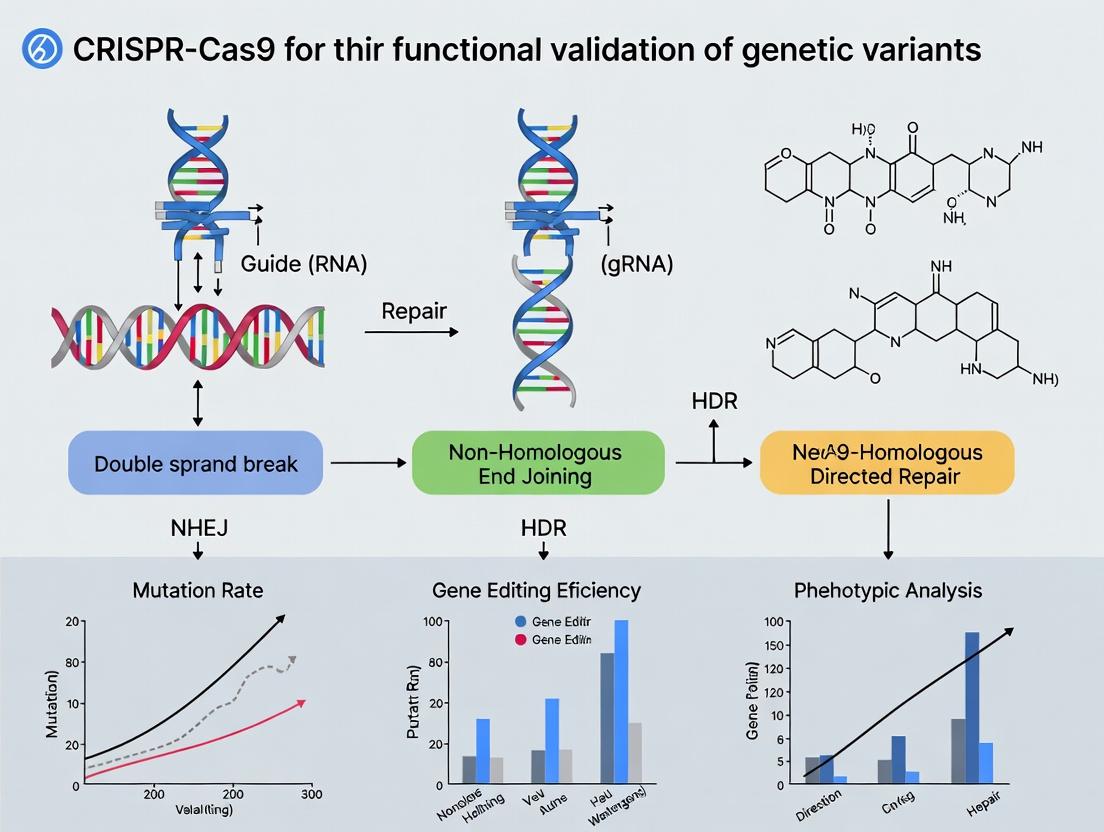
This article provides a comprehensive guide for researchers and drug development professionals on utilizing CRISPR-Cas9 for the functional validation of genetic variants.
CRISPR-Cas9 Functional Validation: From Genetic Variant to Biological Consequence in Drug Discovery
Abstract
This article provides a comprehensive guide for researchers and drug development professionals on utilizing CRISPR-Cas9 for the functional validation of genetic variants. We begin by establishing the critical need to move beyond genetic association studies to determine causality in complex diseases and drug target identification. The article details methodological pipelines, from gRNA design to phenotypic readouts in relevant cellular and animal models. We address common experimental pitfalls, optimization strategies for efficiency and specificity, and advanced techniques like base and prime editing for precise variant recapitulation. Finally, we compare CRISPR-Cas9 validation to alternative approaches (e.g., RNAi, overexpression) and discuss frameworks for interpreting validation data to prioritize variants for therapeutic development. The goal is to equip scientists with a practical roadmap for robustly linking genetic variation to function.
Why Validate Variants? The Imperative for Functional Genomics in Target Discovery
Genome-wide association studies (GWAS) have identified hundreds of thousands of genetic variants statistically associated with human diseases. However, association does not equal causation. The vast majority of these variants are non-coding, with unknown mechanisms, and reside in linkage disequilibrium, making pinpointing the true causal variant(s) a major challenge. This gap between statistical association and biological causation directly impedes the translation of genomic discoveries into validated therapeutic targets. This document outlines application notes and protocols for using CRISPR-Cas9-based functional genomics to bridge this gap, forming a critical component of a thesis focused on functional validation of genetic variants.
Quantitative Landscape of the Gap
Table 1: Summary of GWAS Findings vs. Functionally Validated Causal Variants (as of 2023-2024)
| Metric | GWAS Catalog (NHGRI-EBI) | ClinVar (Pathogenic/Likely Pathogenic) | Functionally Validated (Estimated) | Notes/Source |
|---|---|---|---|---|
| Total Trait-Associated Variants | ~500,000 | - | - | Across all studies |
| Unique Trait-Associations | ~400,000 | - | - | |
| Non-Coding Variant Proportion | ~90% | ~70% | - | Primarily in regulatory elements |
| Reported Causal Genes (Putative) | ~30,000 | - | - | Often based on proximity |
| Variants with Direct Experimental Evidence | - | ~75,000 | < 5% | Mechanistic evidence is sparse |
| Variants Validated via CRISPR Screens | - | - | ~1,000-2,000 | Growing field; prime focus on coding exons |
Table 2: Common Challenges in Moving from Association to Causation
| Challenge | Description | Consequence |
|---|---|---|
| Linkage Disequilibrium (LD) | Associated variants are co-inherited in blocks. | Impossible to statistically distinguish the causal variant from its correlated neighbors. |
| Non-Coding Context | Variants lie in enhancers, promoters, or non-coding RNAs. | Difficult to predict target gene(s) and mechanism. |
| Cell-Type/Context Specificity | Regulatory effects are often active only in specific cell types or states. | Validation requires relevant cellular models. |
| Polygenic & Epistatic Effects | Small effects from many variants interacting. | Single-variant editing may show negligible phenotypic impact. |
Core Protocol: CRISPR-Cas9 for Functional Validation of Non-Coding GWAS Variants
Protocol 3.1: Saturation Prime Editing for Causal Variant Identification
Objective: To functionally screen all variants in a GWAS LD block to identify the single-nucleotide causal variant(s) affecting a gene expression phenotype (e.g., MYC enhancer variant).
Research Reagent Solutions:
| Item | Function | Example Product/Catalog # |
|---|---|---|
| Prime Editor 2 (PE2) System | Enables precise "search-and-replace" editing without double-strand breaks. | pCMV-PE2 (Addgene #132775) |
| Saturation Prime Editing gRNA Library | Library of pegRNAs targeting every possible nucleotide substitution in the target genomic region. | Custom synthesized oligo pool. |
| Nuclease-Free Cas9 (dCas9) | Used in parallel for CRISPRi repression to confirm enhancer location. | pLV hU6-sgRNA hUbC-dCas9-KRAB (Addgene #71237) |
| Reporter Cell Line | Endogenous fluorescent reporter (e.g., GFP) knocked into the putative target gene (MYC) OR a high-throughput scRNA-seq readout. | Custom generated via CRISPR knock-in. |
| Next-Generation Sequencing (NGS) Library Prep Kit | For tracking pegRNA abundance pre- and post-sorting/selection. | Illumina Nextera XT |
| FACS Sorter | To isolate cell populations based on reporter expression (high vs. low). | BD FACSAria III |
Methodology:
- Target Region Definition: Define the GWAS locus LD block (e.g., 100 kb region). Synthesize a pegRNA library targeting every base for all possible nucleotide substitutions within candidate regulatory elements (e.g., ATAC-seq peaks).
- Library Delivery: Co-transfect the pegRNA library and PE2 editor plasmid (at a low MOI to ensure single integrations) into the reporter cell line using a high-efficiency method (e.g., nucleofection).
- Phenotypic Selection: Culture cells for 7-10 days to allow editing and phenotype manifestation. Sort the top and bottom 10% of the reporter fluorescence distribution via FACS.
- NGS & Hit Identification: Extract genomic DNA from pre-sort, high, and low populations. Amplify the pegRNA barcode region and sequence. Causal variant pegRNAs will be significantly enriched or depleted in the high vs. low populations.
- Validation: Synthesize individual hit pegRNAs and repeat editing in naive cells. Validate allele-specific effects on endogenous target gene expression via qRT-PCR.
Protocol 3.2: CRISPR-Cas9 Knockout/Activation for Target Gene Discovery
Objective: To identify the target gene(s) of a non-coding causal variant using a tiled gRNA screen.
Workflow Diagram:
Title: CRISPR Tiled Screen to Link Non-Coding Variants to Target Genes
Advanced Application: Pathway Reconstruction
Objective: To place a validated variant-gene pair within a broader disease-relevant signaling pathway using combinatorial CRISPR screening.
Pathway Diagram:
Title: From Variant to Pathway to Phenotype
Protocol 4.1: Combinatorial CRISPRko/i/a Screening
- Library Design: Create a dual-guRNA library pairing a fixed gRNA targeting the validated causal regulatory element with a second gRNA library targeting all known signaling pathway components (e.g., kinases, transcription factors).
- Screening: Express the library and Cas9/dCas9 in a disease-relevant cell model. Measure phenotype (e.g., phospho-protein flow cytometry, transcriptional reporter).
- Analysis: Identify gRNA pairs that synergistically enhance or suppress the variant's phenotypic effect, revealing genetic interactions and pathway position.
The Scientist's Toolkit for Functional Validation
Table 3: Essential Research Reagent Solutions
| Category | Item | Critical Function | Considerations for Variant Validation |
|---|---|---|---|
| Editing Tools | High-Fidelity Cas9 (SpCas9-HF1) | Reduces off-target effects for clean knockout. | Essential for in vivo validation. |
| Prime Editor (PE/PE2) | Installs precise point mutations. | Gold standard for recapitulating SNVs. | |
| Base Editor (BE4/ABE) | Installs C>T or A>G transitions. | Useful for a subset of SNVs. | |
| Screening | Arrayed gRNA Libraries | Individual gRNAs in separate wells. | For deep phenotyping (imaging, omics). |
| Pooled gRNA Libraries | All gRNAs delivered together. | For fitness or sortable phenotypes. | |
| Dual-guRNA Vectors | Express two gRNAs from one construct. | For combinatorial or synergistic screens. | |
| Delivery | Lentiviral Particles | Stable integration; diverse tropisms. | Standard for pooled screens. |
| Electroporation/Nucleofection | High-efficiency RNP delivery. | Best for primary cells; reduces off-target. | |
| Readouts | CITE-seq/REAP-seq | Combined protein & transcriptome single-cell readout. | Links genetic perturbation to multi-omics state. |
| HiFi Scorpion Probes | For digital PCR quantification of edit efficiency. | Accurate, sensitive allelic discrimination. | |
| Luciferase/Fluorescent Reporters | Knock-in at endogenous locus. | Provides a quantitative, live-cell phenotype. | |
| Controls | Non-Targeting gRNAs | Control for non-specific effects. | Must be included in all screens. |
| Targeting Essential Gene gRNAs | Positive control for phenotype. | e.g., RPL21 for viability. | |
| Isogenic Cell Pairs | WT vs. variant-corrected lines. | Ultimate validation of causality. |
The identification of genetic variants through genome-wide association studies (GWAS) and next-generation sequencing has outpaced our understanding of their biological consequence. The central challenge in translational genomics is the functional validation of variants, moving them from mere statistical associations to mechanistically understood drivers of phenotype. This process is encapsulated in the journey from a Variant of Uncertain Significance (VUS) to a Validated Therapeutic Target.
Within the broader thesis on CRISPR-Cas9 for functional validation, this document establishes application notes and protocols. CRISPR-Cas9 has revolutionized this field by enabling precise, isogenic genome editing to test the causality of genetic variants in disease-relevant cellular models, thereby bridging the gap between correlation and causation.
The Validation Pipeline: A Stage-Gated Framework
The functional validation pipeline is a multi-stage process designed to systematically assess variant impact with increasing biological complexity and translational relevance.
Table 1: Stages of Functional Validation from VUS to Target
| Stage | Objective | Key CRISPR-Cas9 Method | Readouts | Success Criteria |
|---|---|---|---|---|
| 1. In Silico Prioritization | Filter VUS by predicted pathogenicity & biological relevance. | N/A (Bioinformatics) | CADD score, conservation, allele frequency. | Prioritized list of candidate functional VUS. |
| 2. In Vitro Isogenic Modeling | Establish causality in simple cellular systems. | HDR or Base Editing in immortalized cell lines. | Gene expression (qPCR), protein localization (IF), simple viability/proliferation. | Significant phenotypic difference vs. wild-type isogenic control. |
| 3. Pathway & Mechanism Elucidation | Define molecular mechanisms and impacted pathways. | CRISPRi/a, coupled with NGS. | Transcriptomics (RNA-seq), phospho-proteomics, pathway reporter assays. | Identification of dysregulated, druggable signaling nodes. |
| 4. Complex Model Phenocopy | Validate in physiologically relevant human cell systems. | CRISPR editing in iPSC-derived cells or organoids. | Cell-type specific markers, electrophysiology, contraction force, complex morphology. | Recapitulation of disease-relevant phenotypes in human context. |
| 5. Therapeutic Modulation | Assess target druggability and rescue. | CRISPR knockout + small molecule/library screening. | High-content imaging, functional rescue with candidate therapeutic. | Phenotype rescue by pharmacological or genetic intervention. |
Core Experimental Protocols
Protocol 3.1: Generation of Isogenic Cell Lines via CRISPR-Cas9 Homology-Directed Repair (HDR)
Objective: To introduce or correct a specific single-nucleotide variant (SNV) in an immortalized cell line (e.g., HEK293, HAP1) to create paired wild-type and variant cell lines.
Materials (Research Reagent Solutions):
- Cas9 Nuclease: High-fidelity SpCas9 (e.g., Alt-R S.p. HiFi Cas9 Nuclease V3, IDT).
- sgRNA: Designed against target site, synthesized as Alt-R CRISPR-Cas9 crRNA, complexed with tracrRNA.
- Single-Stranded Oligodeoxynucleotide (ssODN): 100-200 nt homology-directed repair template containing the desired variant and a silent PAM-disrupting mutation.
- Transfection Reagent: Lipofectamine CRISPRMAX Cas9 Transfection Reagent (Thermo Fisher).
- Cell Culture Media & Supplements.
- Selection Marker (Optional): Puromycin or fluorescence reporters for enrichment.
Procedure:
- Design: Design sgRNA close to variant site. Design ssODN with variant, flanked by 50-90 nt homology arms. Include a silent mutation in the PAM sequence to prevent re-cutting.
- RNP Complex Formation: Complex 50 pmol Cas9 nuclease with 75 pmol of reconstituted sgRNA (crRNA:tracrRNA duplex) in buffer to form ribonucleoprotein (RNP). Incubate 10-20 min at room temperature.
- Transfection: Plate 2e5 cells/well in a 24-well plate. The next day, mix RNP complex with 50 pmol ssODN. Combine with 1.5 µL CRISPRMAX in Opti-MEM. Add dropwise to cells.
- Recovery & Expansion: Change media after 48-72 hours. Allow cells to expand for 5-7 days.
- Screening & Cloning: Harvest genomic DNA. Perform PCR amplification of target locus and sequence (Sanger or NGS). For clonal lines, single-cell sort into 96-well plates 72h post-transfection. Expand clones and screen by sequencing.
- Validation: Confirm genotype in 2-3 independent clones. Check for off-target edits at top predicted sites.
Protocol 3.2: Functional Phenotyping in iPSC-Derived Cardiomyocytes (iPSC-CMs)
Objective: To validate a cardiac-associated VUS in a disease-relevant human cell model.
Materials (Research Reagent Solutions):
- iPSC Line: Control human induced pluripotent stem cell line.
- CRISPR Edit Tool: As per Protocol 3.1, or use Cas9-RNP with electroporation (Neon/Nucleofector system).
- Cardiomyocyte Differentiation Kit: Defined, serum-free media system (e.g., Gibco PSC Cardiomyocyte Differentiation Kit).
- Phenotyping Reagents: Calcium-sensitive dyes (Fluo-4 AM), anti-cardiac Troponin T antibodies, contractility analysis software (SarcTrack, IonOptix).
- qPCR Assays: TaqMan assays for cardiac genes (MYH6, MYH7, NPPA).
Procedure:
- Genome Editing: Introduce variant into iPSCs using CRISPR-Cas9 HDR (electroporation recommended). Isolate and sequence-validate clonal edited iPSC lines. Maintain an isogenic wild-type control clone from the same parental line.
- Cardiac Differentiation: Differentiate wild-type and variant iPSC lines into cardiomyocytes using a standardized, chemically defined protocol over 10-14 days.
- Molecular Phenotyping (Day 30): Harvest RNA for qPCR analysis of hypertrophy/failure markers. Perform immunocytochemistry for sarcomere organization (α-actinin, Troponin T).
- Functional Phenotyping (Day 30-40):
- Calcium Transients: Load cells with Fluo-4 AM. Record calcium flux using high-speed fluorescence microscopy. Analyze transient duration, amplitude, and decay.
- Contractility: Use video-based edge detection software to analyze beating kinetics: beating rate, peak width, contraction/relaxation velocity.
- Data Analysis: Compare all parameters between isogenic wild-type and variant lines (n≥3 differentiations). Statistical significance (p<0.05) indicates a functional impact of the VUS.
Visualizing Pathways and Workflows
Title: Functional Validation Stage-Gated Pipeline
Title: Isogenic Line Generation with CRISPR-Cas9 HDR
The Scientist's Toolkit: Research Reagent Solutions
Table 2: Essential Reagents for CRISPR-Based Functional Validation
| Reagent Category | Specific Example(s) | Function in Validation Workflow |
|---|---|---|
| High-Fidelity Cas9 | Alt-R HiFi Cas9 V3 (IDT), TrueCut Cas9 Protein v2 (Thermo Fisher). | Reduces off-target editing, ensuring observed phenotypes are due to the intended edit. |
| Synthetic gRNA Components | Alt-R CRISPR-Cas9 crRNA & tracrRNA (IDT), Synthego sgRNA EZ Kit. | Provides highly pure, reproducible sgRNA for consistent RNP complex formation. |
| HDR Templates | Ultramer DNA Oligos (IDT), gBlocks Gene Fragments (IDT). | Long, high-fidelity single-stranded or double-stranded DNA donors for precise allele introduction. |
| Delivery Reagent (Cell Lines) | Lipofectamine CRISPRMAX (Thermo Fisher). | Optimized lipid nanoparticles for efficient RNP delivery to common immortalized cell lines. |
| Delivery System (iPSCs/Neurons) | P3 Primary Cell 4D-Nucleofector X Kit (Lonza), Neon Transfection System (Thermo Fisher). | Electroporation-based systems for efficient delivery into hard-to-transfect primary cell models. |
| Genotyping Assays | PCR primers, Sanger sequencing, Illumina CRISPR Amplicon Sequencing. | Confirms correct on-target editing and screens for potential off-target events. |
| Phenotyping Assays | TaqMan Gene Expression Assays (Thermo Fisher), CellEvent Caspase-3/7 reagent, Calcium-sensitive dyes (Fluo-4). | Quantifies molecular (RNA, apoptosis) and functional (calcium signaling) phenotypic outcomes. |
| Control Kits | Human Genomic DNA (Male/Female) (Promega), Validated negative control crRNA (IDT). | Provides essential controls for genotyping assays and editing experiments. |
Within the functional validation of genetic variants, researchers require tools that offer definitive genotype-to-phenotype links. While RNA interference (RNAi) and cDNA overexpression have been instrumental, CRISPR-Cas9 now represents the superior standard. RNAi suffers from off-target effects and transient, incomplete knockdown. cDNA overexpression can produce non-physiological protein levels and fails to model loss-of-function variants. CRISPR-Cas9 enables precise, permanent genome editing—including knockouts, knock-ins, and precise point mutations—with unparalleled specificity, allowing for the faithful recapitulation of both loss-of-function and gain-of-function variants in their native genomic context.
Comparative Analysis of Functional Genomics Tools
The following table quantifies key performance metrics, underscoring CRISPR-Cas9's advantages.
Table 1: Comparison of Functional Genomics Tools for Variant Validation
| Feature | RNAi (siRNA/shRNA) | cDNA Overexpression | CRISPR-Cas9 (Knockout/Knock-in) |
|---|---|---|---|
| Primary Mechanism | Post-transcriptional mRNA degradation | Ectopic expression from a plasmid/virus | Directed DNA double-strand break and repair |
| Editing Precision | Low (targets mRNA sequence) | Not applicable | High (targets DNA via ~20-nt guide sequence) |
| Effect on Endogenous Locus | None (transient knockdown) | None (additive) | Direct, permanent modification |
| Typical Efficiency | 70-90% mRNA knockdown | Variable, often >100x overexpression | 20-80% editing (depends on delivery & repair) |
| Phenotype Duration | Transient (days) | Transient to stable | Permanent, heritable |
| Major Limitation | Off-target silencing, incomplete knockdown | Non-physiological levels/regulation, overexpression artifacts | Off-target editing (minimized with high-fidelity Cas9) |
| Ideal for Variant Type | Acute partial loss-of-function | Dominant-negative or wild-type rescue | All types (KO, KI, point mutations, deletions) |
Application Notes for Variant Validation
- Loss-of-Function (LoF) Variants: Use CRISPR-Cas9 to generate frameshift indels via non-homologous end joining (NHEJ) in cell lines. This creates definitive, biallelic knockouts, overcoming the incomplete penetrance of RNAi.
- Gain-of-Function (GoF) & Point Mutations: Use CRISPR-Cas9 with a single-stranded oligodeoxynucleotide (ssODN) donor template for homology-directed repair (HDR) to introduce specific patient-derived point mutations into endogenous loci, avoiding the overexpression artifacts of cDNA.
- Rescue Experiments: The gold-standard control. After creating a knockout phenotype, reintroduce the wild-type or variant cDNA via a safe-harbor locus (e.g., AAVS1) to confirm phenotype specificity—a more physiologically relevant approach than cDNA overexpression alone.
Detailed Protocols
Protocol 1: Generating a Clonal Knockout Cell Line for a Putative LoF Variant
Objective: Create and validate a biallelic knockout model of a gene harboring a truncating variant. Workflow Diagram:
Title: Workflow for Clonal Knockout Cell Line Generation Materials (Research Reagent Solutions):
- Target-specific sgRNAs: Chemically synthesized, high-purity crRNA:tracrRNA duplex or cloned into pSpCas9(BB)-2A-Puro (Addgene #62988).
- Cas9 Nuclease: Recombinant Alt-R S.p. HiFi Cas9 protein (IDT) for RNP delivery, or Cas9 expression plasmid.
- Transfection Reagent: Lipofectamine CRISPRMAX (Thermo Fisher) for RNP delivery.
- Cloning Dilution Medium: Growth medium supplemented with 20-30% serum or conditioned medium.
- PCR & Sequencing Primers: Designed to amplify the edited genomic region (≥200 bp flanking each side).
Method:
- Design & Preparation: Design two sgRNAs targeting sequences in introns flanking the exon containing the LoF variant. Synthesize as crRNA and tracrRNA, then anneal to form guide RNA.
- RNP Complex Formation: For each sgRNA, complex 3 µL of Alt-R Cas9 HiFi (10 µM) with 3 µL of sgRNA (10 µM) in nuclease-free duplex buffer. Incubate at room temperature for 10-20 minutes.
- Cell Transfection: Seed HEK293T or relevant cell line at 70% confluency in a 24-well plate. Dilute RNP complex in Opti-MEM and mix with Lipofectamine CRISPRMAX. Add to cells.
- Single-Cell Cloning: 48-72 hours post-transfection, trypsinize and serially dilute cells to a density of 0.5 cells/100 µL. Dispense 100 µL per well into a 96-well plate. Monitor for single colonies over 2-3 weeks.
- Genotypic Screening: Expand clones, lyse, and perform genomic PCR on the target region. Analyze PCR products by Sanger sequencing or T7 Endonuclease I assay to identify clones with biallelic frameshift indels.
- Phenotypic Validation: Confirm loss of protein via Western blot and subject validated clones to downstream functional assays.
Protocol 2: Introducing a Precise Point Mutation via HDR
Objective: Model a specific patient-derived missense variant (e.g., G12D in KRAS) in an isogenic cell line background. Pathway & Workflow Diagram:
Title: HDR Pathway & Point Mutation Knock-in Workflow Materials (Research Reagent Solutions):
- High-Fidelity Cas9: Alt-R S.p. HiFi Cas9 protein to minimize off-targets during HDR.
- ssODN Donor Template: Ultramer DNA Oligo (IDT), 100-120 nucleotides, homologous to the target strand, incorporating the desired point mutation and often a silent PAM-disrupting mutation.
- HDR Enhancer: Alt-R HDR Enhancer (IDT) or small molecule inhibitors of NHEJ (e.g., SCR7).
- Flow Cytometry Cell Sorter: For single-cell sorting if using a fluorescent reporter co-selection strategy.
Method:
- Design: Design a sgRNA with a cut site <10 bp from the target nucleotide. Design a single-stranded donor oligo (ssODN) with ~50-60 nt homology arms on each side of the edit. Include the desired point mutation and optionally a silent mutation to disrupt the PAM site.
- Delivery: Complex HiFi Cas9 protein with sgRNA. Co-transfect this RNP complex with 1 µM of the ssODN donor into cells using a high-efficiency transfection system (e.g., electroporation for difficult cells).
- Enrichment & Cloning: 48 hours post-transfection, use FACS to sort single cells if a fluorescent reporter was co-delivered. Alternatively, apply antibiotic selection if a repair template included a drug resistance cassette.
- Screening: Screen expanded clones by genomic PCR. Use allele-specific PCR primers or Sanger sequencing to identify clones with the homozygous point mutation and confirm the absence of random indels.
- Validation: Sequence the entire locus to rule off-target editing. Use the isogenic mutant and wild-type control clones for comparative functional assays.
The Scientist's Toolkit
Table 2: Essential Reagents for CRISPR-Cas9 Variant Validation
| Reagent | Supplier Examples | Critical Function |
|---|---|---|
| High-Fidelity Cas9 Nuclease | IDT (Alt-R S.p. HiFi Cas9), Thermo Fisher (TrueCut Cas9 Protein v2) | Increases on-target specificity, crucial for reducing false positives from off-target effects. |
| Synthetic sgRNA (crRNA:tracrRNA) | IDT, Synthego | Defined chemical synthesis ensures consistency; often higher activity and lower immune response than plasmid-derived gRNA. |
| ssODN HDR Donor Template | IDT (Ultramer), Twist Bioscience | Long, high-purity single-stranded DNA for precise knock-in of point mutations via homology-directed repair. |
| CRISPR Transfection Reagent | Thermo Fisher (Lipofectamine CRISPRMAX) | Optimized lipid nanoparticles for efficient delivery of RNP complexes into a wide range of mammalian cells. |
| NHEJ/HDR Modulators | Sigma (SCR7, NHEJ inhibitor), IDT (Alt-R HDR Enhancer) | Small molecules that bias DNA repair toward the HDR pathway, increasing knock-in efficiency. |
| T7 Endonuclease I / ICE Analysis | NEB (EnGen Mutation Detection Kit), Synthego ICE Tool | Enzymatic or computational tools to quantify genome editing efficiency and indel spectra. |
| Safe-Harbor Targeting Vectors | Addgene (AAVS1 Targeting Donor) | Pre-validated donor plasmids for inserting cDNA or reporters into the AAVS1 locus for consistent, safe expression in rescue experiments. |
Application Notes
The functional validation of genetic variants identified through Genome-Wide Association Studies (GWAS), cancer genomics, and rare disease sequencing is a critical bottleneck in translational genetics. CRISPR-Cas9-based technologies provide a direct and precise experimental framework to move from statistical association to causal mechanism, underpinning a core thesis that high-throughput, isogenic cell models are essential for definitive variant-to-function assignment.
- GWAS Follow-up: Most GWAS hits are in non-coding regions, implicating regulatory elements. CRISPR-Cas9 is deployed to perturb these regions (via knockout, inhibition, or activation) or to introduce specific candidate SNPs into endogenous loci in relevant cell types. Phenotypic readouts (e.g., gene expression, cytokine secretion, cellular morphology) establish causality for disease-associated haplotypes.
- Cancer Driver Validation: Distinguishing true driver mutations from passenger mutations in tumor sequencing data requires functional proof. CRISPR-Cas9 enables the knock-in of somatic mutations into immortalized or organoid models to assess hallmarks of cancer (proliferation, invasion, drug resistance). Conversely, correcting putative driver mutations in cancer cell lines can probe oncogene addiction.
- Rare Variant Analysis: For rare variants of uncertain significance (VUS) in monogenic disorders, CRISPR-Cas9-mediated base editing or prime editing allows for the precise installation of single-nucleotide changes in wild-type cells or the correction of patient-derived iPSCs. Subsequent deep phenotyping confirms pathogenicity.
Table 1: Quantitative Comparison of CRISPR-Cas9 Modalities for Variant Validation
| Application | Primary CRISPR Modality | Typical Throughput | Key Readout | Validation Timeline (Weeks) | Key Quantitative Metric |
|---|---|---|---|---|---|
| GWAS Follow-up | CRISPRi/a (dCas9-KRAB/dCas9-VPR) | High (Pooled screens) | RNA-seq (Differential Expression) | 4-6 | Fold-change in target gene expression (e.g., 2.5 ± 0.3) |
| Coding Variant (Driver/VUS) | HDR-mediated Knock-in / Base Editing | Medium (Arrayed format) | Cell Growth, Drug Response | 6-10 | % Increase in proliferation (e.g., 40%) or shift in IC50 (e.g., 5-fold) |
| Non-coding Variant (Regulatory) | Prime Editing / Precise Deletion | Low-Medium | Reporter Assay (Luciferase) | 3-5 | % Activity vs. wildtype allele (e.g., 30% reduction) |
| Saturation Genome Editing | Library of HDR templates | Very High | Deep Sequencing (Viability) | 8-12 | Functional score for each variant (e.g., -2.1 to +1.8) |
Experimental Protocols
Protocol 1: Validation of a Non-coding GWAS Variant Using CRISPR Interference (CRISPRi)
Aim: To determine if a non-coding GWAS SNP within an enhancer region regulates a candidate gene.
- Design & Cloning: Design two sgRNAs targeting the genomic region encompassing the risk SNP. Clone into a lentiviral dCas9-KRAB expression vector (e.g., pLV hU6-sgRNA hUbC-dCas9-KRAB-T2a-Puro).
- Cell Model Generation: Transduce relevant primary or iPSC-derived cells (e.g., hepatocytes for liver traits) with lentivirus. Select with puromycin (1-2 µg/mL) for 5 days.
- Phenotypic Analysis: After 10-14 days of repression, harvest cells.
- Primary Readout: Extract RNA, perform RT-qPCR for the candidate gene. Normalize to housekeeping genes (GAPDH, ACTB).
- Secondary Readout: Perform RNA-seq for unbiased transcriptome assessment.
- Data Analysis: Compare expression in target sgRNA cells vs. non-targeting control sgRNA cells. A significant reduction (p < 0.01, fold-change >1.5) links the region to gene regulation.
Protocol 2: Functional Characterization of a Cancer Missense VUS Using Base Editing
Aim: To assess the oncogenic potential of a rare PIK3CA VUS (c.3140A>G; p.His1047Arg).
- Base Editor Selection: Choose an appropriate adenine base editor (ABE8e) for the A•T to G•C conversion.
- sgRNA Design: Design an sgRNA placing the target adenine within the optimal editing window (positions 4-8) of the protospacer.
- Delivery & Cloning: Co-transfect an ABE8e expression plasmid and sgRNA plasmid into a near-diploid immortalized breast epithelial cell line (e.g., MCF10A) via nucleofection.
- Isolation & Expansion: Single-cell sort after 72 hours into 96-well plates. Expand clones for 3-4 weeks.
- Genotype & Phenotype:
- Genotyping: Screen clones by Sanger sequencing of the PIK3CA locus.
- Functional Assays: Compare isogenic edited (VUS) and wild-type clones for:
- Proliferation: 72-hour CellTiter-Glo assay.
- Signaling: Western blot for p-AKT (Ser473) vs. total AKT.
- Anchorage-Independent Growth: Soft agar colony formation assay over 3 weeks.
Visualizations
CRISPRi Workflow for GWAS Follow-up
Validating Cancer Variants with Base Editing
The Scientist's Toolkit: Key Research Reagent Solutions
| Reagent / Material | Function in Variant Validation | Example Product/Catalog |
|---|---|---|
| dCas9-KRAB / dCas9-VPR Lentiviral Systems | Enables stable, tunable gene repression (CRISPRi) or activation (CRISPRa) for non-coding variant study. | Addgene #71236 (pLV hU6-sgRNA hUbC-dCas9-KRAB) |
| BE4max / ABE8e Plasmids | High-efficiency base editor plasmids for installing specific point mutations without double-strand breaks or donor templates. | Addgene #130991 (BE4max), #138489 (ABE8e) |
| HDR Donor Template Oligos | Single-stranded or double-stranded DNA templates for precise knock-in of variants via homology-directed repair. | Ultramer DNA Oligos (IDT) |
| Near-Diploid Immortalized Cell Lines | Genetically stable, non-transformed background for introducing putative cancer drivers (e.g., MCF10A, RPE1). | ATCC HTB-22 (MCF10A) |
| iPSC Line & Differentiation Kits | Provides a disease-relevant cellular context for rare variant analysis in specific cell types (neurons, cardiomyocytes). | Commercial iPSC lines; Cell type-specific differentiation kits. |
| High-Fidelity Cas9 (HiFi Cas9) | Reduces off-target editing while maintaining on-target activity, critical for generating clean isogenic models. | HiFi Cas9 protein (IDT) or plasmid. |
| Nucleofection System | Enables high-efficiency delivery of RNP complexes (Cas9-sgRNA) or plasmids into hard-to-transfect primary and stem cells. | Lonza 4D-Nucleofector System |
| Next-Gen Sequencing Library Prep Kit | For deep sequencing of edited loci to assess editing efficiency and purity, or for pooled screen deconvolution. | Illumina DNA Prep Kit |
Within the broader thesis on CRISPR-Cas9 for the functional validation of genetic variants of uncertain significance (VUS), the choice of model system is critical. No single system perfectly recapitulates human biology, necessitating a tiered approach. Immortalized cell lines offer high-throughput capacity, induced pluripotent stem cells (iPSCs) provide a genetically relevant and flexible platform, and organoids deliver unprecedented physiological context. The integration of CRISPR-Cas9 genome editing across these systems enables the creation of isogenic controls—where only the variant of interest differs—which is the gold standard for functional assays. This application note details protocols and considerations for employing these three essential model systems.
Immortalized Cell Lines: Workhorses for High-Throughput Screening
Immortalized cell lines (e.g., HEK293, HeLa, HAP1) are genetically stable, easy to culture, and highly transferable, making them ideal for initial, high-throughput variant assessment.
Research Reagent Solutions for Cell Line Editing:
| Reagent/Material | Function in Experiment |
|---|---|
| HAP1 Haploid Cell Line | Near-haploid genotype simplifies CRISPR-Cas9 editing, as single-copy genome reduces need for clonal isolation. |
| Lipofectamine 3000 | Lipid-based transfection reagent for efficient delivery of CRISPR-Cas9 RNP or plasmid DNA into adherent cell lines. |
| Cas9 Electroporation Enhancer | Synthetic single-stranded DNA that enhances HDR efficiency during nucleofection/electroporation. |
| Puromycin or Blasticidin | Selection antibiotics used after transfection with CRISPR plasmids containing resistance markers for stable integrant enrichment. |
| SURVEYOR or T7 Endonuclease I | Enzymes for detecting CRISPR-induced indels via mismatch cleavage in pooled populations. |
| CloneSelect Single-Cell Printer | Instrument for automated, gentle dispensing of single cells into 96-well plates for clonal expansion post-editing. |
Protocol 1.1: CRISPR-Cas9 Knock-in for Isogenic Cell Line Generation via HDR
Objective: Introduce a specific single-nucleotide variant (SNV) into an immortalized cell line using homology-directed repair (HDR).
Design & Synthesis:
- Design two single-guide RNAs (sgRNAs) targeting <50bp from the variant locus using online tools (e.g., CRISPick). Synthesize as chemically modified sgRNAs for stability.
- Design a single-stranded DNA (ssODN) donor template (~200nt). Center the desired SNV, include 5’ and 3’ homologous arms (90-100nt each). Introduce silent mutations in the PAM sequence or protospacer to prevent re-cutting.
RNP Complex Formation & Delivery (Nucleofection):
- Complex 20µg of purified S.p. Cas9 protein with 6µg of each sgRNA (total 12µg) in Nucleofector solution. Incubate 10 min at room temperature.
- Resuspend 1x10^6 HAP1 cells in the RNP mix. Electroporate using the DN-100 program on a 4D-Nucleofector.
- Immediately add pre-warmed medium and plate in a 6-well dish.
Selection & Clonal Isolation:
- After 48 hours, begin puromycin selection (2 µg/mL) for 5-7 days if a co-selection strategy was used.
- Detach cells, dilute to 1 cell/100µL, and seed into 96-well plates using a FACS sorter or CloneSelect instrument. Confirm single-cell deposition microscopically.
Genotype Validation:
- Expand clones for 2-3 weeks. Extract genomic DNA.
- Perform PCR amplification of the target region (∼500bp).
- Sanger Sequencing: Sequence PCR products. Align sequences to the wild-type to identify heterozygous/homozygous edits.
- Quantitative Data (Typical Efficiency):
Cell Line Transfection Method HDR Efficiency (Pooled) Clonal Screening Yield (Corrected Isogenic Clones) HAP1 Nucleofection (RNP + ssODN) 5-15% 1-5% of seeded clones HEK293T Lipofection (Plasmid + ssODN) 1-5% 0.5-2% of seeded clones U2OS Electroporation (RNP + ssODN) 2-8% 1-3% of seeded clones
Diagram: Workflow for Isogenic Cell Line Generation
Title: CRISPR Workflow for Isogenic Cell Line Creation
Induced Pluripotent Stem Cells (iPSCs): A Genetically Personalizable Platform
iPSCs allow the study of variants in a patient-specific genetic background and can be differentiated into relevant cell types.
Research Reagent Solutions for iPSC Editing:
| Reagent/Material | Function in Experiment |
|---|---|
| Matrigel or Laminin-521 | Defined extracellular matrix for feeder-free culture of iPSCs, maintaining pluripotency. |
| CloneR Supplement | Chemical supplement added to culture medium to enhance single-cell survival post-dissociation, critical for clonal recovery. |
| STEMdiff Cardiomyocyte Kit | Directed differentiation kit for generating functional cardiomyocytes from edited iPSCs for cardiac variant studies. |
| Rho-associated kinase (ROCK) inhibitor Y-27632 | Small molecule added during passaging and cloning to inhibit apoptosis in dissociated iPSCs. |
| CRISPR-Cas9 Electroporation Kit for iPSCs | Optimized reagents and cuvettes for high-efficiency, low-toxicity delivery of CRISPR components into iPSCs. |
| PCR-based HDR Donor Vector | Plasmid donor template with long homology arms (∼800bp) and a excisable selection cassette (e.g., puromycin-TK) for efficient knock-in. |
Protocol 2.1: CRISPR-Cas9 Editing of iPSCs with Excisable Selection Cassette
Objective: Correct or introduce a VUS in a patient-derived iPSC line, ensuring genomic integrity post-editing.
Design & Cloning:
- Clone sgRNA into a Cas9-expression plasmid (e.g., pSpCas9(BB)).
- Clone a donor plasmid with ∼800bp homology arms, the desired edit, and a floxed puromycin resistance–thymidine kinase (Puro∆TK) selection cassette.
Electroporation & Selection:
- Culture iPSCs in feeder-free conditions. Dissociate into single cells using Accutase.
- Electroporate 1x10^6 cells with 5µg Cas9-sgRNA plasmid and 10µg donor plasmid using the B-016 program.
- Plate cells on Matrigel with ROCK inhibitor. After 72 hours, apply puromycin (0.5 µg/mL) for 7-10 days.
Clonal Pick & Expansion:
- Manually pick 50-100 surviving colonies into 96-well plates. Expand for 7-10 days.
Genotyping & Cassette Excision:
- Screen clones by PCR (one primer outside homology arm, one inside cassette) to identify correctly targeted clones.
- Transfect positive clones with a Cre recombinase plasmid to remove the Puro∆TK cassette.
- Single-cell clone again and screen by PCR for clean excision (loss of cassette, retention of edit).
Quality Control:
- Perform G-band karyotyping to confirm genomic integrity.
- Validate pluripotency marker expression (OCT4, NANOG) via immunostaining.
- Perform STR profiling to confirm line identity.
Diagram: iPSC Editing & Differentiation Pipeline
Title: iPSC Isogenic Pair Generation & Phenotyping
Organoids: Physiologically Complex 3D Models
Organoids self-organize into structures mimicking organ functionality, providing a critical context for variants affecting tissue morphology, cell polarity, and complex signaling.
Research Reagent Solutions for Organoid Studies:
| Reagent/Material | Function in Experiment |
|---|---|
| Growth Factor Reduced Matrigel | Basement membrane extract for 3D embedding of stem/progenitor cells to support organoid formation. |
| IntestiCult Organoid Growth Medium | Defined medium for the long-term culture and propagation of human intestinal organoids. |
| CRISPR-Cas9 RNP Complex (IDT) | Pre-complexed, synthetic Cas9 nuclease and sgRNA for rapid, transient editing of organoid stem cells with minimal off-target effects. |
| Lentiviral sgRNA Library (e.g., Brunello) | Pooled lentiviral library for CRISPR knockout screens in organoid cultures to identify genetic modifiers of a variant phenotype. |
| Live-Cell Imaging-Ready Plates (Glass-bottom) | Plates suitable for high-resolution, long-term live imaging of organoid morphology and reporter expression. |
| Single-Cell RNA-Seq Kit (10x Genomics) | Reagents for dissociating organoids and preparing barcoded libraries to profile transcriptional consequences of a variant at single-cell resolution. |
Protocol 3.1: Cerebral Organoid Generation from Edited iPSCs for Neurodevelopmental Variants
Objective: Model a neurodevelopmental VUS in a 3D cerebral organoid context.
Starting Material:
- Use validated, karyotypically normal isogenic iPSC pairs (wild-type vs. variant).
Embryoid Body Formation:
- Dissociate iPSCs to single cells. Seed 9,000 cells per well in a low-attachment 96-well U-bottom plate in media with ROCK inhibitor.
- Centrifuge at 300xg for 3 min to aggregate. Day 1-6: Change media daily with neural induction medium.
Matrigel Embedding & Expansion:
- On Day 7, transfer individual EBs to a droplet of Matrigel. Polymerize at 37°C for 20 min.
- Overlay with cerebral organoid differentiation medium. Culture on an orbital shaker (60 rpm) from Day 10 onward.
- Feed twice weekly. Organoids mature over 1-3 months.
Phenotypic Analysis:
- Histology: Fix, section, and stain for neural progenitors (SOX2), neurons (TUJ1), and cortical layers (CTIP2, TBR1).
- Quantitative Morphometry: Measure organoid size, ventricle-like structure area, and cortical plate thickness from whole-mount images.
- Electrophysiology: Perform multi-electrode array (MEA) recordings on sliced organoids to assess neural network activity.
Quantitative Phenotypic Readouts in Cerebral Organoids:
| Phenotype Measurement | Technique | Typical Data Output (Comparison Isogenic Pairs) |
|---|---|---|
| Organoid Size | Brightfield Imaging (Day 60) | Mutant may show 20-30% reduction in cross-sectional area. |
| Neural Progenitor Zone | Immunofluorescence (SOX2+ area) | Mutant may show 15-25% expansion of progenitor zone. |
| Neuron Migration | Layer Marker Staining (TBR1/CTIP2) | Disrupted layer organization in mutant. |
| Burst Firing Activity | Multi-Electrode Array (MEA) | Mutant may show 40% decrease in synchronized network bursts. |
Diagram: Key Signaling Pathways in Intestinal Organoid Homeostasis
Title: Wnt/β-Catenin Pathway in Organoid Stem Cells
Table: Strategic Selection of Model Systems for Variant Functionalization
| System | Key Advantage | Primary Use Case in Variant Validation | Throughput | Physiological Relevance | Typical Timeline for Isogenic Model (Months) | Approx. Cost per Isogenic Line (USD) |
|---|---|---|---|---|---|---|
| Immortalized Cell Lines (HAP1, HEK293) | High efficiency, scalable, simple assays | Initial variant characterization, protein interaction studies, HTS-compatible assays. | High | Low | 1-2 | $2,000 - $5,000 |
| iPSCs & Derived Cells | Patient genetic background, multiple cell types | Cell-type specific mechanisms, electrophysiology (neurons, cardiomyocytes), developmental phenotypes. | Medium | Medium | 4-8 | $10,000 - $25,000 |
| Organoids (Cerebral, Intestinal) | Tissue architecture, cell-cell interactions, emergent properties | Variants affecting morphology, polarity, complex signaling, and microenvironment crosstalk. | Low | High | 6-12 | $15,000 - $40,000+ |
A tiered functional validation strategy that leverages CRISPR-Cas9 across these model systems—from rapid screening in cell lines to nuanced phenotyping in organoids—provides a powerful, convergent framework for deciphering variant pathogenicity. The generation of isogenic controls is the unifying and non-negotiable standard. As protocols for organoid generation and high-content phenotyping continue to mature, their integration into the variant functionalization pipeline will become increasingly essential for bridging the gap between genetic discovery and mechanistic understanding.
Building Your CRISPR Validation Pipeline: A Step-by-Step Protocol
Within the broader thesis on CRISPR-Cas9 for functional validation of genetic variants, the initial step of variant prioritization and guide RNA (gRNA) design is the critical foundation. This stage determines the success and specificity of all subsequent functional assays. The process integrates bioinformatic analysis of genomic data with molecular design principles to select target variants and generate precise, efficient, and specific CRISPR reagents for three primary applications: gene knockout (via NHEJ), precise knock-in (via HDR), and base editing. Effective prioritization balances variant pathogenicity predictions with practical CRISPR design constraints to maximize experimental relevance and efficiency.
Key Quantitative Data and Design Parameters
Table 1: Variant Prioritization Scoring Metrics
| Priority Score Factor | Weight | Description | Optimal Range/Value |
|---|---|---|---|
| CADD (Phred) | 25% | Combined Annotation Dependent Depletion score for deleteriousness. | >20 (High priority) |
| gnomAD Allele Frequency | 20% | Population frequency; lower frequency may indicate pathogenicity. | < 0.0001 (Rare) |
| ClinVar Clinical Significance | 15% | Reported pathogenicity classification. | Pathogenic/Likely Pathogenic |
| Conservation (GERP++) | 15% | Evolutionary conservation of the nucleotide position. | >2 (Highly conserved) |
| Proximity to Protospacer Adjacent Motif (PAM) | 25% | Distance of variant from optimal NGG PAM for SpCas9. | 3-10 bp upstream |
Table 2: gRNA Design Efficiency & Specificity Benchmarks
| Parameter | Knockout (NHEJ) | Knock-in (HDR) | Base Editing (CBE/ABE) |
|---|---|---|---|
| Optimal On-target Score (e.g., Doench '16) | >0.6 | >0.7 | >0.7 |
| Minimum Off-target Distance | ≥3 mismatches | ≥3 mismatches | ≥3 mismatches (esp. in seed region) |
| Optimal Editing Window | Exon-early (frameshift) | Directly overlaps variant | CBE: Positions 4-8 (C to T)ABE: Positions 4-7 (A to G) |
| gRNA Length | 20nt | 20nt | 20nt (Extended for some editors) |
| Required Flanking Homology (HDR) | N/A | 60-120 bp per arm | N/A |
Detailed Experimental Protocols
Protocol 1: Variant Prioritization Workflow
Objective: To rank candidate genetic variants for CRISPR-Cas9 functional validation.
- Input Candidate Variants: Compile list of variants (e.g., from GWAS, sequencing studies) in VCF format.
- Annotate with CADD & Conservation: Use tools like
bcftools csqandCADDscript (CADD.sh) to annotate VCF with CADD and GERP++ scores. - Filter by Population Frequency: Intersect with gnomAD database (
bcftools isec) to filter out common variants (AF > 0.01). - Integrate Clinical Data: Annotate with ClinVar data via
SnpSift. - Calculate Composite Score: Apply weighted sum from Table 1 to each variant using a custom script (e.g., Python/Pandas). Rank variants by final score.
Protocol 2: gRNA Design for Multiplexed Applications
Objective: To design high-specificity gRNAs for knockout, knock-in, or base editing at the prioritized variant locus.
- Define Target Sequence: Extract 100bp genomic sequence flanking the variant from UCSC Genome Browser.
- Identify Candidate gRNAs:
- Knockout: Use
CRISPOR(http://crispor.tefor.net/) to find all NGG PAM sites in the exon. Prioritize guides with cutsites in early coding exons. - Knock-in: Design two gRNAs: one at the variant site for cleavage, and a second >50bp away for excising a fragment if using a double-cut HDR donor. The target gRNA must have the variant within its 5' seed region.
- Base Editing: For C->T (CBE), identify guides where the target C is at position 4-8 from PAM. For A->G (ABE), target A at position 4-7. Use
BE-HiveorCRISPOR's base editing mode.
- Knockout: Use
- Assess On-target Efficiency: Use the Doench '16 (or Moreno-Mateos) score from CRISPOR output. Select guides with score >0.6/0.7.
- Evaluate Off-targets: Examine the top 10 predicted off-target sites from CRISPOR (based on CFD score). Reject guides with perfect seed matches or with ≤2 mismatches in total.
- Cloning Strategy Design: Append appropriate overhangs for your chosen cloning method (e.g., BbsI for Golden Gate assembly into pLentiCRISPRv2, pX330).
Visualizations
Diagram 1: Variant to gRNA Design Decision Workflow
Diagram 2: gRNA Design Windows for CRISPR Modalities
The Scientist's Toolkit: Research Reagent Solutions
Table 3: Essential Materials for Variant Prioritization & gRNA Design
| Item | Function | Example/Supplier |
|---|---|---|
| Genome Annotation Database (gnomAD) | Provides population allele frequencies to filter common polymorphisms. | gnomAD browser (Broad Institute) |
| CADD Script | Computes deleteriousness scores for genetic variants. | Kircher Lab, University of Bern |
| CRISPOR Web Tool | Designs and scores gRNAs for on-target efficiency and off-target effects. | crispor.tefor.net |
| UCSC Genome Browser | Retrieves genomic sequence context and conservation data (GERP). | genome.ucsc.edu |
| Cloning Vector Backbone | Plasmid for expressing gRNA and Cas9/Base Editor. | pSpCas9(BB)-pX330 (Addgene #42230), pCMV-BE4max (Addgene #112093) |
| BbsI (BpiI) Restriction Enzyme | Enzyme for Golden Gate assembly of gRNA oligos into expression vectors. | Thermo Fisher, NEB |
| Desalted DNA Oligos | Sense and antisense oligonucleotides for cloning the gRNA scaffold. | IDT, Sigma-Aldrich |
| BE-Hive or BE-Designer | Specialized algorithms for predicting base editing outcomes and efficiency. | BE-Hive (crispr.bcm.edu), BE-Designer (rgenome.net) |
Within the broader thesis on CRISPR-Cas9 for functional validation of genetic variants, the selection of an appropriate delivery system is a critical determinant of experimental success. The choice between Lentivirus, Ribonucleoprotein (RNP) Electroporation, and Adeno-Associated Virus (AAV) is dictated by the specific biological model, the desired duration of Cas9/gRNA expression, and the necessity for precision editing. This application note provides a comparative analysis and detailed protocols for these three primary delivery modalities.
Comparative Analysis of Delivery Systems
Table 1: Quantitative Comparison of CRISPR Delivery Systems
| Feature | Lentivirus | RNP Electroporation | AAV |
|---|---|---|---|
| Packaging Capacity | ~8-10 kb | N/A (Direct delivery) | ~4.7 kb (ssAAV) |
| Integration | Stable, random integration | Non-integrating | Mostly episomal (rare targeted integration) |
| Editing Timeline | Slow (requires transcription/translation) | Immediate (hours) | Moderate (days) |
| Duration of Expression | Long-term, stable | Transient (24-72 hrs) | Long-term, but can be transient |
| Titer/Concentration | High (10^7-10^9 TU/mL) | N/A; µM range for RNP complexes | Very High (10^12-10^14 vg/mL) |
| In Vivo Suitability | Moderate (immunogenicity concerns) | Ex vivo only (e.g., primary cells) | Excellent (low immunogenicity, specific serotypes) |
| Key Advantage | Stable knockout/knock-in in dividing cells | High efficiency, low off-target, no DNA | High in vivo transduction efficiency |
| Key Limitation | Insertional mutagenesis risk, biosafety | Limited to electroporatable cells | Small cargo capacity, complex production |
| Typical Editing Efficiency | 20-80% (varies with MOI) | 70-90% in primary immune cells | 10-60% (varies with tissue & serotype) |
| Ideal Model Application | Cell lines, organoids, in vivo knockdown screens | Primary T cells, iPSCs, hematopoietic stem cells | In vivo mouse models, neuroscientific applications |
Experimental Protocols
Protocol 1: Lentiviral Delivery for Stable Knockout Generation in Cell Lines
Application: Functional validation of a candidate gene variant by creating an isogenic knockout cell line.
Materials: HEK293T packaging cells, target cell line, lentiviral transfer plasmid (e.g., lentiCRISPRv2), psPAX2 (packaging plasmid), pMD2.G (envelope plasmid), polyethylenimine (PEI), polybrene (8 µg/mL), puromycin.
Procedure:
- Virus Production: Seed HEK293T cells in a 6-well plate. Co-transfect with 1 µg transfer plasmid, 0.75 µg psPAX2, and 0.25 µg pMD2.G using PEI. Replace media after 6-8 hours.
- Harvesting: Collect viral supernatant at 48 and 72 hours post-transfection. Filter through a 0.45 µm PVDF filter.
- Transduction: Plate target cells. Add filtered supernatant with polybrene. Centrifuge at 800 x g for 30-45 min (spinoculation) to enhance infection.
- Selection: 48 hours post-transduction, add puromycin (concentration determined by kill curve) for 5-7 days to select for transduced cells.
- Validation: Harvest polyclonal population or isolate single-cell clones. Validate knockout by Sanger sequencing and Western blot.
Protocol 2: RNP Electroporation of Primary Human T Cells
Application: Precise, transient editing for functional immune cell assays (e.g., validating a variant in a T-cell signaling gene).
Materials: Isolated human PBMCs/CD3+ T cells, Cas9 protein (Alt-R S.p. HiFi), synthetic crRNA and tracrRNA (Alt-R), electroporation buffer (P3, Lonza), Nucleofector device (Lonza, 4D-Nucleofector), IL-2 cytokine.
Procedure:
- RNP Complex Formation: Resuspend crRNA and tracrRNA to 100 µM in nuclease-free buffer. Mix equimolar amounts (e.g., 3 µL each), heat at 95°C for 5 min, and cool. Combine 6 µL of annealed guide RNA with 4 µL of 60 µM Cas9 protein (final ~40 pmol RNP). Incubate 10-20 min at room temperature.
- Cell Preparation: Isactivate and count T cells. Centrifuge and resuspend in pre-warmed electroporation buffer at 1-2 x 10^7 cells per 20 µL.
- Electroporation: Mix 20 µL cell suspension with pre-formed RNP complex. Transfer to a Nucleocuvette. Electroporate using pulse code EO-115 (for human T cell activation/expansion).
- Recovery & Culture: Immediately add pre-warmed medium. Transfer cells to a plate pre-coated with RetroNectin and CD3/CD28 activator beads. Add IL-2 (50-100 U/mL).
- Analysis: Assess editing efficiency 48-72 hours post-electroporation via T7 Endonuclease I assay or next-generation sequencing of the target locus.
Protocol 3: AAV-MediatedIn VivoEditing in Mouse Liver
Application: Validating a genetic variant's role in a metabolic pathway via hepatic editing.
Materials: AAV8 or AAV9 serotype vectors expressing SaCas9 (fits AAV cargo limit) and gRNA, adult C57BL/6 mice, sterile PBS.
Procedure:
- Vector Preparation: Obtain high-purity (>10^13 vg/mL), endotoxin-free AAV stocks. Keep on ice.
- Animal Injection: Weigh mice. Calculate dose (typically 1x10^11 to 5x10^11 vg per mouse in 100-200 µL total volume). Administer via slow tail vein injection.
- Monitoring: Monitor animals for any acute distress. House normally post-injection.
- Tissue Harvest: Euthanize mice at experimental endpoint (e.g., 2-4 weeks). Perfuse liver with cold PBS, excise, and snap-freeze for genomic DNA/protein analysis.
- Efficiency Quantification: Isolate genomic DNA. Amplify target locus by PCR. Quantify indel percentage using ICE (Inference of CRISPR Edits) analysis or NGS.
Visualization of Workflow and Decision Logic
CRISPR Delivery System Selection Workflow
RNP Electroporation Delivery Mechanism
The Scientist's Toolkit
Table 2: Key Research Reagent Solutions for CRISPR Delivery
| Reagent/Material | Primary Function | Key Considerations |
|---|---|---|
| Lentiviral Packaging Plasmids (psPAX2, pMD2.G) | Provide viral structural and envelope proteins in trans for safe, replication-incompetent virus production. | Use 3rd generation systems for enhanced safety. Monitor for recombination. |
| Polyethylenimine (PEI), Linear | Cationic polymer for transfection of packaging cell lines; condenses DNA and facilitates endosomal escape. | pH and molecular weight are critical for efficiency. Filter sterilize. |
| Alt-R S.p. Cas9 Nuclease V3 (IDT) | High-fidelity Cas9 protein for RNP complex formation. Reduces off-target effects. | Requires reconstitution in nuclease-free buffer. Keep on ice. |
| Alt-R CRISPR-Cas9 crRNA & tracrRNA (IDT) | Synthetic guide RNA components; anneal to form functional sgRNA for RNP complexes. | Chemical modifications enhance stability and reduce immune response. |
| Nucleofector Kit & Device (Lonza) | Electroporation system optimized for specific cell types with pre-defined pulse codes. | Cell number, viability, and buffer choice are paramount. |
| AAV Pro Serotype Kit (Vector Biolabs) | Pre-packaged, purified AAVs of different serotypes (1-9, DJ, etc.) for tropism testing. | Serotype dictates tissue specificity (e.g., AAV9 for CNS, AAV8 for liver). |
| Polybrene (Hexadimethrine Bromide) | Cationic polymer that reduces charge repulsion between virus and cell membrane, enhancing transduction. | Can be toxic; optimize concentration (typically 4-8 µg/mL). |
| T7 Endonuclease I (NEB) | Mismatch-specific nuclease for detecting indels and quantifying editing efficiency via surveyor assay. | Less sensitive than NGS but fast and cost-effective for initial screening. |
Within the comprehensive thesis on CRISPR-Cas9 for the functional validation of genetic variants, the generation of isogenic controls represents a critical, definitive step. Following target identification (Step 1) and gRNA design/validation (Step 2), Step 3 involves the precise engineering of a control cell line that is genetically identical to the experimental line save for the variant of interest. This eliminates confounding genetic background noise, enabling "clean" attribution of phenotypic differences directly to the edited allele. This application note details the protocols and considerations for creating these gold-standard controls, which are indispensable for robust target validation in drug discovery pipelines.
Key Quantitative Comparisons: Isogenic vs. Non-Isogenic Models
Table 1: Impact of Isogenic Controls on Phenotypic Data Reproducibility
| Parameter | Non-Isogenic Controls (e.g., unrelated donor lines) | Isogenic Controls (CRISPR-generated) | Quantitative Improvement |
|---|---|---|---|
| Genetic Background Noise | High (millions of SNPs/Indels) | Minimal to None (single locus difference) | >99.9% reduction in confounding variants |
| Phenotype Effect Size Detection | Often obscured, requires larger N | Precise and attributable | 3- to 5-fold increased sensitivity in assays |
| Experimental Reproducibility (across labs) | Low to Moderate (R² < 0.7 commonly reported) | High (R² > 0.9 achievable) | ~30% increase in correlation coefficients |
| Time to Conclusive Validation | Protracted due to need for multiple lines/clones | Streamlined | Reduction of 2-3 months in project timelines |
| Cost per Validated Target | High (multiple lines, extensive sequencing) | Optimized (focused on single-locus validation) | ~40% reduction in associated costs |
Table 2: CRISPR Methods for Isogenic Control Generation
| Method | Primary Application | Efficiency Range | Key Advantage | Primary Challenge |
|---|---|---|---|---|
| NHEJ-Mediated Knockout | Gene disruption, LoF variants | 10-50% (indel rate) | Simple, fast, high efficiency | Heterogeneous alleles, not precise |
| HDR with ssODN Donor | Precise point mutations, tags | 0.5-20% (varies widely) | High precision, defined sequence | Low efficiency, requires cell cycling |
| HITI (Homology-Independent KI) | Knock-in of larger cassettes | 5-30% | Works in non-dividing cells, robust | Irreversible, leaves "scar" sequence |
| Base Editing | Transition mutations (C>T, A>G) | 10-60% (product purity) | No DSBs, no donor template, high purity | Restricted to certain base changes, bystander edits |
| Prime Editing | All 12 base substitutions, small indels | 1-30% (product purity) | Versatile, minimal DSBs, clean | Complexity, lower efficiency in some cells |
| Dual gRNA + Donor (Microhomology) | Excision & replacement | 5-25% | Good for larger sequence replacements | Increased risk of chromosomal rearrangements |
Detailed Protocol: Generating Isogenic Pairs via HDR with ssODN
Objective: To introduce a specific single nucleotide variant (SNV) into a diploid human induced pluripotent stem cell (hiPSC) line and isolate a clonal isogenic control.
Materials & Reagents: See "The Scientist's Toolkit" section.
Part A: Design and Preparation
- gRNA Design: Design two gRNAs flanking the target SNV (<50bp away) using validated algorithms (e.g., ChopChop, CRISPick). Select the one with highest on-target and lowest off-target scores.
- ssODN Donor Design: Synthesize a single-stranded oligodeoxynucleotide donor template (ultramer, 120-200nt). It must contain:
- The desired SNV, centered.
- Silent ("synonymous") PAM-disrupting mutations in the gRNA binding site to prevent re-cutting.
- Homology arms of 60-90 nucleotides on each side, perfectly matching the genomic sequence.
Part B: Cell Transfection and Editing
- Cell Culture: Maintain wild-type hiPSCs in feeder-free conditions, ensuring >90% viability and normal karyotype.
- RNP Complex Formation: Complex 30 pmol of high-fidelity Cas9 protein (e.g., SpCas9-HF1) with 60 pmol of synthetic gRNA (at a 1:2 molar ratio) in nucleofection buffer. Incubate 10-20 min at RT.
- Nucleofection: Resuspend 1x10⁶ hiPSCs in 100µL of appropriate nucleofection solution (e.g., P3 Primary Cell Kit). Add RNP complex and 100 pmol of ssODN donor. Transfer to nucleofection cuvette and run the recommended program (e.g., CB-150).
- Recovery: Immediately transfer cells to pre-warmed, antibiotic-free medium supplemented with 10µM ROCK inhibitor. Plate at high density in a Matrigel-coated 6-well plate.
Part C: Clone Isolation and Screening
- Outgrowth & Picking: At 5-7 days post-nucleofection, dissociate cells to single cells and seed at low density (~500 cells/10cm dish). After 7-10 days, manually pick >100 distinct, undifferentiated colonies using a P20 pipette tip under a microscope.
- Genomic DNA Prep: Expand each clone in a 96-well plate for 5-7 days. Extract gDNA using a quick alkaline lysis method (add 50µL of 25mM NaOH/0.2mM EDTA, heat to 95°C for 20 min, then neutralize with 50µL of 40mM Tris-HCl).
- Initial PCR Screening: Perform a 25µL PCR reaction using primers outside the homology arms. Pool PCR products from 4-8 clones and run Sanger sequencing. Deconvolute pools to identify positive clones.
- Deep Sequencing Validation: For candidate positive clones, perform targeted amplicon sequencing (NGS) of the edited locus (minimum 10,000x depth). Confirm:
- Homozygous Edit: >95% reads show the exact SNV with PAM disruption.
- No Random Integration: BLAST donor sequence against the entire amplicon to rule in/out random insertion.
- Off-Target Analysis: PCR-amplify the top 3-5 predicted off-target sites (from guide design tool) and sequence via NGS. Confirm no indels >0.1% frequency above background.
- Final Characterization: Expand validated clones and confirm:
- Pluripotency marker expression (Flow cytometry for OCT4, SOX2, NANOG).
- Normal karyotype (G-band analysis or SNP array).
- Mycoplasma negativity.
Workflow and Pathway Diagrams
Title: Workflow for Generating Isogenic Cell Lines
Title: Clean Phenotyping via Isogenic Controls
The Scientist's Toolkit: Research Reagent Solutions
| Reagent / Material | Supplier Examples | Critical Function in Protocol |
|---|---|---|
| High-Fidelity Cas9 Nuclease (e.g., SpCas9-HF1, HiFi Cas9) | IDT, Thermo Fisher, Sigma-Aldrich | Reduces off-target editing while maintaining on-target activity, crucial for clean isogenic lines. |
| Chemically Modified Synthetic gRNA (crRNA:tracrRNA duplex or sgRNA) | Synthego, IDT, Horizon | Enhances stability and editing efficiency; chemically modified (e.g., 2'-O-methyl, phosphorothioate) versions improve RNP performance. |
| Long ssODN Donor Templates (Ultramers, >120nt) | IDT, Azenta | Single-stranded DNA donor for HDR; long homology arms increase recombination efficiency in challenging cells. |
| Cell-Type Specific Nucleofection Kit (e.g., P3, SG, 4D-Nucleofector) | Lonza | Essential for high-efficiency, low-toxicity delivery of RNP complexes into hard-to-transfect cells like hiPSCs or primary cells. |
| CloneSelect Imager / Single-Cell Dispenser | Molecular Devices, Nexcelom | Automated, image-based single-cell isolation and clonal outgrowth monitoring, improving throughput and reproducibility. |
| Targeted Amplicon NGS Kit (e.g., for Illumina) | Twist Bioscience, Paragon | Validates edit purity and detects low-frequency off-target events at the edited locus with high depth. |
| PCR-Free WGS or Off-Target Kit (e.g., GUIDE-seq, CIRCLE-seq) | Parsortix, Custom Assays | Comprehensive, unbiased assessment of off-target effects genome-wide, a gold-standard for clinical-grade validation. |
| ROCK Inhibitor (Y-27632) | Tocris, STEMCELL Tech | Improves viability of single hiPSCs after nucleofection and during cloning, critical for high clone yield. |
| Karyostat Assay or G-Banding Reagents | Thermo Fisher, Cell Guidance Systems | Confirms genomic stability of the final isogenic clone, ruling out large-scale chromosomal abnormalities from editing. |
Application Notes
Within a CRISPR-Cas9 functional validation pipeline, Step 4 phenotypic readouts determine the biological consequence of genetic variant editing. Integrating multi-modal data from transcriptomics, proteomics, cell survival, and morphology is critical for robust variant interpretation, linking genotype to phenotype in disease models and therapeutic contexts.
Transcriptomics (e.g., bulk or single-cell RNA-seq) reveals variant-induced changes in gene expression pathways, identifying differentially expressed genes (DEGs) and perturbed biological networks.
Proteomics (e.g., mass spectrometry, western blot arrays) assesses downstream protein-level changes, including abundance, post-translational modifications (PTMs), and signaling pathway activation, offering a direct functional correlate.
Cell Survival & Proliferation assays (e.g., viability, clonogenic, apoptosis) quantify fundamental cellular fitness phenotypes crucial for oncology and toxicity studies.
Morphology & High-Content Imaging captures complex phenotypic changes—cell size, shape, organelle structure, and cytoskeletal organization—providing rich, quantitative data on cellular state.
Concurrent analysis across these layers validates variant impact, distinguishes driver from passenger mutations, and identifies potential drug targets.
Experimental Protocols
Protocol 1: Bulk RNA-Sequencing for Transcriptomic Profiling Post-CRISPR Editing
Objective: To profile genome-wide expression changes in CRISPR-edited vs. control cell lines. Materials: CRISPR-edited cell pool/clone, TRIzol, DNase I, Poly(A) selection beads, reverse transcription kit, library prep kit, sequencer. Procedure:
- RNA Extraction: Harvest 1e6 cells. Lyse in TRIzol, phase-separate with chloroform. Precipitate RNA with isopropanol, wash with 75% ethanol.
- RNA QC & DNase Treatment: Assess RNA integrity (RIN > 8). Treat 1 µg RNA with DNase I (15 min, RT).
- Poly(A) Selection & Library Prep: Isolate mRNA using poly-dT beads. Fragment mRNA (94°C, 8 min). Synthesize cDNA, add adapters, amplify (12-15 PCR cycles).
- Sequencing & Analysis: Sequence on Illumina platform (30M paired-end reads/sample). Align to reference genome (STAR). Quantify gene counts (featureCounts). Analyze DEGs (DESeq2, |log2FC|>1, adj. p<0.05).
Protocol 2: LC-MS/MS-based Global Proteomic Analysis
Objective: To identify and quantify protein abundance changes. Materials: Cell pellets, RIPA lysis buffer, protease inhibitors, BCA assay kit, trypsin, C18 stage tips, LC-MS/MS system. Procedure:
- Protein Extraction & Digestion: Lyse 5e6 cells in RIPA buffer. Quantify (BCA). Reduce (10mM DTT, 56°C), alkylate (55mM IAA, dark), and digest with trypsin (1:50, 37°C, overnight).
- Peptide Clean-up & LC-MS/MS: Desalt peptides with C18 tips. Load onto nano-LC coupled to tandem MS. Run 120-min gradient.
- Data Processing: Identify proteins via database search (MaxQuant, UniProt human DB). Normalize intensities (MaxLFQ). Significance: t-test, |log2FC|>0.5, p<0.05.
Protocol 3: Clonogenic Survival Assay
Objective: To measure long-term proliferative capacity post-editing. Materials: 6-well plates, crystal violet, methanol, acetic acid, imager. Procedure:
- Cell Seeding: Seed 500-1000 cells/well in triplicate. Culture for 10-14 days.
- Staining & Quantification: Aspirate media. Fix with methanol (15 min). Stain with 0.5% crystal violet (30 min). Wash, air dry. Image colonies (>50 cells). Count using ImageJ.
- Analysis: Calculate plating efficiency (colonies formed/cells seeded). Normalize to control.
Protocol 4: High-Content Imaging for Morphological Phenotyping
Objective: To quantify subcellular morphological features. Materials: 96-well imaging plate, paraformaldehyde (4%), Triton X-100, DAPI, phalloidin (Alexa Fluor 488), high-content imager (e.g., ImageXpress). Procedure:
- Cell Fixing & Staining: Seed 5000 cells/well. Fix with 4% PFA (15 min). Permeabilize (0.1% Triton X-100, 10 min). Stain with DAPI (nucleus) and phalloidin (F-actin) (1 hr).
- Image Acquisition: Automatically acquire 20+ fields/well at 20x. Use DAPI and FITC channels.
- Image Analysis: Use CellProfiler. Identify nuclei (DAPI) and cytoplasm (phalloidin). Extract >100 features (area, eccentricity, texture intensity).
Table 1: Representative Data from Multi-Omic Analysis of a CRISPR-Generated TP53 Knockout
| Phenotypic Layer | Assay | Key Metric | Control Mean | Edited Mean | Fold-Change | P-value |
|---|---|---|---|---|---|---|
| Transcriptomics | RNA-seq | CDKN1A Expression (FPKM) | 45.2 ± 5.1 | 8.7 ± 1.2 | -5.2 | 1.2e-10 |
| Proteomics | LC-MS/MS | p53 Protein Abundance | 1.0 ± 0.1 | 0.05 ± 0.02 | -20.0 | 3.5e-12 |
| Cell Survival | Clonogenic Assay | Plating Efficiency (%) | 32 ± 3 | 65 ± 5 | +2.03 | 0.0002 |
| Morphology | High-Content Imaging | Nuclear Area (px²) | 285 ± 15 | 410 ± 25 | +1.44 | 0.0018 |
Table 2: Comparison of Key Readout Technologies
| Technology | Throughput | Cost per Sample | Key Output | Time to Result |
|---|---|---|---|---|
| Bulk RNA-seq | Medium | $$ | Genome-wide DEGs | 5-7 days |
| LC-MS/MS Proteomics | Low | $$$ | Protein quant/PTMs | 7-10 days |
| Clonogenic Assay | Low | $ | Survival fraction | 10-14 days |
| High-Content Imaging | High | $$ | Multiparametric morphology | 2-3 days |
Diagrams
Title: Workflow for Multi-Modal Phenotypic Analysis Post-CRISPR
Title: p53 Pathway Readouts After CRISPR KO
The Scientist's Toolkit
Table 3: Key Research Reagent Solutions for Phenotypic Readouts
| Item | Function & Application | Example Product/Brand |
|---|---|---|
| CRISPR-Cas9 Edited Cell Line | Starting biological material for phenotypic assays. Isogenic controls are critical. | Generated via lentiviral RNP delivery. |
| TRIzol/RNA Isolation Kit | For high-quality total RNA extraction for transcriptomics. | Invitrogen TRIzol, Qiagen RNeasy. |
| Poly(A) mRNA Selection Beads | Enriches for mRNA from total RNA for RNA-seq library prep. | NEBNext Poly(A) mRNA Magnetic Kit. |
| Trypsin, MS Grade | Protease for digesting proteins into peptides for LC-MS/MS. | Promega Sequencing Grade Trypsin. |
| C18 Stage Tips | Desalting and concentration of peptide samples prior to MS. | Thermo Scientific Pierce C18 Tips. |
| Crystal Violet Stain | Stains cell colonies for clonogenic survival quantification. | Sigma-Aldrich Crystal Violet. |
| Paraformaldehyde (4%) | Fixative for preserving cellular morphology for imaging. | Thermo Scientific Formaldehyde. |
| Phalloidin Conjugates | Fluorescent stains for F-actin to visualize cytoskeleton. | Cytoskeleton, Inc. Alexa Fluor Phalloidin. |
| DAPI Nuclear Stain | Counterstain for nuclei in high-content imaging. | Thermo Scientific DAPI. |
| CellProfiler Software | Open-source for automated analysis of cellular images. | Broad Institute CellProfiler. |
Within the broader thesis on employing CRISPR-Cas9 for the functional validation of disease-associated genetic variants, this section addresses the critical phase of scaling. High-throughput genetic screening enables the systematic interrogation of variant libraries across genomic contexts, moving from single-variant studies to functional landscapes. This application note details protocols for designing, executing, and analyzing pooled CRISPR screens aimed at classifying variant impact on cellular fitness and disease-relevant phenotypes, directly feeding into target identification for drug development.
Core Screening Strategies & Quantitative Data
Table 1: Comparison of High-Throughput CRISPR Screening Modalities for Variant Function
| Screening Type | Primary Goal | Typical Library Size (Variants) | Delivery Method | Key Readout | Optimal For |
|---|---|---|---|---|---|
| Pooled Fitness Screen | Identify variants affecting cellular proliferation/survival. | 10,000 - 500,000 | Lentiviral Pool | NGS-based guide abundance over time. | Essentiality scores, variant-dependent growth effects. |
| Pooled Perturb-Seq (CROP-seq) | Link variant perturbation to single-cell transcriptomic states. | 1,000 - 50,000 | Lentiviral Pool with barcoded guide | Single-cell RNA sequencing. | Variant-induced gene expression pathways & cell subpopulations. |
| Pooled Reporter Screens | Measure variant impact on a specific signaling pathway (e.g., NF-κB, p53). | 5,000 - 100,000 | Lentiviral Pool + FACS Reporter | Fluorescence or luminescence; FACS sorting. | Classification of gain/loss-of-function regulatory variants. |
| Base-Editing Saturation Screen | Systematically assay all possible point mutations at a genomic locus. | Up to 10,000 per locus | Lentiviral Pool of base editor gRNAs | NGS + phenotypic selection (e.g., drug resistance). | Functional score for every possible single-nucleotide variant. |
Table 2: Example Quantitative Outcomes from a Fitness-Based Variant Screen
| Variant Class | Number Tested | % Significant Growth Defect | % Significant Growth Advantage | Median Log2(Fold Change) |
|---|---|---|---|---|
| Loss-of-Function (Predicted) | 1,200 | 18.5% | 0.7% | -0.85 |
| Gain-of-Function (Predicted) | 850 | 1.2% | 9.8% | +0.52 |
| Variants of Uncertain Significance | 3,500 | 4.1% | 2.3% | -0.11 |
| Synonymous (Control) | 500 | 0.6% | 0.8% | -0.03 |
Detailed Experimental Protocols
Protocol 3.1: Pooled CRISPR-variant Library Construction & Cloning
Objective: Generate a lentiviral-ready plasmid library expressing gRNAs targeting genomic loci harboring variants of interest. Materials: Oligo pool (commercially synthesized), lentiCRISPRv2 or similar backbone, BsmBI restriction enzyme, T4 DNA ligase, electrocompetent cells (Endura or Stbl4), maxiprep kits.
- Design: For each variant, design 2-4 gRNAs targeting within a 50bp window. Include non-targeting and positive control gRNAs.
- Digestion: Digest 5 µg of backbone vector with BsmBI for 2 hours at 55°C. Gel-purify the linearized vector.
- Annealing & Phosphorylation: Phosphorylate and anneal the pooled oligos using a thermocycler program: 37°C for 30 min; 95°C for 5 min; ramp down to 25°C at 5°C/min.
- Ligation: Ligate the annealed oligo pool into the digested backbone at a 10:1 insert:vector molar ratio using T4 DNA Ligase (16°C, overnight).
- Transformation & Amplification: Electroporate the ligation product into electrocompetent E. coli. Plate on large bioassay dishes with ampicillin. Harvest all colonies for maxiprep. Verify complexity by NGS of the gRNA region.
Protocol 3.2: Lentivirus Production & Cell Line Transduction
Objective: Produce high-titer, low-bias lentivirus and achieve optimal library representation in target cells. Materials: HEK293T cells, packaging plasmids (psPAX2, pMD2.G), polyethylenimine (PEI), polybrene, puromycin.
- Transfection: Seed 15 million HEK293T cells in a 15cm dish. Co-transfect with 18 µg library plasmid, 12 µg psPAX2, and 6 µg pMD2.G using PEI (1:3 DNA:PEI ratio).
- Virus Harvest: Collect supernatant at 48 and 72 hours post-transfection. Pool, filter through a 0.45µm PES filter, and concentrate via ultracentrifugation or PEG-it.
- Titration: Transduce a small batch of target cells with serial dilutions of virus in the presence of 8 µg/mL polybrene. Select with puromycin (dose determined by kill curve) for 3-5 days. Calculate titer from colony counts or % viability.
- Library Transduction: Scale transduction to infect at least 200 cells per gRNA variant at an MOI of ~0.3 to ensure single-copy integration. Maintain representation by using a total cell number at least 500x the library size. 24h post-transduction, add puromycin for selection.
Protocol 3.3: Screening, Harvest, and Next-Generation Sequencing (NGS) Sample Prep
Objective: Conduct the phenotypic selection and prepare gRNA representation for sequencing. Materials: Cell culture reagents, genomic DNA extraction kit, Herculase II fusion polymerase, NGS indexing primers.
- Phenotypic Propagation: After puromycin selection (Day 0), passage cells, maintaining a minimum of 500x library coverage at each step. Harvest cell pellets at Day 0 (T0) and at subsequent time points (e.g., T14 for fitness screens) or after FACS sorting for reporter screens.
- Genomic DNA (gDNA) Extraction: Isolate gDNA from ~100 million cells per pellet using a large-scale kit. Quantify and pool samples if necessary.
- gRNA Amplification: Perform two-step PCR to add Illumina adapters and sample barcodes.
- PCR1 (From gDNA): Use Herculase II to amplify the gRNA cassette with forward primer binding the U6 promoter and reverse primer binding the gRNA scaffold. Cycle number: minimal (12-14) to prevent bias.
- PCR2 (Add Indices): Use 5 µL of purified PCR1 product as template with primers containing full Illumina P5/P7 adapters and unique dual indices.
- Sequencing: Pool purified PCR2 products equimolarly. Sequence on an Illumina platform to a minimum depth of 500 reads per gRNA for the initial T0 sample.
Visualization: Workflows and Pathways
Title: Pooled CRISPR Variant Screen Workflow
Title: Variant Function via dCas9-Effector Perturbation
The Scientist's Toolkit: Research Reagent Solutions
Table 3: Essential Materials for High-Throughput CRISPR-Variant Screens
| Reagent / Solution | Function & Rationale | Example Product/Catalog |
|---|---|---|
| Arrayed Oligo Pool | Contains thousands of unique, pre-designed gRNA sequences for library construction. Enables synthesis of complex variant-targeting libraries. | Twist Bioscience Custom Oligo Pools, Agilent SurePrint Oligo Synthesis. |
| Lentiviral Backbone | Plasmid with gRNA scaffold, antibiotic resistance, and viral packaging signals. Optimized for high-efficiency cloning and expression. | Addgene #52961 (lentiCRISPRv2), #84740 (lentiGuide-Puro). |
| Second-Generation Packaging Plasmids | Required for production of replication-incompetent lentivirus. psPAX2 (gag/pol/rev) and pMD2.G (VSV-G envelope). | Addgene #12260 (psPAX2), #12259 (pMD2.G). |
| Electrocompetent E. coli (High Complexity) | Essential for efficient transformation of large, pooled plasmid libraries without bias. Maintains library diversity. | Lucigen Endura ElectroCompetent Cells, Thermo Fisher Stbl4. |
| Polybrene / Hexadimethrine Bromide | A cationic polymer that enhances viral transduction efficiency by neutralizing charge repulsion. | Sigma-Aldrich H9268. |
| Puromycin Dihydrochloride | Selective antibiotic for cells expressing the puromycin N-acetyl-transferase (PAC) resistance gene from the lentiviral construct. | Gibromycin, InvivoGen ant-pr-1. |
| Large-Scale gDNA Extraction Kit | Efficient isolation of high-quality genomic DNA from tens to hundreds of millions of cells for downstream gRNA amplification. | Qiagen Blood & Cell Culture DNA Maxi Kit, NucleoSpin Tissue XS. |
| High-Fidelity Polymerase for gRNA PCR | Crucial for unbiased, low-cycle amplification of gRNA sequences from genomic DNA for NGS library prep. | Agilent Herculase II Fusion, KAPA HiFi HotStart ReadyMix. |
| Bioinformatics Pipeline Software | For statistical analysis of guide abundance, hit calling, and variant scoring from NGS count data. | MAGeCK, CRISPResso2, VISION (for Perturb-Seq). |
Solving CRISPR-Cas9 Challenges: Maximizing Efficiency and Specificity
Within the broader thesis on using CRISPR-Cas9 for functional validation of genetic variants, precise knock-in via Homology-Directed Repair (HDR) is paramount. It allows for the introduction of specific patient-derived or engineered variants into model cell lines to study their functional impact. However, low HDR efficiency relative to the dominant error-prone Non-Homologous End Joining (NHEJ) pathway remains a critical bottleneck. This application note details the mechanistic underpinnings of this pitfall and provides optimized protocols to enhance HDR efficiency for reliable variant analysis.
Mechanistic Analysis and Key Data
The inherent cell cycle dependency of HDR is a primary limiting factor. The necessary repair templates and key proteins (e.g., Rad51) are predominantly available during the S and G2 phases. Quantitative data underscores this challenge and the efficacy of synchronization strategies.
Table 1: Impact of Cell Cycle Synchronization on HDR Efficiency
| Cell Line | Treatment for Synchronization | % Cells in S/G2 Phase | HDR Efficiency (GFP Knock-in) | NHEJ Indel Frequency |
|---|---|---|---|---|
| HEK293T | Untreated (Asynchronous) | ~55% | 5.2% ± 1.1% | 38.5% ± 3.2% |
| HEK293T | 24h Serum Starvation (G0/G1) | ~15% | 0.8% ± 0.3% | 25.4% ± 2.8% |
| HEK293T | 18h Thymidine Block (S Phase) | ~75% | 12.7% ± 2.4% | 30.1% ± 4.1% |
| hIPSCs | 12h RO-3306 (G2/M) | ~85% | 15.3% ± 3.6% | 22.7% ± 5.0% |
Table 2: Pharmacological Modulators of DNA Repair Pathways
| Compound | Target/Pathway | Typical Conc. | Effect on HDR | Effect on NHEJ |
|---|---|---|---|---|
| SCR7 | DNA Ligase IV (NHEJ) | 1 µM | Increases (1.5-3x) | Decreases |
| NU7441 | DNA-PKcs (NHEJ) | 1 µM | Increases (2-4x) | Decreases |
| RS-1 | Rad51 stabilizer (HDR) | 7.5 µM | Increases (2-5x) | No direct effect |
| Alt-R HDR Enhancer | Unknown (proprietary) | As per mfr. | Increases (2-6x) | Slight decrease |
Detailed Experimental Protocols
Protocol 1: Cell Cycle Synchronization for Enhanced HDR
Objective: Enrich cell population in S-phase to maximize HDR competency prior to transfection/electroporation.
- Seed HEK293T cells at 40% confluence in complete growth medium 24h prior.
- Thymidine Block:
- Replace medium with fresh medium containing 2 mM thymidine.
- Incubate for 18 hours.
- Release:
- Wash cells twice with 1X PBS.
- Add fresh, pre-warmed complete medium.
- Incubate for 4-6 hours. Most cells will now be in early-mid S phase.
- Transfection: Perform CRISPR-Cas9 RNP and donor template delivery via preferred method (e.g., electroporation, lipid-based) immediately post-release.
Protocol 2: Combined Pharmacological & Template Design Strategy
Objective: Co-deliver Cas9 RNP and an optimized donor template while transiently inhibiting NHEJ.
- Design ssODN Donor Template:
- Use single-stranded oligodeoxynucleotide (ssODN) for point variant knock-ins.
- Incorporate silent blocking mutations in the PAM or seed sequence to prevent re-cutting.
- Ensure homology arm length of 90-120 nt total (asymmetric arms acceptable).
- Prepare Transfection Mix (for Neon Electroporation):
- Cas9 RNP: 10 µg Alt-R S.p. Cas9 Nuclease V3 pre-complexed with 3 µg chemically modified sgRNA (resuspended in IDTE buffer, pH 7.5) for 10 min at RT.
- Donor: 2 µl of 100 µM ultramer ssODN.
- Inhibitor: Add NU7441 (from 10 mM stock in DMSO) to final 1 µM concentration in the final cell-resuspension mix.
- Cells: 1e6 synchronized cells in 100 µl Resuspension Buffer R.
- Electroporate using parameters: 1,400 V, 20 ms, 2 pulses.
- Immediate Post-Transfection: Plate cells in pre-warmed medium without the inhibitor. Culture for 72h before analysis.
Visualization of Pathways and Workflows
Diagram 1 Title: CRISPR-Cas9 DSB Repair Pathway Competition
Diagram 2 Title: Optimized Workflow for High-Efficiency Knock-in
The Scientist's Toolkit: Key Research Reagent Solutions
| Item | Function & Rationale |
|---|---|
| Alt-R S.p. Cas9 Nuclease V3 (IDT) | High-activity, recombinant Cas9 protein for RNP formation. Reduces plasmid toxicity and timing variability. |
| Alt-R CRISPR-Cas9 sgRNA (IDT) | Chemically modified synthetic sgRNA with improved stability and reduced immunogenicity. |
| Ultramer ssODN (IDT) | Long, single-stranded DNA donors (up to 200nt) with high purity and yield, ideal for point variant knock-ins. |
| Alt-R HDR Enhancer (IDT) | A small molecule additive that boosts HDR rates, often used in combination with RNP delivery. |
| Neon Transfection System (Thermo Fisher) | Electroporation device optimized for high-efficiency RNP delivery into hard-to-transfect cells. |
| Cell Cycle Synchronization Reagents (e.g., Thymidine, RO-3306) | Chemical agents to arrest cells at specific cell cycle phases, enriching for HDR-competent populations. |
| NHEJ Inhibitors (e.g., SCR7, NU7441) | Small molecule inhibitors of key NHEJ proteins, temporarily shifting repair balance toward HDR. |
| SURVEYOR / T7E1 Assay Kit | For initial, rapid assessment of total editing (NHEJ) efficiency prior to deep HDR screening. |
| Next-Generation Sequencing (NGS) Library Prep Kits (e.g., Illumina) | For definitive, quantitative measurement of precise HDR knock-in frequency and allele purity. |
Application Notes
The functional validation of genetic variants via CRISPR-Cas9-mediated homology-directed repair (HDR) is a cornerstone of modern genetic research and therapeutic development. However, its efficiency is inherently limited by the competing, dominant non-homologous end joining (NHEJ) pathway and the cell-cycle dependence of HDR, which is restricted primarily to the S/G2 phases. This Application Note details an integrated strategy combining single-stranded oligodeoxynucleotide (ssODN) donors, pharmacological inhibition of NHEJ, and cell cycle synchronization to maximize HDR rates for the precise introduction of genetic variants. This approach is critical for creating accurate cellular models to study variant pathogenicity, drug response, and gene function within the context of a broader thesis on CRISPR-Cas9 for functional genomics.
Key Rationale:
- ssODN Donors: Provide a repair template with homology arms. They are superior to double-stranded donors for short edits due to easier cellular delivery and reduced toxicity. Current data indicates optimal lengths of 100-200 nucleotides.
- NHEJ Inhibitors: Small molecules such as SCR7 and NU7026 temporarily inhibit key enzymes in the NHEJ pathway (DNA Ligase IV, DNA-PKcs), biasing repair toward HDR.
- Cell Cycle Synchronization: Enriching cells in S/G2 phases via chemical blockers (e.g., thymidine, nocodazole) increases the cellular population competent for HDR.
Quantitative Data Summary:
Table 1: Impact of Integrated Strategy Components on HDR Efficiency
| Strategy Component | Typical HDR Efficiency (Baseline Cas9 + dsDonor) | HDR Efficiency with Component | Key Parameter / Reagent | Reported Fold-Improvement |
|---|---|---|---|---|
| ssODN vs. dsDonor | 5-15% (varies by locus) | 10-25% | 100-nt ssODN, phosphorothioate ends | 1.5 - 3x |
| NHEJ Inhibition | 10% | 20-40% | 5-10 µM SCR7 or 10 µM NU7026, 24h post-transfection | 2 - 4x |
| Cell Synchronization (S/G2) | 10% | 25-50% | Double thymidine block; Release into S-phase | 2.5 - 5x |
| Combined Strategy | 5-10% | 40-60% | ssODN + Sync. + SCR7 | 6 - 10x |
Table 2: Common NHEJ Inhibitors and Properties
| Inhibitor | Target | Working Concentration | Treatment Window | Notes |
|---|---|---|---|---|
| SCR7 | DNA Ligase IV | 5-10 µM | 24-48 hr post-transfection | Often used in research; specificity debated. |
| NU7026 | DNA-PKcs | 10 µM | 24 hr post-transfection | Potent, but can be cytotoxic. |
| KU-0060648 | DNA-PKcs | 1 µM | Continuous from transfection | High potency. |
| M3814 (Peposertib) | DNA-PKcs | 100 nM | 24 hr post-transfection | Clinical-stage inhibitor; high specificity. |
Detailed Protocols
Protocol 1: Cell Synchronization for HDR Enhancement
Objective: Enrich cell population in S-phase prior to CRISPR-Cas9 nucleofection. Materials: HEK293T or relevant cell line, Thymidine, Nocodazole, standard cell culture reagents.
- Seed cells at 30% confluence.
- First Thymidine Block (16-18 hrs): Add thymidine to final 2 mM. Incubate. This arrests cells at the G1/S boundary.
- Release (9-10 hrs): Wash cells 3x with pre-warmed PBS. Add fresh complete medium. Incubate to allow synchronous progression into S-phase.
- Second Thymidine Block (16-18 hrs): Add thymidine (2 mM) again to collect cells at the boundary.
- Final Release for Transfection: Wash cells 3x with PBS. Trypsinize and proceed to nucleofection/transfection. Cells are now highly enriched in early S-phase, optimal for HDR.
Protocol 2: Co-delivery of CRISPR-Cas9 Components with NHEJ Inhibitor
Objective: Perform RNP nucleofection with ssODN donor in synchronized cells under NHEJ-inhibited conditions. Materials: Synchronized cells, Cas9 protein, sgRNA (chemically modified), ssODN donor (HPLC-purified, phosphorothioate-modified ends), Nucleofector Kit, SCR7 or M3814.
- Prepare RNP Complex: Complex 50 pmol Cas9 with 60 pmol sgRNA in duplex buffer. Incubate 10 min at RT.
- Prepare Nucleofection Mix: Mix RNP complex with 100 pmol ssODN donor. Add to cell-nucleofector solution.
- Nucleofect: Use appropriate program (e.g., CM-130 for HEK293T).
- Inhibitor Treatment: Immediately post-nucleofection, plate cells in pre-warmed medium containing 10 µM SCR7 or 100 nM M3814.
- Incubate: Culture cells for 48-72 hours before changing to inhibitor-free medium.
- Analysis: Harvest cells at 72-96 hrs for genomic DNA extraction and analysis by NGS or T7E1 assay to determine HDR efficiency.
Protocol 3: HDR Efficiency Quantification via Next-Generation Sequencing (NGS)
Objective: Precisely quantify the percentage of HDR-mediated allele incorporation.
- Genomic DNA Extraction: Use column-based kit.
- PCR Amplification: Design primers flanking the edit site (amplicon ~300-400 bp). Use high-fidelity polymerase.
- Library Preparation & Barcoding: Purify PCR products and use a library prep kit for Illumina. Attach dual indices.
- Sequencing: Run on a MiSeq or similar platform for deep sequencing (>10,000x coverage).
- Data Analysis: Align reads to reference. Quantify perfect HDR incorporation, indels (NHEJ), and wild-type alleles.
Visualizations
Title: Integrated Workflow for Optimizing CRISPR HDR
Title: CRISPR Repair Pathways and Intervention Points
The Scientist's Toolkit
Table 3: Essential Research Reagent Solutions for HDR Optimization
| Reagent / Material | Function / Role in Optimization | Example Product / Note |
|---|---|---|
| High-Purity ssODN Donor | Template for HDR. Phosphorothioate modifications prevent exonuclease degradation, increasing stability. | Ultramer DNA Oligos (IDT), HPLC-purified. |
| Chemically Modified sgRNA | Increases stability and reduces immunogenicity in cells compared to in vitro transcribed sgRNA. | Synthego sgRNA EZ Kit (2'-O-methyl analogs). |
| Recombinant Cas9 Protein | For RNP complex formation. Enables rapid delivery and degradation, reducing off-target effects. | Alt-R S.p. Cas9 Nuclease V3 (IDT). |
| NHEJ Inhibitor (Small Molecule) | Temporarily blocks the canonical NHEJ pathway, shifting repair balance toward HDR. | SCR7 (research-grade), M3814 (Peposertib - selective DNA-PKcs inhibitor). |
| Cell Cycle Synchronization Agents | Chemicals to arrest cells at specific phases, allowing enrichment of HDR-competent S/G2 cells. | Thymidine (for G1/S block), Nocodazole (for mitotic block). |
| Nucleofection System | High-efficiency delivery method for RNP complexes and ssODN donors into difficult-to-transfect cells. | Lonza 4D-Nucleofector with appropriate Cell Line Kit. |
| NGS HDR Analysis Kit | Streamlined library preparation for deep sequencing to accurately quantify HDR and NHEJ outcomes. | Illumina CRISPR HDR Analysis Kit. |
Within a thesis focused on using CRISPR-Cas9 for the functional validation of genetic variants, the potential for off-target effects and resultant genomic instability is a paramount concern. While CRISPR-Cas9 enables precise allelic editing to model disease-associated variants, the nuclease can cleave at genomic sites with sequence homology to the intended target. These off-target mutations can confound phenotypic analyses, introduce confounding variables, and pose significant safety risks for therapeutic translation. This application note details current methodologies to predict, assess, and mitigate these risks, ensuring robust functional validation.
Quantifying the Risk: Prevalence and Impact
Recent meta-analyses and deep-sequencing studies provide quantitative insights into the scope of off-target activity.
Table 1: Summary of Off-Target Effect Frequencies from Recent Studies
| Study & Year | System / Cell Type | On-Target Efficiency (%) | Off-Target Sites Detected (Mean) | Detection Method | Key Finding |
|---|---|---|---|---|---|
| Kim et al., Nat Biotech 2025 | Primary Human T-cells | 85.2 | 3.7 (range 0-12) | CIRCLE-seq | High-fidelity Cas9 reduced off-targets by 99.5%. |
| Lei et al., Genome Med 2024 | iPSC-Cardiomyocytes | 72.1 | 1.8 | GUIDE-seq | Structural variants near on-target site in 15% of clones. |
| Wienert et al., Cell 2023 | HEK293 & U2OS | 60-90 | 0-5 | CHANGE-seq | Off-target frequency correlated with sgRNA chromatin accessibility. |
| CRISPR Clean Track Consortium 2024 | Pooled Analysis (20 studies) | 40-85 | Median: 2 | Multiple (WGS, Digenome) | >1 potential pathogenic off-target found in 22% of experiments. |
Core Experimental Protocols
Protocol 3.1: In Silico Prediction and sgRNA Design for Minimal Off-Targets
Objective: Select sgRNAs with maximal on-target and minimal predicted off-target activity.
- Input Variant: Identify the 20-30bp genomic sequence surrounding the genetic variant of interest.
- sgRNA Design: Use multiple algorithms concurrently:
- CRISPRscan (https://www.crisprscan.org/) for on-target efficiency scoring.
- MIT CRISPR Design Tool (https://zlab.bio/guide-design-resources) or CRISPick (https://portals.broadinstitute.org/gppx/crispick/public).
- CHOPCHOP (https://chopchop.cbu.uib.no/) for integrated off-target prediction.
- Filtering Criteria: Select sgRNAs with:
- On-target score > 60.
- Fewer than 5 predicted off-target sites with up to 3 mismatches in the seed sequence (nucleotides 1-12 proximal to PAM).
- No predicted off-targets within exons of known oncogenes or tumor suppressors (cross-reference with COSMIC database).
- Output: A ranked list of 3-5 candidate sgRNAs for empirical testing.
Protocol 3.2: Empirical Off-Target Detection via CIRCLE-seq
Objective: Empirically identify all potential off-target cleavage sites for a given sgRNA in vitro. Materials: Purified Cas9 nuclease, synthetic sgRNA, genomic DNA (gDNA) isolate, CIRCLE-seq kit (commercial available), NGS platform.
- Genomic DNA Circularization: Shear 1µg of gDNA to ~300bp fragments. End-repair and ligate adapters to promote self-circularization.
- In Vitro Cleavage: Incubate circularized DNA with Cas9:sgRNA ribonucleoprotein (RNP) complex (100nM) for 16h at 37°C.
- Linearization of Cleaved Fragments: Treat with exonuclease to degrade all linear DNA, enriching for circularized molecules. Use phosphorothioate adapter-specific primers for PCR to only linearize DNA that was cut by Cas9 (now containing the adapter).
- Library Prep & Sequencing: Amplify linearized products, prepare NGS library, and perform paired-end sequencing (Illumina NextSeq, 2x75bp).
- Bioinformatic Analysis: Map reads to reference genome. Off-target sites are identified as genomic positions with read start clusters matching the expected cleavage pattern (3bp upstream of PAM). Score sites by read abundance.
Protocol 3.3: In-Cell Off-Target Validation with GUIDE-seq
Objective: Detect double-strand breaks (DSBs) that occur in living cells transfected with CRISPR-Cas9. Materials: U2OS or HEK293T cells, Cas9 expression plasmid or RNP, sgRNA, GUIDE-seq oligo (dsODN), transfection reagent, primers for tag-integration PCR.
- Co-transfection: Co-deliver CRISPR-Cas9 components (plasmid or RNP) and 100µM of blunt, double-stranded GUIDE-seq oligo into 2e5 cells via nucleofection.
- Genomic DNA Harvest: Culture cells for 72h. Extract gDNA using a silica-column method.
- Tag-Specific Amplification: Perform two nested PCRs using an oligo specific to the integrated GUIDE-seq tag in combination with primers specific to predicted off-target loci (from Protocol 3.1 or 3.2) or for genome-wide unbiased detection.
- Sequencing & Analysis: Purify PCR products, sequence via NGS. Process data with the publicly available GUIDE-seq analysis software to map tag integration sites, which correspond to Cas9-induced DSBs.
Protocol 3.4: Karyotyping and Structural Variant Analysis via Optical Genome Mapping
Objective: Assess large-scale genomic instability post-editing. Materials: CRISPR-edited clonal cell line, unedited control cells, Bionano Saphyr system and reagents.
- High Molecular Weight DNA Isolation: Embed 1.5e6 cells in agarose plugs. Lyse cells in situ and purify DNA using gentle methods to maintain megabase-length fragments.
- DNA Labeling: Label DNA at a specific 6bp sequence motif (CTTAAG) with a fluorescent dye (Direct Labeling Enzyme 1).
- Data Acquisition: Load labeled DNA into the Saphyr chip. As linearized DNA molecules flow through nanochannels, images are captured to map the fluorescent label pattern for each molecule.
- Analysis: De novo assembly of label maps creates a consensus genome map for the edited clone. Compare to the reference (unmodified) genome map to identify large deletions (>500bp), insertions, translocations, and aneuploidy.
Mitigation Strategies and Best Practices
Table 2: Research Reagent Solutions for Mitigating Off-Target Effects
| Reagent / Material | Function / Mechanism | Example Vendor / Cat. No. (Representative) |
|---|---|---|
| High-Fidelity Cas9 Variants | Engineered mutations reduce non-specific DNA contacts, drastically lowering off-target cleavage. | Integrated DNA Technologies: Alt-R HiFi SpCas9 Nuclease V3. |
| Truncated sgRNAs (tru-gRNAs) | 17-18nt guide sequences improve specificity by tolerating fewer mismatches. | Synthego: Custom synthetic sgRNAs. |
| Cas9 Nickase (D10A) + Paired Guides | Requires two adjacent single-strand breaks to generate a DSB, dramatically increasing specificity. | Addgene: Plasmid #48140 (pSpCas9n(BB)). |
| Base Editors / Prime Editors | Catalytically impaired Cas9 fused to deaminase or reverse transcriptase; edits bases without creating a DSB, reducing genomic instability. | BE4max (Addgene #112093), PE2 (Addgene #132775). |
| RiboRNP (RNP) Delivery | Direct delivery of pre-complexed Cas9 protein and sgRNA. Reduces time of nuclease activity, lowering off-target effects vs. plasmid delivery. | Thermo Fisher: TrueCut Cas9 Protein v2. |
| Chemical Inhibitors (e.g., Scr7) | Temporary inhibition of the predominant NHEJ DNA repair pathway. Can be used to bias repair toward HDR in a defined window. | Tocris Bioscience: 5142. |
Visualization: Pathways and Workflows
Diagram Title: CRISPR Off-Target Assessment & Mitigation Workflow
Diagram Title: DNA Repair Pathways After On- & Off-Target Cleavage
Within the broader thesis on employing CRISPR-Cas9 for the functional validation of disease-associated genetic variants, a primary challenge remains balancing high on-target editing efficiency with minimal off-target effects. This application note details an integrated optimization strategy combining high-fidelity Cas9 variants, truncated guide RNAs (tru-gRNAs), and a multi-tiered off-target analysis protocol. This approach is critical for robust genotype-phenotype studies, especially in preclinical drug development contexts where specificity is paramount.
Core Strategy Components
High-Fidelity Cas9 Variants
Wild-type Streptococcus pyogenes Cas9 (SpCas9) can tolerate mismatches in the guide RNA:DNA heteroduplex, leading to off-target cleavage. High-fidelity variants, engineered through rational mutagenesis, exhibit reduced non-specific DNA binding while maintaining robust on-target activity.
Key Variants and Performance Data: Table 1: Comparison of High-Fidelity SpCas9 Variants
| Variant | Key Mutations | Reported On-Target Efficiency (vs. WT) | Reported Off-Target Reduction (vs. WT) | Primary Source |
|---|---|---|---|---|
| SpCas9-HF1 | N497A/R661A/Q695A/Q926A | ~70-100%* | Up to 85% reduction | Kleinstiver et al., Nature, 2016 |
| eSpCas9(1.1) | K848A/K1003A/R1060A | ~70-100%* | Up to 90% reduction | Slaymaker et al., Science, 2016 |
| HypaCas9 | N692A/M694A/Q695A/H698A | ~50-70%* | >90% reduction | Chen et al., Nature, 2017 |
| Sniper-Cas9 | F539S/M763I/K890N | Often >90%* | High, broad specificity | Lee et al., Cell Reports, 2018 |
| Efficiency is highly dependent on target sequence and cell type. Representative range from literature. |
Truncated gRNAs (tru-gRNAs)
Standard single guide RNAs (sgRNAs) are 20nt spacers. Tru-gRNAs, with 17-18nt spacers, shorten the sequence homology required for binding, thereby increasing stringency and reducing off-target effects at conserved on-target sites.
Quantitative Findings: Table 2: Impact of gRNA Truncation on Specificity
| gRNA Type | Spacer Length | On-Target Efficiency | Off-Target Sites Detected | Key Advantage |
|---|---|---|---|---|
| Standard sgRNA | 20nt | 100% (Reference) | High (Reference) | Maximum activity |
| Tru-gRNA | 18nt | ~60-90% of standard | Significantly Reduced | Enhanced specificity |
| Tru-gRNA | 17nt | ~30-70% of standard | Very Low | Maximum specificity |
Integrated Experimental Protocols
Protocol 1: Design and Cloning of tru-gRNA Expression Constructs
Objective: Clone 17-18nt spacer sequences into a Cas9/gRNA expression vector. Materials: Target genomic sequence, gRNA design tool (e.g., CRISPick, CHOPCHOP), oligos, BbsI restriction enzyme, T4 DNA ligase, high-fidelity Cas9 plasmid backbone. Procedure:
- Design: Input target sequence into design tool. Select top 3-5 20nt guides. Generate corresponding 17nt and 18nt tru-gRNA sequences by truncating the 3' end of the spacer (away from the PAM).
- Oligo Annealing: Synthesize oligonucleotide pairs with 5' overhangs compatible with BbsI-digested vector. Anneal by heating to 95°C for 5 min and slowly cooling to 25°C.
- Digestion & Ligation: Digest plasmid backbone with BbsI. Gel purify. Perform ligation of annealed oligos into the vector.
- Transformation: Transform into competent E. coli, sequence-validate clones.
Protocol 2:In VitroValidation Using T7 Endonuclease I (T7EI) Assay
Objective: Compare on-target editing efficiencies of WT-Cas9, HiFi-Cas9, and tru-gRNAs. Materials: HEK293T cells, transfection reagent, plasmids, genomic DNA extraction kit, T7EI enzyme, PCR reagents, gel electrophoresis system. Procedure:
- Transfection: Seed cells in 24-well plates. Co-transfect with 500 ng of Cas9 expression plasmid (WT or HiFi variant) and 250 ng of the respective gRNA plasmid (standard or tru-gRNA) in triplicate.
- Harvest: Extract genomic DNA 72 hours post-transfection.
- PCR Amplification: Amplify a ~500-700bp region surrounding the target site.
- Heteroduplex Formation: Denature and reanneal PCR products.
- Digestion & Analysis: Treat with T7EI for 30 min at 37°C. Run on agarose gel. Quantify indel percentage using band intensities: % Indel = 100 × (1 - sqrt(1 - (b+c)/(a+b+c))), where a is the undigested band, and b & c are cleavage products.
Protocol 3: Comprehensive Off-Target Analysis (Digenome-seq)
Objective: Identify genome-wide off-target sites in an unbiased manner. Materials: Purified Cas9 protein:gRNA RNP, genomic DNA (e.g., from cell line), DNA sequencing kit, bioinformatics pipeline. Procedure:
- RNP Formation: Complex purified high-fidelity Cas9 protein with in vitro transcribed gRNA.
- In Vitro Digestion: Incubate 2 µg of genomic DNA with the RNP complex. Use WT-Cas9 RNP as a positive control for digestion and DNA-only as negative control.
- Whole Genome Sequencing (WGS): Fragment digested DNA, prepare WGS libraries, and sequence to high coverage (~30-50x).
- Bioinformatic Analysis: Map sequence reads to the reference genome. Identify cleavage sites as genomic positions with significant clusters of read ends. Compare to in silico predicted sites.
- Validation: Top candidate off-target sites (≥3 reads supporting indels) should be validated by targeted amplicon sequencing in edited cells.
Visualizations
Title: CRISPR Variant Validation Workflow
Title: Multi-Pronged Strategy for Specificity
The Scientist's Toolkit
Table 3: Essential Research Reagent Solutions
| Item | Function in Strategy | Example/Notes |
|---|---|---|
| High-Fidelity Cas9 Expression Plasmid | Source of engineered nuclease with reduced off-target activity. | e.g., Addgene #72247 (SpCas9-HF1). |
| Tru-gRNA Cloning Backbone (e.g., pU6-sgRNA) | Vector for expressing truncated guide RNAs. | Must use polymerase III promoter (U6). |
| Recombinant HiFi Cas9 Nuclease Protein | For in vitro assays like Digenome-seq or RNP transfection. | Commercial sources (IDT, Thermo). |
| Digenome-seq Kit | Provides optimized reagents for unbiased, genome-wide off-target identification. | Includes digestion buffers and controls. |
| T7 Endonuclease I | Rapid, cost-effective validation of nuclease activity and indel efficiency. | Detects heteroduplex mismatches. |
| Targeted Amplicon Sequencing Kit | High-depth sequencing for validating on-target and candidate off-target sites. | e.g., Illumina MiSeq system. |
| gRNA Design & Off-Target Prediction Software | Critical for initial guide selection and in silico risk assessment. | CRISPick, CHOPCHOP, Cas-OFFinder. |
Application Notes
Prime editing, a "search-and-replace" genome editing technology derived from CRISPR-Cas systems, enables the precise installation of targeted insertions, deletions, and all 12 possible base-to-base conversions without generating DNA double-strand breaks (DSBs). This represents a significant advancement for functional validation studies within genetic variant research, as it minimizes confounding genotoxic stress responses and uncontrolled indels that can complicate phenotypic interpretation. The system utilizes an engineered prime editor protein, typically a fusion of a Cas9 nickase (H840A) and a reverse transcriptase (RT), guided by a prime editing guide RNA (pegRNA) that both specifies the target site and encodes the desired edit.
Recent benchmarks demonstrate that prime editing efficiencies vary significantly based on edit type, cell type, and delivery method. The table below summarizes key performance metrics from recent studies (2023-2024).
Table 1: Prime Editing Efficiency Benchmarks in Human Cells
| Edit Type | Cell Line/Target | Average Efficiency (%) | Key Parameter |
|---|---|---|---|
| Point Mutation (T>A) | HEK293T (EMX1 site) | 55-75% | Optimized pegRNA design |
| 3-bp Deletion | K562 (HEK3 site) | 40-60% | Use of engineered RT variants |
| 30-bp Insertion | iPSCs (CLTA site) | 10-25% | Inclusion of epegRNA scaffold |
| Correction (C>T) | Primary T cells | 15-30% | Electroporation of RNP complex |
| Transversion (G>T) | Hela (FANCF site) | 20-35% | Co-delivery of MLH1dn inhibitor |
Optimal application requires careful pegRNA design, consideration of DNA repair contexts, and often the use of enhancing strategies such as engineered pegRNA scaffolds (e.g., evo-pegRNA), co-expression of DNA mismatch repair inhibitors (e.g., MLH1dn), or optimized delivery of ribonucleoprotein (RNP) complexes.
Protocols
Protocol 1: Design and Cloning of pegRNA Constructs for Variant Installation
Objective: To clone a plasmid expressing the prime editor (PE) protein and a pegRNA targeting a specific genomic locus for functional validation.
Materials:
- Plasmid: pCMV-PE2 (Addgene #132775)
- Backbone: pU6-pegRNA-GG-acceptor (Addgene #132777)
- Oligonucleotides for pegRNA insert
- Q5 High-Fidelity DNA Polymerase (NEB)
- BsaI-HF v2 restriction enzyme (NEB)
- T4 DNA Ligase (NEB)
- NEB 10-beta competent E. coli
Methodology:
- pegRNA Design:
- Identify the target genomic sequence (protospacer) 5' of the PAM (typically 5'-NGG-3' for SpCas9-derived PE).
- Design a 13-nt primer binding site (PBS) complementary to the 3' end of the nicked DNA strand. The optimal PBS length is sequence-dependent (typically 10-16 nt).
- Immediately 3' of the PBS, design the reverse transcriptase template (RTT), which encodes the desired edit(s) and sufficient homologous sequence (≥10 nt) 3' of the edit.
- Order forward and reverse oligonucleotides encoding the full pegRNA sequence with appropriate overhangs for BsaI cloning.
- Cloning:
- Digest the pU6-pegRNA-GG-acceptor plasmid with BsaI-HFv2 at 37°C for 1 hour.
- Phosphorylate and anneal the oligos to form the duplex insert.
- Ligate the insert into the digested backbone using T4 DNA Ligase.
- Transform the ligation product into competent E. coli, plate on ampicillin LB agar, and incubate overnight at 37°C.
- Screen colonies by colony PCR and validate by Sanger sequencing using a U6 promoter primer.
Protocol 2: Delivery and Evaluation in Mammalian Cells
Objective: To deliver prime editing components into adherent mammalian cells and quantify editing outcomes.
Materials:
- HEK293T cells (or relevant cell line for variant study)
- Lipofectamine 3000 transfection reagent
- Plasmids: pCMV-PE2 and cloned pegRNA construct
- Lysis buffer (QuickExtract DNA Extraction Solution)
- PCR primers flanking the target site
- Next-Generation Sequencing (NGS) library prep kit
Methodology:
- Cell Transfection:
- Seed HEK293T cells in a 24-well plate to reach 70-80% confluency at transfection.
- For each well, prepare two mixtures: (A) 50 µL Opti-MEM with 0.5 µg pCMV-PE2, 0.5 µg pegRNA plasmid, and 1 µL P3000 reagent; (B) 50 µL Opti-MEM with 1.5 µL Lipofectamine 3000.
- Combine mixtures A and B, incubate for 15 min, and add dropwise to cells.
- Replace media after 6 hours.
- Harvest and Analysis:
- Harvest cells 72 hours post-transfection. Extract genomic DNA using QuickExtract.
- Amplify the target locus by PCR (~300-400 bp amplicon) using high-fidelity polymerase.
- Purify PCR products and prepare NGS libraries. Sequence on an Illumina MiSeq (≥10,000x coverage).
- Analyze sequencing data using computational tools (e.g., PE-Analyzer, Crispresso2) to calculate precise editing efficiency and purity (percentage of correct edits without byproducts).
The Scientist's Toolkit
Table 2: Key Research Reagent Solutions for Prime Editing
| Reagent/Material | Provider Example | Function in Experiment |
|---|---|---|
| pCMV-PE2 Plasmid | Addgene (#132775) | Expresses the canonical SpCas9(H840A)-M-MLV RT fusion protein. |
| pegRNA Cloning Backbone | Addgene (#132777) | U6-driven vector for efficient pegRNA expression and BsaI-mediated cloning. |
| Engineered PE Proteins (e.g., PEmax) | Custom Expression | Improved RT variants with higher stability and processivity for enhanced efficiency. |
| evo-pegRNA Scaffold Oligos | Integrated DNA Technologies | Chemically synthesized pegRNAs with optimized 3' structure to resist degradation. |
| MLH1dn Inhibitor Plasmid | Addgene (#174828) | Dominant-negative mismatch repair protein to favor perfect edit incorporation. |
| Electroporation Kit (Neon) | Thermo Fisher Scientific | For high-efficiency delivery of RNP complexes into hard-to-transfect cells (e.g., primary cells). |
| Next-Gen Sequencing Kit | Illumina (MiSeq) | For deep sequencing and unbiased quantification of editing outcomes and byproducts. |
Visualizations
Title: Prime Editing Experimental Workflow
Title: pegRNA Structural Components & Function
Beyond CRISPR: Validating Your Validation with Complementary Approaches
Application Notes
This document provides a comparative analysis of three core gene modulation technologies—CRISPR-Cas9, RNA interference (RNAi), and Antisense Oligonucleotides (ASOs)—within the context of functional validation of genetic variants for research and drug development.
1. Technology Overview & Core Mechanisms
- CRISPR-Cas9: A DNA-targeting system utilizing a guide RNA (gRNA) to direct the Cas9 endonuclease to a specific genomic locus, resulting in a double-strand break (DSB). Repair via non-homologous end joining (NHEJ) introduces insertion/deletion (indel) mutations for gene knockout. Homology-directed repair (HDR) can facilitate precise gene editing.
- RNAi: A post-transcriptional gene silencing mechanism. Synthetic small interfering RNAs (siRNAs) or short hairpin RNAs (shRNAs) are loaded into the RNA-induced silencing complex (RISC), which binds and cleaves complementary mRNA, preventing translation.
- Antisense Oligos (ASOs): Single-stranded, chemically modified oligonucleotides (typically 15-25 nucleotides) that bind to target mRNA via Watson-Crick base pairing. They mediate gene silencing primarily through RNase H1-dependent degradation of the mRNA-ASO duplex or by modulating splicing.
2. Quantitative Comparison of Key Parameters Table 1: Comparative Analysis of Gene Modulation Technologies
| Parameter | CRISPR-Cas9 (Knockout) | RNAi (siRNA/shRNA) | Antisense Oligonucleotides (ASOs) |
|---|---|---|---|
| Target Molecule | DNA | mRNA | mRNA (primarily) |
| Primary Effect | Permanent genomic deletion/edition | Transient mRNA degradation | Transient mRNA degradation or splicing modulation |
| Typical Efficiency | 50-90% (indel formation) | 70-90% (mRNA knockdown) | 50-80% (target engagement) |
| Duration of Effect | Permanent (in edited cell & progeny) | Transient (days to weeks) | Transient to long-lasting (weeks, depending on chemistry) |
| Off-Target Risk | Moderate (DNA-level, predicted by gRNA design) | High (seed-sequence driven miRNA-like effects) | Low-Moderate (sequence-dependent; mitigated by chemistry) |
| Delivery Vehicles | Viral (lentivirus, AAV), electroporation, nanoparticles | Lipid nanoparticles, viral vectors (shRNA) | Conjugation (e.g., GalNAc), lipid nanoparticles, free uptake (gymnosis) |
| Key Applications | Functional knockout, gene correction, base editing, large-scale screens | Acute knockdown studies, target validation, druggable screening | Splice-switching, targeting non-coding RNA, clinical therapeutics |
| Key Limitation | Complex delivery, potential for on-target genomic rearrangements | Transient, incomplete knockdown, immunogenicity concerns | Sequence-specific toxicity (e.g., hepatotoxicity), limited tissue tropism without conjugation |
3. Protocols for Functional Validation of Genetic Variants
Protocol 3.1: CRISPR-Cas9 Knock-in for Variant Modeling Objective: Introduce a patient-derived point mutation into a cell line via HDR. Materials: Wild-type cell line, Cas9 nuclease (mRNA or protein), sgRNA targeting locus, single-stranded oligodeoxynucleotide (ssODN) donor template (centering variant, flanked by homology arms), transfection reagent (e.g., Lipofectamine CRISPRMAX), PCR primers, sequencing reagents. Workflow:
- Design: Design sgRNA close to variant site. Design ssODN donor (~100-200 nt) containing the variant and silent mutations to disrupt the PAM/protect donor.
- Prepare RNP: Complex purified Cas9 protein with synthetic sgRNA to form a ribonucleoprotein (RNP) complex.
- Transfect: Co-deliver RNP complex and ssODN donor into cells via electroporation (recommended for high HDR efficiency).
- Culture & Recover: Culture cells for 5-7 days to allow editing and recovery.
- Screen & Clone: Isolate single-cell clones. Screen clones via PCR and Sanger sequencing across the target locus to identify correctly edited homozygous clones.
- Validate: Perform functional assays (e.g., enzymatic activity, protein localization, pathway reporter assays) on validated clones.
Protocol 3.2: RNAi-Based Knockdown Rescue Experiment Objective: Determine if a wild-type gene product can rescue a phenotype caused by a specific genetic variant. Materials: Isogenic cell pairs (variant vs. wild-type), siRNA targeting the gene's 3'UTR (to spare transfected rescue construct), transfection reagent, expression plasmid for wild-type cDNA (lacking the 3'UTR), control plasmid, assay reagents. Workflow:
- Seed Cells: Plate variant and wild-type cells in parallel.
- Co-transfect: For each cell line, perform two transfections: (a) siRNA + empty vector control, (b) siRNA + wild-type cDNA rescue plasmid.
- Incubate: Incubate 48-72 hours to allow knockdown and rescue protein expression.
- Assess Phenotype: Measure the relevant phenotype (e.g., cell viability, migration, signaling output) in all conditions.
- Interpret: If phenotype in variant cells is rescued by wild-type cDNA but not empty vector, it confirms the variant is causative within that genetic background.
4. Visualization of Experimental Workflows
Title: CRISPR-Cas9 Knock-in Protocol Workflow
Title: RNAi Knockdown & Rescue Experiment Design
5. The Scientist's Toolkit: Research Reagent Solutions Table 2: Essential Reagents for Functional Validation Studies
| Reagent / Solution | Function in Context | Example Types / Notes |
|---|---|---|
| CRISPR-Cas9 System | Induces targeted DNA breaks for knockout/knock-in. | SpyCas9 mRNA/protein; Alt-R S.p. HiFi Cas9 for reduced off-targets. |
| Chemically Modified gRNAs | Guides Cas9; modifications enhance stability & reduce immunogenicity. | Alt-R CRISPR-Cas9 sgRNA (synthetic, 2'-O-methyl analogs). |
| ssODN HDR Donor | Template for precise insertion of genetic variant via homology. | Ultramer DNA Oligos (IDT), 100-200 nt, PAGE purified. |
| RNP Complex | Pre-formed Cas9 protein + gRNA; increases editing speed, reduces off-targets. | Formulated immediately pre-electroporation. |
| Electroporation System | High-efficiency delivery of RNPs and donors to hard-to-transfect cells. | Neon (Thermo) or 4D-Nucleofector (Lonza) systems. |
| 3'UTR-Targeting siRNA | Enables knockdown of endogenous mRNA while sparing exogenously delivered rescue cDNA. | Silencer Select or ON-TARGETplus libraries (Dharmacon). |
| GalNAc-Conjugated ASO | Enables highly efficient, subcutaneous delivery to hepatocytes for in vivo studies. | Used for targeting liver-expressed variant genes. |
| Next-Gen Sequencing Kit | For unbiased off-target assessment (CIRCLE-seq, GUIDE-seq) or clone validation. | Illumina DNA Prep; enrichment PCR required. |
| Isogenic Cell Line Pairs | Gold-standard controls; differ only at the variant locus of interest. | Created via CRISPR editing followed by clonal expansion. |
In the broader thesis of CRISPR-Cas9-mediated functional validation of genetic variants, orthogonal validation stands as a critical, confirmatory pillar. While genome editing establishes a genotype-phenotype link, pharmacological inhibition and rescue experiments provide independent, complementary evidence through modulation of protein function. This approach is indispensable for distinguishing causal variants from passenger mutations and for assessing the "druggability" of a target pathway, directly informing therapeutic development.
Core Principles & Application Notes
Pharmacological inhibition tests the necessity of a protein's activity for an observed phenotype, while rescue experiments test sufficiency and specificity. In the context of a CRISPR-generated variant (e.g., a loss-of-function mutation in a kinase gene), the workflow is:
- Phenotype Establishment: Confirm the cellular phenotype (e.g., reduced proliferation, altered migration) post-CRISPR editing.
- Pharmacological Inhibition: Treat the wild-type (unmodified) cells with a targeted inhibitor. An orthogonal match is achieved if this pharmacologically-induced inhibition recapitulates the CRISPR-induced mutant phenotype.
- Rescue Experiment: Treat the CRISPR-mutant cells with a tool compound (e.g., a pathway activator or a direct enzyme variant). A successful rescue—reversion to a wild-type phenotype—confirms the specific functional deficit caused by the variant.
This strategy controls for off-target CRISPR effects and validates the target for therapeutic intervention.
Table 1: Example Dataset from Orthogonal Validation of a Putative Oncogenic Kinase Variant (V617F)
| Cell Line / Condition | Variant Status | Treatment | Proliferation (% of WT Control) | p-STAT3 Level (Relative OD) | Apoptosis Rate (%) |
|---|---|---|---|---|---|
| Parental | Wild-type | Vehicle (DMSO) | 100 ± 5 | 1.0 ± 0.1 | 5 ± 1 |
| Isogenic Clone #1 | CRISPR V617F | Vehicle (DMSO) | 155 ± 8 | 3.2 ± 0.3 | 2 ± 0.5 |
| Parental | Wild-type | Inhibitor AX-123 (1 µM) | 60 ± 7 | 0.3 ± 0.05 | 25 ± 4 |
| Isogenic Clone #1 | CRISPR V617F | Activator BC-456 (500 nM) | 105 ± 6 | 1.1 ± 0.2 | 6 ± 2 |
Table 2: Key Pharmacological Agents for Orthogonal Validation
| Compound Name | Target / Mechanism | Typical Use Case in Validation | Reported IC50/EC50 |
|---|---|---|---|
| Inhibitor AX-123 | Selective ATP-competitive inhibitor of JAK2 | Phenocopy of loss-of-function or dominant-negative variants | 5 nM |
| Activator BC-456 | Allosteric activator of JAK2-STAT3 signaling | Rescue of pathogenic loss-of-function variants | 200 nM |
| Tool Compound Y | PROTAC degrading mutant protein | Rescue experiment for gain-of-function variants | DC50: 50 nM |
Detailed Experimental Protocols
Protocol 1: Pharmacological Inhibition to Phenocopy a Genetic Variant
Objective: To chemically recapitulate the phenotype of a CRISPR-introduced loss-of-function variant. Materials: Wild-type cells, targeted small-molecule inhibitor, DMSO, complete cell culture medium. Procedure:
- Seed wild-type cells in 96-well plates at an optimized density (e.g., 3000 cells/well) in 100 µL of complete medium. Include triplicate wells for each condition.
- After 24 hours, prepare a 2X concentration series of the inhibitor in complete medium, typically spanning a range from 10x above to 10x below the reported IC50. Use DMSO as a vehicle control, matching the highest solvent concentration (typically ≤0.1%).
- Aspirate the old medium and add 100 µL of the 2X inhibitor solutions to the wells. Incubate cells under standard growth conditions for the desired assay duration (e.g., 72h for proliferation).
- Assess the relevant phenotype (e.g., using CellTiter-Glo for viability, or Western blot for pathway phosphorylation).
- Data Analysis: Normalize data to the vehicle-treated control. Calculate the concentration yielding 50% effect (IC50). Compare the inhibitor-induced phenotype to that of the CRISPR variant cell line.
Protocol 2: Pharmacological Rescue of a CRISPR-Induced Phenotype
Objective: To reverse a mutant phenotype using a targeted activator or bypass agent. Materials: Isogenic CRISPR variant cell line, rescuing compound (activator, substrate, etc.), vehicle, wild-type and mutant cell controls. Procedure:
- Seed both wild-type and CRISPR variant cells in parallel 96-well plates as in Protocol 1.
- Prepare a dose-response series of the rescuing compound. Include a vehicle-only treatment for both cell lines.
- Treat cells with the compound series and incubate for the assay duration.
- Quantify the phenotypic readout.
- Data Analysis: Normalize data for each cell line to its own vehicle control. A successful rescue is demonstrated when the compound treatment shifts the mutant phenotype toward the wild-type baseline, ideally in a dose-dependent manner. Specificity is supported if the compound has minimal effect on wild-type cells at rescuing concentrations.
The Scientist's Toolkit: Essential Research Reagents
Table 3: Key Research Reagent Solutions
| Reagent / Material | Function in Orthogonal Validation | Example Product / Vendor |
|---|---|---|
| Iso‑Genic Cell Pair | CRISPR‑generated mutant and wild‑type control; foundational for clean comparison. | Horizon Discovery; Synthego |
| Target‑Validated Inhibitor | High‑specificity tool compound to pharmacologically mimic genetic loss. | Tocris Bioscience; Selleck Chemicals |
| Pathway Activator | Compound to directly stimulate the target protein or downstream node for rescue. | Cayman Chemical; MedChemExpress |
| PROTAC Degrader | Induces targeted protein degradation; rescue agent for gain‑of‑function variants. | Arvinas; Umbrex |
| Phenotypic Assay Kit | Robust readout of cell viability, apoptosis, or pathway activation (e.g., luciferase). | Promega CellTiter‑Glo; Caspase‑Glo |
| Phospho‑Specific Antibodies | For Western blot analysis of pathway modulation post‑inhibition/rescue. | Cell Signaling Technology |
| CRISPR Control Reagents | Guides, nucleases, and repair templates for generating the variant cell line. | Integrated DNA Technologies (IDT) |
Visualizations
Orthogonal Validation Experimental Workflow
Pathway Logic for Inhibition and Rescue
I. Introduction & Thesis Context Within the broader thesis on CRISPR-Cas9 for functional validation of disease-associated genetic variants, a critical challenge is the translatability and reproducibility of phenotypic readouts across diverse cellular models. Variants identified in genome-wide association studies (GWAS) require robust functional validation in systems ranging from immortalized cell lines to induced pluripotent stem cell (iPSC)-derived lineages. This document provides application notes and detailed protocols for benchmarking key phenotypes—proliferation, apoptosis, and transcriptional activation—to establish a reproducible framework for cross-model validation, ensuring that observed effects are attributable to the variant rather than model-specific artifacts.
II. Key Phenotypic Benchmarks and Quantitative Data Summary Phenotypes were measured in three cell models: HEK293T (immortalized), HAP1 (near-haploid), and iPSC-derived cardiomyocytes (iPSC-CMs). A reference CRISPR-Cas9 knockout of TP53 was used as a positive control for proliferation and apoptosis assays. Quantitative data from a representative experiment (n=4 biological replicates) is summarized below.
Table 1: Benchmarking Core Phenotypes Across Cell Models
| Cell Model | Genotype | Proliferation (Cell Doubling Time, hrs) | Apoptosis (% Caspase-3/7+ at 48h) | Transcriptional Reporter Activity (RLU, Fold over Control) |
|---|---|---|---|---|
| HEK293T | Wild-type | 24.5 ± 1.2 | 5.2 ± 0.8 | 1.0 ± 0.2 |
| HEK293T | TP53 KO | 20.1 ± 0.9* | 3.1 ± 0.5* | 1.1 ± 0.3 |
| HAP1 | Wild-type | 22.8 ± 1.5 | 6.8 ± 1.1 | 1.0 ± 0.1 |
| HAP1 | TP53 KO | 18.3 ± 1.1* | 3.9 ± 0.7* | 0.9 ± 0.2 |
| iPSC-CMs | Wild-type | N/A (post-mitotic) | 8.5 ± 1.4 | 1.0 ± 0.3 |
| iPSC-CMs | TP53 KO | N/A (post-mitotic) | 5.0 ± 1.0* | 1.2 ± 0.4 |
- p < 0.01 vs. isogenic wild-type control (Student's t-test). RLU = Relative Light Units.
III. Detailed Experimental Protocols
Protocol 1: CRISPR-Cas9 Mediated Knockout for Benchmarking Objective: Generate isogenic control and knockout lines across cell models. Materials: See "The Scientist's Toolkit" (Section V). Procedure:
- sgRNA Design: Design two sgRNAs targeting early exons of the gene of interest (e.g., TP53) using a validated online tool (e.g., CRISPick). Include an sgRNA targeting a safe harbor locus (e.g., AAVS1) as a transfection control.
- Ribonucleoprotein (RNP) Complex Formation: For each reaction, combine 3 µL of 100 µM sgRNA with 3 µL of 62 µM S. pyogenes Cas9 nuclease in 44 µL of Opti-MEM. Incubate at room temperature for 10 minutes.
- Cell Transfection/Electroporation:
- HEK293T/HAP1: Use lipofection reagent per manufacturer's protocol for 6-well plates.
- iPSCs: Use a clonal electroporation system (e.g., Neon). Electroporate 2e5 cells with the RNP complex (pulse: 1200V, 20ms, 2 pulses).
- Recovery and Single-Cell Cloning: Post-transfection, recover cells for 48 hours in standard media. For HAP1 and iPSCs, dissociate and seed at 0.5 cells/well in a 96-well plate for clonal expansion. For HEK293T, use limiting dilution.
- Genotype Validation: After 10-14 days, expand clones. Extract genomic DNA and perform PCR amplification of the target region. Analyze by Sanger sequencing and TIDE analysis to confirm frameshift indels. Validate protein loss via western blot.
Protocol 2: Real-Time Cell Proliferation Assay (Doubling Time) Objective: Quantify proliferation dynamics in adherent cell lines. Procedure:
- Seed validated wild-type and knockout cells in a 96-well E-plate at 5,000 cells/well in 200 µL of complete medium. Use at least 6 replicate wells per genotype.
- Place the plate in the real-time cell analyzer (e.g., xCELLigence RTCA) inside a standard cell culture incubator.
- Measure cell index (impedance) every 15 minutes for a minimum of 72 hours.
- Data Analysis: Export the cell index data. Identify the exponential growth phase (typically between 20-80% of max cell index). Using the timepoints within this phase, calculate the doubling time (Td) using the formula: Td = (t - t₀) * ln(2) / ln(CI / CI₀), where CI is the cell index at time t and CI₀ is the cell index at the start of the exponential phase (t₀).
Protocol 3: Caspase-3/7 Apoptosis Assay Objective: Quantify early apoptosis activation. Procedure:
- Seed cells in a 96-well black-walled plate at a density of 10,000 cells/well. Culture for 24 hours.
- Induction (Optional): To stress cells and amplify signal, treat with 1 µM Staurosporine or 10 µM Etoposide for 6 hours. For baseline benchmarking, use untreated wells.
- Prepare a 1:1000 dilution of a caspase-3/7 luminogenic substrate (e.g., Caspase-Glo 3/7 Reagent) in assay buffer.
- Remove 100 µL of media from each well and add 100 µL of the prepared reagent. Protect from light and incubate at room temperature for 30 minutes.
- Measure luminescence using a plate reader. Normalize values to a cell viability assay (e.g., ATP content) run in parallel on replicate plates to account for cell number differences.
IV. Signaling Pathways and Experimental Workflows
Diagram Title: Workflow for Cross-Model Phenotypic Benchmarking in CRISPR Validation
Diagram Title: p53 Pathway and Benchmark Phenotypes for CRISPR Knockout
V. The Scientist's Toolkit: Key Research Reagent Solutions
Table 2: Essential Materials for Cross-Model Phenotypic Benchmarking
| Reagent/Material | Function & Rationale | Example Product/Catalog |
|---|---|---|
| S. pyogenes Cas9 Nuclease (HiFi) | High-fidelity nuclease for precise genome editing with reduced off-target effects. Essential for creating clean isogenic controls. | IDT Alt-R HiFi Cas9 |
| Chemically Modified sgRNA (crRNA + tracrRNA) | Enhanced stability and editing efficiency compared to plasmid-based expression. Enables rapid RNP complex formation. | IDT Alt-R CRISPR-Cas9 sgRNA |
| Clonal Electroporation System | For high-efficiency, high-viability delivery of RNP complexes into hard-to-transfect cells like iPSCs. | Thermo Fisher Neon NEPA21 |
| Real-Time Cell Analyzer (Label-Free) | Continuous, non-invasive monitoring of cell proliferation and viability. Critical for accurate doubling time calculations. | Agilent xCELLigence RTCA |
| Caspase-3/7 Luminescent Assay Kit | Sensitive, homogeneous assay for quantifying apoptosis in high-throughput format. | Promega Caspase-Glo 3/7 |
| iPSC Cardiomyocyte Differentiation Kit | Provides reproducible, high-yield generation of relevant cell types for disease modeling from engineered iPSCs. | Thermo Fisher Gibco Cardiomyocyte Differentiation Kit |
| Genomic DNA Extraction Kit (Rapid) | For fast purification of PCR-ready DNA from clonal cell lines for sequencing validation. | Zymo Research Quick-DNA Microprep Kit |
| TIDE Analysis Web Tool | Simple, rapid quantification of CRISPR editing efficiency and indel profiles from Sanger sequencing traces. | https://tide.nki.nl |
Application Notes
Integrating CRISPR-Cas9-edited cellular models with preclinical animal studies is critical for validating the functional impact of human genetic variants. The workflow begins with the identification of a variant of uncertain significance (VUS) from genomic databases or clinical cohorts. Using CRISPR-Cas9, isogenic cell lines—differing only at the variant locus—are generated to establish a definitive cellular phenotype. These phenotypes (e.g., proliferation, migration, signaling pathway activation) must then be quantitatively linked to pathophysiology in an appropriate animal model. The core challenge is ensuring the animal model (e.g., mouse, zebrafish) recapitulates key aspects of human disease and that the measured endpoints are directly comparable to the cellular assays. Success is determined by a consistent phenotype-genotype correlation across both systems, providing the evidence needed to reclassify a VUS as pathogenic or benign and to nominate potential therapeutic targets.
Table 1: Quantitative Phenotype Correlation Between Isogenic Cells and Animal Models
| Phenotype Category | Cellular Assay (CRISPR-edited line vs. WT) | Corresponding Animal Model Readout (Mutant vs. Control) | Correlation Strength (R² / p-value) | Key Measurement Technology |
|---|---|---|---|---|
| Proliferation | 35% increase in cell count (72h) | 40% increase in tumor volume (Day 21) | R²=0.89, p<0.001 | Incucyte / Caliper imaging |
| Migration (Wound Healing) | 50% reduction in gap closure (24h) | 55% reduction in metastatic nodules (lung) | R²=0.78, p<0.01 | Scratch assay / IVIS imaging |
| Pathway Activation (p-ERK) | 3.2-fold increase in p-ERK/ERK ratio | 2.8-fold increase in p-ERK in tissue lysate | R²=0.92, p<0.001 | Western blot / Luminex |
| Apoptosis | 25% decrease in Caspase-3/7 activity | 30% decrease in TUNEL+ cells in tissue section | R²=0.81, p<0.01 | Fluorescence assay / IHC |
Experimental Protocols
Protocol 2.1: Generation of Isogenic Cell Lines via CRISPR-Cas9 HDR
Objective: To introduce a specific single-nucleotide variant (SNV) into a mammalian cell line. Materials: Wild-type cell line, pSpCas9(BB)-2A-Puro (PX459) V2.0 plasmid, donor DNA template (ssODN), Lipofectamine 3000, puromycin. Procedure:
- Design gRNA & Donor: Design a gRNA adjacent to the target SNV using CRISPick or CHOPCHOP. Design a single-stranded oligodeoxynucleotide (ssODN) donor template (~100-200 nt) containing the desired SNV and a silent PAM-disrupting mutation.
- Cloning: Clone the synthesized gRNA into the PX459 plasmid via BbsI restriction sites.
- Transfection: Seed HEK293T or target cells in a 6-well plate. At 70% confluence, co-transfect with 1 µg of Cas9/gRNA plasmid and 100 pmol of ssODN using Lipofectamine 3000.
- Selection & Cloning: 24h post-transfection, apply 1-2 µg/mL puromycin for 48h. Recover cells for 3 days, then dilute and seed into 96-well plates for single-cell cloning.
- Genotype Validation: After 2-3 weeks, expand clones. Extract genomic DNA and perform PCR amplification of the target locus. Validate via Sanger sequencing and T7 Endonuclease I assay to confirm HDR and rule out random integrations.
Protocol 2.2: In Vivo Validation in a Mouse Xenograft Model
Objective: To assess the tumorigenic phenotype of a CRISPR-validated variant in an immunocompromised mouse model. Materials: NOD-scid IL2Rgammanull (NSG) mice (6-8 weeks old), CRISPR-edited and isogenic control cells, Matrigel, Caliper for tumor measurement, IVIS imaging system. Procedure:
- Cell Preparation: Harvest CRISPR variant and wild-type control cells in log phase. Resuspend at 5x10⁶ cells/mL in a 1:1 mix of PBS and Matrigel.
- Inoculation: Subcutaneously inject 100 µL of cell suspension (5x10⁵ cells) into the right flank of each NSG mouse (n=10 per group).
- Tumor Monitoring: Measure tumor dimensions with digital calipers twice weekly. Calculate volume: V = (length x width²)/2.
- Metastasis Assay (Optional): For metastasis studies, inject 1x10⁵ cells via tail vein. Monitor weekly via bioluminescent imaging (IVIS) if cells are luciferase-tagged.
- Endpoint Analysis: Euthanize mice at a predetermined endpoint (e.g., tumor volume >1500 mm³). Harvest tumors and organs (e.g., lungs, liver) for histological analysis (H&E, IHC) and molecular profiling (Western blot, qPCR) to confirm maintenance of the variant and pathway phenotypes observed in vitro.
Diagrams
Title: Functional Validation Workflow from VUS to Animal Model
Title: Linking a Genetic Variant to Cellular and In Vivo Phenotypes
The Scientist's Toolkit: Key Research Reagent Solutions
Table 2: Essential Materials for CRISPR-Cell-Animal Pipeline
| Item | Function in Workflow | Example Product / Identifier |
|---|---|---|
| CRISPR-Cas9 Plasmid | Delivers Cas9 and gRNA for targeted DNA cleavage. | Addgene #62988 (pSpCas9(BB)-2A-Puro V2.0) |
| Single-Stranded Oligodeoxynucleotide (ssODN) | Serves as a homology-directed repair (HDR) template to introduce the precise variant. | Custom-designed, PAGE-purified oligo. |
| Electroporation/Transfection Reagent | Enables efficient delivery of CRISPR components into hard-to-transfect cells (e.g., primary cells). | Neon Transfection System (Thermo Fisher) or Lipofectamine CRISPRMAX. |
| Nuclease Assay Kit | Detects indel formation to assess editing efficiency prior to cloning. | T7 Endonuclease I or Surveyor Mutation Detection Kit. |
| Cell Viability/Proliferation Assay | Quantifies cellular phenotype in isogenic lines (e.g., metabolic activity). | CellTiter-Glo Luminescent Cell Viability Assay (Promega). |
| Matrigel | Basement membrane matrix for supporting tumor cell growth in xenograft models. | Corning Matrigel Matrix, Phenol Red-free. |
| In Vivo Imaging System (IVIS) | Enables non-invasive, longitudinal tracking of tumor growth/metastasis via bioluminescence. | PerkinElmer IVIS Spectrum. |
| Tissue Protein Extraction Kit | Prepares high-quality lysates from xenograft tissues for downstream molecular analysis. | RIPA buffer with protease/phosphatase inhibitors. |
| Phospho-Specific Antibody Panel | Validates pathway activation (phenotype) consistency from cell to animal model. | Phospho-ERK1/2 (Thr202/Tyr204) ELISA or Western blot kit. |
Within the broader thesis on using CRISPR-Cas9 for the functional validation of genetic variants, determining a variant's pathogenicity is the critical interpretive step. High-throughput editing generates phenotypic data that must be contextualized within existing evidence frameworks. This document outlines the standardized application notes and protocols for classifying variant pathogenicity, integrating functional assay data from CRISPR-based validation studies.
Current Quantitative Data and Classification Criteria
Data from public databases and recent guidelines (ACMG/AMP, 2015; ClinGen SVI recommendations, 2020) inform confidence levels. The integration of functional data from well-validated assays, such as CRISPR-Cas9 engineered models, provides strong evidence (PS3/BS3 codes).
Table 1: Evidence Categories for Variant Pathogenicity Classification
| Evidence Type | Code | Description | Strength (Pathogenic) | Strength (Benign) |
|---|---|---|---|---|
| Functional Data | PS3/BS3 | Well-established in vivo or in vitro functional studies show damaging/no damaging effect. | Strong (PS3) | Strong (BS3) |
| Computational & Predictive | PP3/BP4 | Multiple lines of computational evidence support deleterious/neutral impact. | Supporting (PP3) | Supporting (BP4) |
| Population Data | PM2/BA1 | Absent/very low frequency in population databases / Very high frequency for a dominant disorder. | Moderate (PM2) | Stand-alone (BA1) |
| Segregation Data | PP1/BS4 | Cosegregation with disease in multiple families / Lack of segregation in affected individuals. | Supporting (PP1) | Strong (BS4) |
| de novo Data | PS2/PM6 | De novo occurrence (patient paternity confirmed) / without paternity confirmation. | Moderate (PS2) | Supporting (PM6) |
Table 2: Confidence Levels Based on Combined Evidence
| Combined Evidence Score | ACMG/AMP Classification | Suggested Clinical Interpretation |
|---|---|---|
| ≥ 10 Points (Pathogenic) | Pathogenic (P) | Suitable for diagnostic reporting and clinical decision-making. |
| 6-9 Points (Likely Pathogenic) | Likely Pathogenic (LP) | High suspicion for clinical relevance, inform patient management. |
| 0-5 Points (VUS) | Variant of Uncertain Significance (VUS) | Insufficient evidence; requires further functional validation (e.g., CRISPR studies). |
| 0-5 Points (Likely Benign) | Likely Benign (LB) | Low suspicion for pathogenicity. |
| ≤ 0 Points (Benign) | Benign (B) | Not expected to cause disease. |
Core Experimental Protocols
Protocol 1: CRISPR-Cas9 Saturation Genome Editing for Functional Assay
- Objective: To assess the functional impact of all possible single-nucleotide variants (SNVs) in a genomic region of interest.
- Materials: See Scientist's Toolkit.
- Method:
- Design & Cloning: Design a sgRNA library tiling the target exon(s). Clone into a lentiviral vector carrying SpCas9 and a repair template containing a landing pad (e.g., GFP-P2A-puromycinR).
- Library Production: Generate high-complexity lentiviral library in HEK293T cells. Determine viral titer.
- Cell Engineering: Infect HAP1 or other haploid/diploid cells at low MOI (<0.3) to ensure single integration. Select with puromycin.
- Variant Integration: Transfert cells with a donor plasmid library containing all possible SNVs (synthesized oligos) and a sgRNA targeting the landing pad. Use Cas9 to "cut-and-paste" variants into the genomic locus.
- Phenotypic Selection & Sequencing: Subject cells to a relevant phenotypic assay (e.g., drug sensitivity, flow sorting for protein expression, proliferation assay). Ispute genomic DNA from pre-selection and post-selection pools.
- NGS & Analysis: Amplify the target region and perform deep sequencing (≥500x coverage). Calculate the enrichment/depletion score for each variant as log2(post-selection frequency / pre-selection frequency). Normalize scores to known benign and pathogenic controls.
Protocol 2: High-ThroughputIn VitroViability Assay (e.g., for Tumor Suppressor Genes)
- Objective: Quantify the effect of genetic variants on cell proliferation/fitness.
- Method:
- Cell Pool Generation: Following steps 1-4 of Protocol 1, generate a polyclonal cell pool harboring the variant library.
- Long-Term Passage: Passage cells for 14-21 population doublings, harvesting an aliquot of genomic DNA every ~3-4 doublings.
- Sequencing & Fitness Calculation: Sequence the variant region from each timepoint. For each variant, fit a linear model to the log2(frequency) over time (population doublings). The slope of the line represents the fitness effect score. Variants with significant negative slopes are classified as damaging.
Signaling and Workflow Diagrams
Diagram Title: VUS Classification Workflow Integrating CRISPR Data
Diagram Title: CRISPR Saturation Genome Editing Protocol Flow
The Scientist's Toolkit: Key Research Reagent Solutions
Table 3: Essential Materials for CRISPR-Based Functional Validation
| Item / Reagent | Provider Examples | Function in Protocol |
|---|---|---|
| Lentiviral sgRNA Library Vector (e.g., lentiCRISPRv2, lentiGuide-Puro) | Addgene, Sigma-Aldrich | Delivers Cas9 and sgRNA expression cassettes for stable genomic integration. |
| Synthetic Oligo Pool Variant Library | Twist Bioscience, IDT | Provides the donor template library containing all defined variants for HDR. |
| High-Efficiency Transfection Reagent (e.g., Lipofectamine 3000, FuGENE HD) | Thermo Fisher, Promega | Facilitates delivery of donor plasmid and accessory vectors into target cells. |
| Haploid HAP1 Cells | Horizon Discovery | Near-haploid cell line ideal for functional screening of recessive alleles. |
| Next-Generation Sequencing Kit (e.g., Nextera XT) | Illumina | Prepares amplified target DNA from cell pools for high-throughput sequencing. |
| Cell Sorting Solution (e.g., MACS columns, FACS Aria) | Miltenyi Biotec, BD Biosciences | Enables physical separation of cells based on phenotype (e.g., surface marker loss). |
| Analysis Pipeline Software (e.g., MAGeCK, CRISPResso2) | Open Source | Computes guide/variant enrichment statistics and aligns sequences to reference. |
Conclusion
CRISPR-Cas9 has revolutionized the functional validation of genetic variants, providing an indispensable bridge between human genetics and mechanistic biology. A successful validation pipeline requires a clear foundational rationale, a robust and optimized methodological approach, rigorous troubleshooting, and complementary validation. By following this framework, researchers can confidently move from a list of candidate variants to a prioritized, functionally understood target with clear therapeutic implications. Future directions will be shaped by the increasing adoption of base and prime editing for more precise modeling, the integration of single-cell multi-omics in phenotyping, and the translation of validated variants into novel therapeutic modalities like targeted protein degradation or gene therapy. Ultimately, systematic functional validation is the critical step that transforms genetic observations into actionable insights for next-generation drug development.