Multi-Omics Integration in Cancer Subtyping: A Comprehensive Guide to Methods, Tools, and Clinical Translation
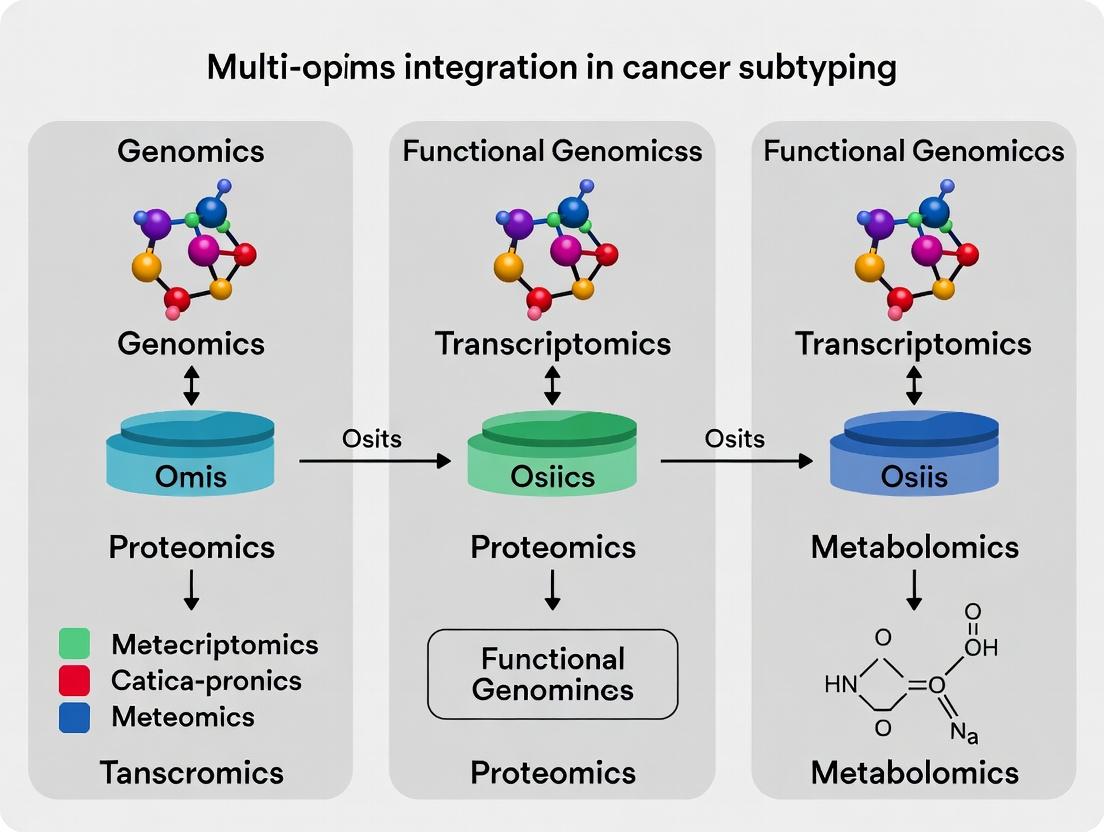
This article provides a comprehensive guide for researchers and bioinformaticians on the integration of multi-omics data for refined cancer subtyping.
Multi-Omics Integration in Cancer Subtyping: A Comprehensive Guide to Methods, Tools, and Clinical Translation
Abstract
This article provides a comprehensive guide for researchers and bioinformaticians on the integration of multi-omics data for refined cancer subtyping. It begins by establishing the foundational rationale, moving through core methodologies and computational tools for application. The guide addresses common challenges in data integration, batch effects, and dimensionality reduction, offering troubleshooting and optimization strategies. Finally, it covers essential validation frameworks, benchmarking of approaches, and the pathway to clinical translation. The goal is to equip the target audience with a practical understanding to implement robust, biologically meaningful multi-omics subtyping that can inform precision oncology and therapeutic development.
The Foundation of Multi-Omics Subtyping: Why Integrative Analysis Is Transforming Oncology
Cancer is a complex, heterogeneous disease driven by multi-layered molecular alterations. Traditional single-omics approaches often fail to capture the full biological complexity necessary for precise subtyping and therapeutic targeting. The integration of genomics, transcriptomics, epigenomics, proteomics, and metabolomics—multi-omics—provides a systems-level view. This holistic perspective is critical for discovering robust molecular subtypes, identifying master regulatory networks, and uncovering novel, actionable biomarkers for personalized oncology. This application note details the core omics layers and provides protocols for generating data suitable for integrative analysis in cancer research.
The Omics Layers: Definitions and Key Technologies
| Omics Layer | Core Definition | Primary Analytical Technology (Current) | Key Output in Cancer Subtyping |
|---|---|---|---|
| Genomics | Study of the complete set of DNA, including all genes and their structural variations. | Next-Generation Sequencing (NGS): Whole Genome Sequencing (WGS), Whole Exome Sequencing (WES). | Somatic mutations (SNVs, Indels), copy number variations (CNVs), structural rearrangements (e.g., gene fusions). |
| Transcriptomics | Study of the complete set of RNA transcripts (the transcriptome) produced by the genome. | NGS: Bulk or Single-Cell RNA-Sequencing (scRNA-seq). | Gene expression profiles, differentially expressed genes (DEGs), alternative splicing events, novel isoforms. |
| Epigenomics | Study of the complete set of epigenetic modifications on the genetic material of a cell. | NGS: Assay for Transposase-Accessible Chromatin (ATAC-seq), ChIP-seq, Whole Genome Bisulfite Sequencing (WGBS). | Chromatin accessibility landscape, histone modification maps, DNA methylation profiles (e.g., promoter hypermethylation). |
| Proteomics | Study of the complete set of proteins (the proteome), including their structures, functions, and modifications. | Mass Spectrometry (MS): Liquid Chromatography-Tandem MS (LC-MS/MS) with TMT/Isobaric labeling. | Protein abundance, post-translational modifications (PTMs: e.g., phosphorylation), signaling pathway activation. |
| Metabolomics | Study of the complete set of small-molecule metabolites (the metabolome) within a biological system. | Mass Spectrometry (MS): LC-MS or Gas Chromatography-MS (GC-MS); Nuclear Magnetic Resonance (NMR). | Levels of metabolites (e.g., oncometabolites like 2-hydroxyglutarate), metabolic pathway activity (e.g., glycolysis, TCA cycle). |
Detailed Application Notes and Protocols
Protocol 2.1: Integrated Multi-omics Sample Preparation from Tumor Tissue Objective: To generate high-quality DNA, RNA, protein, and metabolites from a single tumor tissue specimen (e.g., frozen or fresh) for parallel multi-omics profiling.
- Tissue Lysis & Homogenization: Cryopreserved tissue (30-50 mg) is placed in a Precellys tube with a ceramic bead blend and 1 mL of QIAzol Lysis Reagent. Homogenize using a bead mill homogenizer (2x 30 sec cycles, 5 m/sec).
- Phase Separation: Add 200 µL chloroform, shake vigorously, and centrifuge at 12,000 x g for 15 min at 4°C. The mixture separates into: a) upper aqueous phase (RNA), b) interphase (DNA), c) lower organic phase (protein & metabolites).
- RNA Recovery: Transfer the aqueous phase to a new tube. Precipitate RNA with isopropanol, wash with 75% ethanol, and elute in nuclease-free water. Assess integrity (RIN > 7.0) via Bioanalyzer.
- DNA Recovery: Recover the interphase and organic phase. Add ethanol to precipitate DNA, wash, and elute in TE buffer. Quantity via fluorometry.
- Protein/Metabolite Recovery: From the remaining organic phase, proteins are precipitated with isopropanol, washed with guanidine-HCl in ethanol, and solubilized in SDS buffer. The supernatant from the protein precipitation is retained for metabolite extraction via solvent evaporation and reconstitution in LC-MS compatible buffer.
Protocol 2.2: Library Preparation for Integrated Genomic and Epigenomic Sequencing Objective: To prepare WGS and ATAC-seq libraries from the same DNA sample to correlate genetic variants with chromatin accessibility.
- DNA QC & Shearing: Verify DNA integrity (DV200 > 80%). For WGS: shear 100 ng DNA to ~350 bp via acoustic shearing (Covaris). For ATAC-seq: Use the Th5 transposase (Illumina Tagment DNA TDE1 Enzyme) to simultaneously fragment and tag 50,000 nuclei with sequencing adapters.
- Library Construction:
- WGS: Perform end-repair, A-tailing, and ligation of indexed adapters. Clean up with bead-based purification. Amplify with 4-6 PCR cycles.
- ATAC-seq: Directly amplify tagmented DNA with indexed primers for 9-12 PCR cycles, determined via qPCR to avoid over-amplification.
- Library QC & Pooling: Quantify libraries via qPCR (KAPA Library Quant Kit). Assess size distribution via TapeStation (Agilent). Pool libraries at equimolar ratios for sequencing on an Illumina NovaSeq X (150 bp paired-end).
Protocol 2.3: LC-MS/MS for Global Proteomics and Phosphoproteomics Objective: To quantify global protein expression and phosphorylation dynamics from tumor lysates.
- Protein Digestion & TMT Labeling: Reduce (DTT), alkylate (IAA), and digest 100 µg of protein lysate with trypsin (1:50 w/w) overnight. Desalt peptides. Label peptides from 10 different samples (e.g., different tumor subtypes) with 10-plex TMT isobaric tags.
- High-pH Fractionation: Pool TMT-labeled peptides and fractionate using basic pH reversed-phase HPLC (e.g., 96 fractions consolidated into 24). This reduces complexity.
- Phosphopeptide Enrichment: Take an aliquot of pooled peptides pre-fractionation for phosphoproteomics. Enrich phosphorylated peptides using Fe-IMAC or TiO2 magnetic beads.
- LC-MS/MS Analysis: Analyze fractions on a Q-Exactive HF-X or Orbitrap Astral mass spectrometer. Use a 120 min gradient. MS1: 120k resolution. MS2: Use higher-energy collisional dissociation (HCD) for TMT quantification and synchronous precursor selection (SPS) for MS3 to reduce ratio compression.
- Data Processing: Search raw files against the human UniProt database using SequestHT (in Proteome Discoverer 3.0) or FragPipe. Quantify TMT reporter ions. Phosphosite localization probability > 0.75.
Signaling Pathway and Workflow Visualizations
Multi-omics Cascade in Cancer Cell Signaling
Integrated Multi-omics Experimental Workflow
The Scientist's Toolkit: Research Reagent Solutions
| Item | Vendor Examples (Research-Use) | Function in Multi-omics Cancer Research |
|---|---|---|
| AllPrep DNA/RNA/Protein Mini Kit | Qiagen | Simultaneous, co-isolation of genomic DNA, total RNA, and total protein from a single tumor sample. Minimizes sample-to-sample variability for integration. |
| Chromium Next GEM Single Cell ATAC & Gene Expression Kit | 10x Genomics | Enables paired, single-cell chromatin accessibility and transcriptome profiling from the same cell, crucial for dissecting tumor heterogeneity. |
| TMTpro 16-plex Isobaric Label Reagent Set | Thermo Fisher Scientific | Allows multiplexed quantitative comparison of proteomes from up to 16 different tumor samples or conditions in a single MS run, enhancing throughput and quantitative accuracy. |
| MagReSyn Ti-IMAC Beads | ReSyn Biosciences | Magnetic beads for highly specific enrichment of phosphorylated peptides from complex lysates for phosphoproteomics studies of signaling networks. |
| MTBE for Metabolite Extraction | Sigma-Aldrich | Methyl-tert-butyl ether, used in a biphasic solvent system (MTBE/Methanol/Water) for comprehensive extraction of polar and non-polar metabolites. |
| KAPA HyperPrep & HyperPlus Kits | Roche | Robust, high-yield library preparation kits for WGS, WES, and RNA-seq, ensuring high-quality NGS libraries from low-input tumor samples. |
| Cell Signaling PathScan Antibody Arrays | Cell Signaling Technology | Multiplexed, semi-quantitative immunoassays to rapidly validate the activity of key signaling pathways (e.g., MAPK, PI3K/AKT) identified from omics data. |
Within the thesis on multi-omics integration for cancer subtyping, this application note addresses the critical limitations of single-omics approaches. While genomics, transcriptomics, proteomics, and metabolomics individually provide valuable insights, they offer a fragmented view of tumor biology. This document details protocols and data demonstrating the necessity of an integrated, holistic analytical framework to uncover the complex, multi-layered drivers of cancer heterogeneity, progression, and therapeutic resistance.
Quantitative Comparison of Single-Omics vs. Multi-Omics Studies
Table 1: Performance Metrics in Cancer Subtyping (Representative Studies 2023-2024)
| Study Focus & Cancer Type | Omics Approach | Number of Subtypes Identified | Prognostic Accuracy (C-index) | Therapeutic Target Concordance | Key Limitation of Single-Omics Addressed |
|---|---|---|---|---|---|
| Breast Carcinoma (TNBC) | Genomics (WES) only | 2-3 | 0.62 | Low | Misses post-translational drivers |
| Breast Carcinoma (TNBC) | Transcriptomics (RNA-seq) only | 4-5 | 0.67 | Moderate | Poor correlation with functional protein activity |
| Breast Carcinoma (TNBC) | Integrated (WES, RNA-seq, RPPA) | 6 | 0.81 | High | Identified functional phospho-protein driven subtype |
| Colorectal Adenocarcinoma | Genomics (SNP Array) only | 3 | 0.58 | Low | Incomplete molecular classification |
| Colorectal Adenocarcinoma | Metabolomics (LC-MS) only | 2 | 0.61 | Low | Lacks genetic context |
| Colorectal Adenocarcinoma | Integrated (WGS, RNA-seq, LC-MS) | 5 | 0.85 | High | Linked metabolic dysregulation to specific mutational pathways |
| Glioblastoma Multiforme | Methylomics (EPIC Array) only | 3 | 0.65 | Moderate | Does not inform on downstream protein effect |
| Glioblastoma Multiforme | Integrated (Methylation, scRNA-seq, Proteomics) | 4 | 0.78 | High | Revealed epigenetic-immune-proteomic axis of resistance |
C-index: Concordance index; WES: Whole Exome Sequencing; RPPA: Reverse Phase Protein Array; LC-MS: Liquid Chromatography-Mass Spectrometry; WGS: Whole Genome Sequencing; scRNA-seq: single-cell RNA-sequencing.
Experimental Protocols
Protocol 3.1: Multi-Omic Tumor Tissue Processing for Integrated Analysis
Objective: To generate high-quality genomic, transcriptomic, and proteomic material from a single tumor tissue specimen.
Materials: See Scientist's Toolkit (Section 6).
Procedure:
- Tissue Sectioning (Cryostat):
- Embed fresh-frozen tumor tissue in optimal cutting temperature (OCT) compound.
- Cut sequential 5-10 µm sections. Number sections consecutively.
- Sections 1-5: Place directly into lysis buffer for concurrent DNA/RNA co-extraction (AllPrep protocol). Store at -80°C.
- Section 6: Hematoxylin and Eosin (H&E) staining for pathological validation.
- Sections 7-15: Place into chilled protein extraction buffer. Homogenize immediately. Aliquot for proteomics (mass spec) and phospho-proteomics (RPPA or LC-MS/MS). Flash freeze in liquid N₂. Store at -80°C.
Nucleic Acid Co-Extraction (AllPrep DNA/RNA Mini Kit):
- Follow manufacturer's protocol. Utilize QIAshredder columns for complete homogenization.
- Elute DNA in 50 µL and RNA in 30 µL nuclease-free water.
- Quantify DNA by Qubit dsDNA BR Assay. Assess RNA integrity number (RIN) via Bioanalyzer (accept RIN > 7.0).
Protein Extraction for Multi-Analyte Profiling:
- Thaw aliquot on ice. Centrifuge at 16,000 x g for 15 min at 4°C.
- Transfer supernatant to new tube. Perform BCA assay for quantification.
- For MS-Proteomics: Dilute 50 µg protein in SDT lysis buffer. Proceed with filter-aided sample preparation (FASP).
- For RPPA: Dilute to 1 µg/µL in 4X Laemmli buffer with 2-Mercaptoethanol. Serial dilute for printing.
Protocol 3.2: Computational Integration of Matched Multi-Omics Data
Objective: To perform unsupervised clustering and subtype discovery using matched DNA, RNA, and protein data from the same patients.
Software: R (v4.3+), MOMA R package, iClusterPlus, LinkedOmics.
Procedure:
- Data Preprocessing & Normalization:
- Genomics (SNVs/CNA): Process WES data through GATK pipeline. Convert somatic mutations to a binary matrix (1/0). Segment copy number alterations (CNA) using
CNVkit. Create a CNA matrix (log2 ratio). - Transcriptomics: Process RNA-seq reads with
Salmonfor quantification. Import toDESeq2for variance stabilizing transformation (VST). - Proteomics: Process LC-MS/MS data with
MaxQuant. Normalize LFQ intensities usingvsnpackage. - Batch Correction: Apply
ComBat(fromsvapackage) separately to each modality, using processing batch as a covariate.
- Genomics (SNVs/CNA): Process WES data through GATK pipeline. Convert somatic mutations to a binary matrix (1/0). Segment copy number alterations (CNA) using
Joint Dimensionality Reduction and Clustering:
- Run multi-omics factor analysis (MOFA+) to derive a shared latent factor space across all data types.
- Use the top 10-15 factors as input for consensus clustering (
ConsensusClusterPluspackage). - Determine optimal cluster number (k) by evaluating consensus cumulative distribution function (CDF) and tracking plot stability.
Validation and Biological Interpretation:
- Perform survival analysis (Kaplan-Meier, log-rank test) for each multi-omic subtype.
- Run pathway enrichment (GSEA, GSVA) on the RNA and protein factor loadings from MOFA+.
- Visualize results using multi-omics heatmaps (
ComplexHeatmappackage).
Visualization of Key Concepts and Workflows
Single vs Multi-Omics Tumor View
Multi-Omic Tumor Analysis Workflow
Case Study Data: Integrated Analysis of PI3K-AKT-mTOR Signaling
Table 2: Discrepancies Uncovered by Multi-Omics in a Lung Adenocarcinoma Cohort (n=120)
| Data Layer | Measurement | Single-Layer Interpretation | Integrated Multi-Omic Finding |
|---|---|---|---|
| Genomics | PIK3CA E545K Mutation (40% samples) | Activated PI3K signaling pathway; candidate for PI3Kα inhibitors. | Only 60% of mutated cases show pathway activation at protein level. |
| Transcriptomics | Increased AKT1 & MTOR mRNA (30% samples) | Upregulated PI3K-AKT-mTOR pathway activity. | Poor correlation (r=0.35) with phospho-AKT (S473) levels. |
| Phospho-Proteomics | High p-AKT (S473), p-S6 (S235/236) (25% samples) | Functional pathway activation. | Defines true "active signaling" subtype. Best predictor of response to mTOR inhibitors (p<0.01). |
| Metabolomics | Elevated lactate/pyruvate ratio, low glucose (20% samples) | Warburg effect, glycolytic phenotype. | Strong association with phospho-proteomic "active signaling" subtype, not with PIK3CA mutation alone. |
The Scientist's Toolkit: Research Reagent Solutions
Table 3: Essential Materials for Multi-Omics Sample Preparation
| Item Name | Vendor (Example) | Function in Protocol | Critical Note |
|---|---|---|---|
| AllPrep DNA/RNA Mini Kit | Qiagen | Concurrent isolation of genomic DNA and total RNA from a single tissue lysate. Minimizes sample degradation and material loss. | Essential for maintaining molecular integrity from the same cellular population. |
| MI Tissue Storage Tubes | Miltenyi Biotec | Stabilizes tissue at -80°C without embedding medium, optimal for subsequent multi-analyte extraction. | Prevents OCT compound interference in MS-based proteomics. |
| PhosSTOP Phosphatase Inhibitor Cocktail | Roche/Sigma | Preserves the native phospho-protein state during tissue homogenization and protein extraction. | Critical for phospho-proteomic and RPPA analysis to capture signaling activity. |
| BCA Protein Assay Kit | Thermo Fisher | Accurate colorimetric quantification of protein concentration in complex lysates. | Required for normalizing input across downstream proteomic applications (MS, RPPA). |
| TruSeq RNA Exome / Stranded mRNA Kit | Illumina | Target enrichment for RNA-seq, focusing on exonic regions. Efficient and cost-effective for large cohorts. | Provides deep coverage of coding transcriptome aligned with WES data. |
| TMTpro 16plex | Thermo Fisher | Isobaric labeling reagents for multiplexed quantitative proteomics via LC-MS/MS. | Allows simultaneous quantification of proteins from 16 samples, reducing batch effects. |
| Human Phospho-MAPK Antibody Array | R&D Systems | Rapid, parallel profiling of dozens of phospho-kinases for validation of signaling states. | Useful as a secondary validation tool after broad discovery phospho-proteomics. |
Application Notes
Complementary Driver Identification in Breast Cancer
Multi-omics integration transcends single-layer analysis by revealing how genomic alterations manifest functionally. For instance, a PIK3CA mutation (genomics) may only confer a survival advantage when coupled with specific phospho-protein activation (phosphoproteomics) and metabolic rewiring (metabolomics). This complementary view identifies co-dependent drivers essential for tumor maintenance.
Table 1: Multi-Omics Drivers in Triple-Negative Breast Cancer (TNBC) Subtypes
| Subtype (Source: TCGA) | Genomic Alteration | Transcriptomic Signature | Proteomic/Phosphoproteomic Feature | Potential Co-Targeting Strategy |
|---|---|---|---|---|
| Basal-Like Immune-Suppressed | MYC amplification (32%) | Low CD8+ T-cell score | High p-STAT3 (Tyr705) | MYC inhibitor + STAT3 inhibitor |
| Basal-Like Immune-Activated | PD-L1 amplification (15%) | High IFN-γ response, Exhausted T-cell | High PD-L1 protein, JAK/STAT signaling | Immune Checkpoint Inhibitor + JAK inhibitor |
| Luminal Androgen Receptor (LAR) | PIK3CA mutation (45%) | AR signaling high, Luminal gene set | High AR protein, Active PI3K/mTOR pathway | AR antagonist + Alpelisib (PI3Kα inhibitor) |
Resolving Intra-Tumoral Heterogeneity
Single-omics subtyping often groups molecularly distinct tumors. Multi-omics deconvolutes this. For example, tumors classified as "Glioblastoma Mesenchymal" by mRNA can be stratified into subgroups with differential survival based on integrated proteogenomic clusters, revealing heterogeneity in immune infiltration and kinase activity.
Table 2: Proteogenomic Clusters in Glioblastoma & Clinical Correlation
| Cluster (CPTAC Study) | Key Genomic Driver | Dominant Proteomic Pathway | Tumor Microenvironment Signature | Median Survival (Months) |
|---|---|---|---|---|
| Receptor Tyrosine Kinase (RTK) I | EGFR amplification | High EGFR/p-EGFR, Active MAPK | Low macrophage infiltration | 14.2 |
| Receptor Tyrosine Kinase (RTK) II | PDGFRA alteration | High PDGFR pathway activity | High microglia presence | 18.7 |
| Mesenchymal | NF1 mutation/deletion | High MET, Inflammatory signaling | High monocyte-derived macrophages | 11.5 |
| Mitochondrial | IDH1 mutation (if present) | Oxidative phosphorylation high | Low immune cell infiltration | 27.1* |
*Includes some lower-grade glioma with GB morphology.
Detailed Protocols
Protocol 1: Integrated Multi-Omics Workflow for Tumor Subtyping
Objective: To generate and integrate WGS, RNA-Seq, and LC-MS/MS proteomic data from tumor biopsies for subtype discovery.
Materials (Research Reagent Solutions):
- Smart-Seq2 v5 Reagent Kit: For low-input, full-length RNA-seq library prep.
- KAPA HyperPrep Kit: For whole-genome sequencing library construction.
- TMTpro 16plex Kit: For tandem mass tag multiplexing of peptides for high-throughput quantitative proteomics.
- Pierce Phosphopeptide Enrichment Kit: For enrichment of phosphorylated peptides prior to LC-MS/MS.
- CIBERSORTx: Computational tool for deconvoluting transcriptomic cell-type abundances.
- MSFragger/FragPipe: Ultra-fast proteomic search platform for identifying peptides and post-translational modifications.
Procedure:
- Sample Preparation: Snap-frozen tumor tissue is pulverized under liquid N₂ and divided into aliquots for DNA, RNA, and protein extraction.
- DNA/Genomics: a. Extract high-molecular-weight DNA using a silica-column method. b. Prepare WGS libraries (350bp insert) using the KAPA HyperPrep Kit. c. Sequence on an Illumina NovaSeq X (150bp PE) to >60x coverage. d. Process with GATK Mutect2 (somatic variants), CNVkit (copy number), and Manta (structural variants).
- RNA/Transcriptomics: a. Extract total RNA with a TRIzol-based method. b. Prepare stranded mRNA-seq libraries using Smart-Seq2 v5 for poly-A selection and cDNA amplification. c. Sequence on Illumina NextSeq 2000 (75bp PE) for ~50M reads/sample. d. Align to GRCh38 with STAR, quantify with RSEM, and perform differential expression with DESeq2.
- Protein/Proteomics: a. Lyse protein aliquot in 8M Urea buffer, reduce, alkylate, and digest with trypsin/Lys-C. b. Label peptides with TMTpro 16plex Kit according to manufacturer's protocol. c. For phosphoproteomics, enrich labeled peptides using the Pierce Phosphopeptide Enrichment Kit (TiO₂ beads). d. Analyze by LC-MS/MS on an Orbitrap Eclipse Tribrid mass spectrometer. e. Identify and quantify proteins/phosphosites using FragPipe with MSFragger and Philosopher.
- Data Integration & Clustering: a. Perform per-omic normalization (e.g., log2 for RNA/protein, centered for CNV). b. Use Multi-Omics Factor Analysis (MOFA+) R package to integrate all data types and infer latent factors. c. Cluster samples based on the latent factors using consensus non-negative matrix factorization (cNMF). d. Validate clusters using survival data and independent cohorts.
Protocol 2: Cross-Omic Validation of Driver Pathway Activity
Objective: To validate predicted kinase activity from phosphoproteomics using orthogonal functional assays.
Materials (Research Reagent Solutions):
- Reverse Phase Protein Array (RPPA) Core Kit: For high-throughput antibody-based validation of protein levels and modifications.
- PamStation12 Platform & PamChip Tyrosine Kinase (PTK) Peptide Microarray: For measuring active kinase profiling in lysates.
- CellTiter-Glo 3D Assay: For measuring cell viability in 3D spheroid models post-perturbation.
Procedure:
- Hypothesis Generation: From integrated analysis (Protocol 1), identify a tumor cluster with high inferred activity of a kinase (e.g., MET) based on phosphosite enrichment, despite low mRNA expression.
- RPPA Validation: a. Prepare tumor lysates from representative cluster samples. b. Serially dilute and print onto nitrocellulose-coated slides using the RPPA Core Kit. c. Probe with validated anti-p-MET (Tyr1234/1235) and total MET antibodies. d. Quantify signal and confirm high p-MET/MET ratio specific to the predicted cluster.
- Functional Kinase Assay: a. Prepare active tumor lysates. b. Run on the PamStation12 using the PTK PamChip, which displays immobilized peptide substrates. c. Measure kinetic phosphorylation by fluorescently labeled anti-phospho-tyrosine antibody. d. Use BioNavigator software to derive kinase activity scores, confirming high MET activity.
- Perturbation in Model Systems: a. Establish patient-derived organoids (PDOs) from a cluster biopsy. b. Treat PDOs with a MET inhibitor (e.g., Capmatinib) vs. DMSO control. c. Monitor viability over 7 days using the CellTiter-Glo 3D Assay. d. Expected result: PDOs from the high MET-activity cluster show significant sensitivity versus other clusters.
Diagrams
Title: Multi-Omics Subtyping Workflow for Cancer
Title: Complementary Drivers from Multi-Omics Integration
Key Biological Questions Addressed by Integrated Subtyping
Within the broader thesis on multi-omics integration in cancer subtyping research, integrated subtyping is a cornerstone methodology. It moves beyond single-omics classifications to synthesize data from genomics, transcriptomics, epigenomics, and proteomics. This approach directly addresses fundamental biological questions that are intractable with reductionist methods, thereby refining our understanding of tumor heterogeneity, origins, and therapeutic vulnerabilities.
Key Biological Questions and Application Notes
What are the Molecular Drivers Defining Clinically Distinct Subtypes?
Single-omics subtyping (e.g., PAM50 for breast cancer) often reveals correlations but not causality. Integrated subtyping links genetic alterations to their functional consequences, identifying driver events.
Application Note: In glioblastoma, integration of DNA methylation, copy number variation, and gene expression data has defined subtypes like RTK I, RTK II, and mesenchymal, which are driven by distinct combinations of EGFR, PDGFRA, and NF1 alterations alongside epigenetic silencing.
How Does Intra-Tumor Heterogeneity (ITH) Arise and Evolve?
Tumors are ecosystems of co-existing clones. Multi-omics profiling of single cells or spatially resolved regions maps the phylogenetic architecture and the interplay between genetic, epigenetic, and phenotypic diversity.
Application Note: Spatial transcriptomics coupled with targeted DNA sequencing in breast cancer has charted how distinct clones occupy specific niches, influenced by local immune cell infiltration and stromal signals, driving adaptation.
What are the Underlying Cellular States and Lineages of Tumor Cells?
Tumors often hijack developmental pathways. Integrated analysis can deconvolute the cellular composition and identify master regulator transcription factors and epigenetic programs that maintain subtype identity.
Application Note: In colorectal cancer, integration of chromatin accessibility (ATAC-seq) and gene expression (RNA-seq) has uncovered subtypes recapitulating normal colon cell lineages (stem-like, goblet-like, enterocyte-like), with implications for metastatic potential.
How do the Tumor Microenvironment (TME) and Tumor Cell States Co-evolve?
The tumor is not an isolated entity. Integrated subtyping of tumor and stromal/immune compartments reveals reciprocal signaling that defines immunosuppressive or inflamed phenotypes.
Application Note: Multi-omics profiling (transcriptomics, proteomics) of tumor and immune cells in lung adenocarcinoma has identified subtypes where specific oncogenic pathways (e.g., KRAS) are linked to distinct T-cell exhaustion programs, predicting response to immunotherapy.
What are the Mechanisms of Therapeutic Resistance and Sensitivity?
Integrated pre- and post-treatment profiling identifies convergent adaptive pathways, distinguishing intrinsic from acquired resistance.
Application Note: In ER+ breast cancer, integrating DNA sequencing, RNA-seq, and reverse-phase protein arrays (RPPA) from biopsy cohorts has revealed that ESR1 mutations, in cis with specific GATA3 alterations and activated kinase pathways, define a subtype with superior response to CDK4/6 inhibition.
Table 1: Impact of Integrated Subtyping in Selected Cancers
| Cancer Type | Key Integrated Subtype | Defining Multi-omics Features | Clinical Association |
|---|---|---|---|
| Glioblastoma | Mesenchymal | NF1 deletion/mutation, Chr7 gain/Chr10 loss, high TNF pathway (RNA), specific methylation cluster | Worse prognosis, potential sensitivity to immunotherapy |
| Colorectal Cancer | Consensus Molecular Subtype 4 (CMS4) | Stromal infiltration (RNA), TGF-β activation (RNA), widespread hypomethylation (DNAme), high matrix proteins (Prot) | Poor survival, mesenchymal, metastatic |
| Breast Cancer | Luminal B / Reversed ER Signaling | ESR1 mutation (DNA), low ER pathway score (RNA), high AKT phosphorylation (Prot) | Resistance to endocrine therapy, sensitivity to PI3K/AKT inhibitors |
| Lung Adenocarcinoma | STK11-inactivated Co-mutant | STK11 & KRAS mutations (DNA), low PD-L1 protein (Prot), Neutrophil signature (RNA) | Primary resistance to immune checkpoint blockade |
Table 2: Common Multi-omics Platforms for Integrated Subtyping
| Platform | Omics Layer | Typical Throughput | Key Output for Subtyping |
|---|---|---|---|
| Bulk RNA-seq | Transcriptomics | High | Gene expression signatures, pathway activity |
| Whole Exome/Genome Seq | Genomics | Medium-High | Somatic mutations, copy number alterations |
| Methylation Array (EPIC) | Epigenomics | High | Genome-wide CpG methylation profiles |
| RPPA or Mass Spectrometry | Proteomics & Phosphoproteomics | Low-Medium | Protein abundance & activation states |
| Single-cell Multi-omics (CITE-seq) | Transcriptomics + Surface Proteomics | Medium | Paired cell phenotype and gene expression |
Experimental Protocols
Protocol 1: Bulk Multi-omics Tumor Subtyping Workflow
Objective: To classify tumor samples into integrated subtypes using DNA, RNA, and DNA methylation data from bulk tissue.
Materials: Fresh-frozen or optimally preserved tissue sections, DNA/RNA extraction kits, sequencing or array platforms.
Procedure:
- Nucleic Acid Co-isolation: Extract high-quality DNA and RNA from the same tumor tissue aliquot using a dual-purpose kit (e.g., AllPrep DNA/RNA/miRNA Universal Kit). Assess integrity (RIN > 7, DIN > 7).
- Parallel Library Preparation:
- DNA: Perform whole exome capture sequencing (150bp paired-end) and/or methylation profiling using the Illumina EPIC array.
- RNA: Perform poly-A selected stranded RNA-seq (100bp paired-end, ~50M reads).
- Bioinformatic Processing & Integration:
- Process Individually: Align reads, generate counts/matrices (RNA-seq), mutation/CNV calls (WES), beta-values (Methylation).
- Data Integration: Use an ensemble or clustering-based approach (e.g., MOFA+ or Similarity Network Fusion).
- Normalize data per platform.
- Construct patient similarity networks for each omics layer.
- Fuse networks into a single integrated network.
- Perform clustering on the fused network to define subtypes.
- Subtype Characterization: Perform differential analysis across subtypes for each data layer. Use pathway enrichment (GSEA) and regulator inference (VIPER) to define biological drivers.
Protocol 2: Spatial Multi-omics Validation of Subtypes
Objective: To validate bulk-derived subtypes and assess spatial heterogeneity using GeoMx Digital Spatial Profiler (DSP) or Visium.
Materials: FFPE tissue blocks from bulk-profiled cases, GeoMx Cancer Transcriptome Atlas, morphology markers.
Procedure:
- Region of Interest (ROI) Selection: Based on H&E, select 3-5 ROIs per case representing core tumor, invasive margin, and stromal-rich areas.
- Oligonucleotide-tagged Antibody/RNA Probe Hybridization: Incubate slides with the GeoMx panel of oligo-tagged antibodies (proteomics) and/or RNA probes.
- UV Cleavage and Collection: Use the instrument to selectively release oligos from each predefined ROI into separate collection tubes.
- Quantification: Process collected oligos via nCounter or sequencing.
- Data Integration: Compare spatial protein/gene expression patterns from ROIs to the bulk-defined subtype call. Confirm the presence of subtype-specific signals and identify spatially restricted biomarkers.
Visualization Diagrams
Title: Integrated Subtyping Logic Flow
Title: Multi-omics Defines a Resistance Subtype
The Scientist's Toolkit
Table 3: Essential Research Reagent Solutions for Multi-omics Subtyping
| Item | Function in Integrated Subtyping |
|---|---|
| AllPrep DNA/RNA/miRNA Universal Kit (Qiagen) | Enables simultaneous isolation of high-quality DNA and RNA from a single tissue specimen, crucial for correlative analysis. |
| TruSeq RNA Exome / Stranded mRNA Kit (Illumina) | Provides targeted or whole-transcriptome RNA-seq libraries for expression and variant calling from limited input. |
| Infinium MethylationEPIC BeadChip (Illumina) | Industry-standard array for genome-wide DNA methylation profiling at >850,000 CpG sites. |
| Cell Signaling Technology (CST) Antibody Panels | Validated antibodies for Western Blot, IHC, or RPPA to measure key protein signaling pathways identified in subtypes. |
| Bio-Plex Pro Cell Signaling Assays (Bio-Rad) | Multiplexed immunoassays to quantify phosphorylated and total proteins from lysates, enabling pathway activity mapping. |
| GeoMx DSP Cancer Transcriptome Atlas (NanoString) | Oligo-tagged RNA probes for spatially resolved, whole-transcriptome profiling from FFPE tissue sections. |
| 10x Genomics Visium FFPE Spatial Gene Expression | Enables untargeted, genome-wide spatial transcriptomics on intact FFPE tissue sections. |
| MOFA+ (R/Python Package) | Key computational tool for unsupervised integration of multi-omics data sets and latent factor discovery. |
Historical Milestones and Pioneering Studies in Cancer Multi-Omics
The systematic molecular characterization of human cancers represents one of the most significant biomedical advances of the 21st century, forming the cornerstone of precision oncology. This journey, evolving from single-analyte studies to integrated multi-omics, has fundamentally reshaped cancer taxonomy, moving beyond histology towards molecularly defined subtypes with direct implications for prognosis and therapy. Within the broader thesis on multi-omics integration for cancer subtyping, these pioneering efforts provide the essential data layers—genomic, transcriptomic, epigenomic, and proteomic—that, when fused, yield a holistic view of oncogenic mechanisms.
Pioneering Studies and Key Findings
The table below summarizes seminal projects that established the foundation for modern cancer multi-omics.
Table 1: Landmark Multi-Omics Studies in Oncology
| Project/Study (Year) | Cancer Type(s) | Primary Omics Layers | Key Subtyping Findings | Sample Size |
|---|---|---|---|---|
| The Cancer Genome Atlas (TCGA) Pan-Cancer Atlas (2018) | 33 cancer types | WGS/WES, RNA-Seq, miRNA, DNA Methylation, Proteomics (RPPA) | Identified 28 molecular subtypes across cancers, often transcending tissue-of-origin; defined key oncogenic signaling pathways. | >11,000 tumors |
| International Cancer Genome Consortium (ICGC) Pan-Cancer Analysis (2020) | ~2,800 whole genomes across cancers | WGS, RNA-Seq, DNA Methylation | Catalogued non-coding driver mutations and characterized whole-genome duplication events as subtyping features. | ~2,800 tumors |
| Clinical Proteomic Tumor Analysis Consortium (CPTAC) | Glioblastoma, Breast, Colon, Ovarian, Lung, etc. | WGS, RNA-Seq, Proteomics, Phosphoproteomics, Acetylomics | Proteomic clusters often redefined transcriptomic subtypes, identifying dominant kinase pathways and immune subtypes. | ~1,000 tumors (aggregate) |
| METABRIC (2012, 2016) | Breast Cancer | Copy Number, Gene Expression, Exome Sequencing | Defined 10 integrative clusters (IntClust) with distinct clinical outcomes and copy-number drivers. | ~2,000 tumor samples |
| The Cancer Cell Line Encyclopedia (CCLE) Multi-Omics (2019, 2022) | Pan-Cancer (Cell Lines) | WES, RNA-Seq, DNA Methylation, RPPA, Metabolomics (subset) | Created a comprehensive molecular map of models, enabling pharmacogenomic studies linking omics features to drug response. | >1,000 cell lines |
Detailed Application Notes & Protocols
Protocol 1: Integrated Multi-Omics Data Generation from Tumor Tissue (TCGA/CPTAC-style)
Application Note: This workflow is designed for the comprehensive molecular profiling of solid tumor biopsies, essential for discovering novel integrated subtypes.
Sample Preparation & QC:
- Obtain fresh-frozen tumor tissue with matched normal (blood or adjacent tissue). A pathologist confirms tumor cellularity (>60% recommended).
- Extract high-quality DNA (Qubit, Agilent Bioanalyzer: DV200 > 50%), RNA (RIN > 7), and protein from the same tissue aliquot using trizol-based or parallel methods.
- Aliquot and store at -80°C.
Multi-Layer Data Generation:
- Whole Exome Sequencing (DNA): 100ng genomic DNA sheared, exome-captured (e.g., SeqCap EZ), and sequenced on Illumina NovaSeq (150bp paired-end, 100x tumor/30x normal coverage).
- Total RNA Sequencing: 100ng total RNA subjected to ribosomal RNA depletion, library prep (e.g., KAPA HyperPrep), sequenced for >50M paired-end reads.
- DNA Methylation Profiling: 500ng bisulfite-converted DNA applied to Illumina Infinium MethylationEPIC BeadChip (~850k CpG sites).
- Global Proteomics/Phosphoproteomics: 100μg protein lysate digested (trypsin), peptides fractionated (high-pH reverse phase), and analyzed by LC-MS/MS on a Q Exactive HF or timsTOF platform with TMT or label-free quantification. For phosphoproteomics, enrich peptides using TiO2 or Fe-NTA beads prior to LC-MS/MS.
Primary Data Processing:
- Sequencing: Align to GRCh38, call somatic variants (GATK MuTect2), copy number alterations (Control-FREEC), and perform fusion detection (STAR-Fusion).
- RNA-Seq: Quantify transcripts (featureCounts) and perform quality assessment (FastQC, MultiQC).
- Methylation: Process idat files (R
minfi), normalize (SWAN), and get beta-values. - Proteomics: Process raw files (MaxQuant, Spectronaut), map to UniProt, and normalize intensities.
Integrated Multi-Omics Profiling Workflow
Protocol 2: Multi-Omics Integrative Clustering for Subtype Discovery
Application Note: This computational protocol outlines the use of unsupervised integration methods to define novel cancer subtypes from multiple omics data matrices.
Data Preprocessing & Dimension Reduction:
- For each omics dataset (e.g., gene expression, copy number, methylation), perform feature selection (e.g., most variable genes/regions).
- Normalize each dataset appropriately (e.g., log2(TPM+1) for RNA-seq, beta-values for methylation) and scale (z-score).
- Apply omics-specific dimension reduction: Principal Component Analysis (PCA) is typical. Retain top N PCs (e.g., explaining 80% variance) per dataset.
Data Integration and Consensus Clustering:
- Method A (Similarity Network Fusion - SNF):
- Construct patient similarity networks for each omics dataset using the reduced features (e.g., Euclidean distance).
- Fuse networks using SNF (
RpackageSNFtool) to create a unified patient similarity matrix. - Apply spectral clustering on the fused matrix.
- Method B (Multi-Omic Factor Analysis - MOFA):
- Input all omics datasets into the MOFA2 framework (
RpackageMOFA2). - Train the model to decompose data into a set of latent factors capturing shared and dataset-specific variance.
- Cluster patients in the latent factor space using k-means.
- Input all omics datasets into the MOFA2 framework (
- Method A (Similarity Network Fusion - SNF):
Subtype Validation and Characterization:
- Evaluate cluster stability (e.g., silhouette width, consensus clustering).
- Assess association with known clinical variables (survival, grade, stage) via log-rank tests and Cox models.
- Perform differential analysis (expression, methylation, etc.) between subtypes to identify defining features.
- Validate findings in an independent cohort if available.
Data Integration for Subtype Discovery
The Scientist's Toolkit: Key Research Reagent Solutions
Table 2: Essential Reagents and Kits for Multi-Omics Profiling
| Item Name | Provider/Example | Function in Multi-Omics Workflow |
|---|---|---|
| AllPrep DNA/RNA/Protein Kit | Qiagen | Simultaneous co-extraction of high-quality genomic DNA, total RNA, and native protein from a single tissue specimen, minimizing sample input bias. |
| KAPA HyperPrep Kit (with RNA depletion) | Roche | Library preparation for total RNA-seq following ribosomal RNA depletion, ensuring broad transcriptome coverage. |
| Illumina Infinium MethylationEPIC Kit | Illumina | Genome-wide profiling of DNA methylation at over 850,000 CpG sites, covering enhancer regions relevant to cancer. |
| TMTpro 16plex Isobaric Label Reagent Set | Thermo Fisher | Allows multiplexed quantitative proteomics of up to 16 samples in a single LC-MS/MS run, enhancing throughput and quantitative precision. |
| Phosphopeptide Enrichment Kit (TiO2) | GL Sciences, Thermo Fisher | Selective enrichment of phosphorylated peptides from complex digests for deep phosphoproteome analysis. |
| NovaSeq 6000 S4 Reagent Kit (300 cycles) | Illumina | High-output sequencing reagent for generating the deep coverage required for WES and RNA-seq in large cohorts. |
| Human Reference Genome (GRCh38) & Annotations | Gencode, UCSC | Standardized reference files for alignment, variant calling, and annotation across all genomic and transcriptomic analyses. |
| Multi-omics Data Processing Suites (e.g., nf-core pipelines) | nf-core community | Pre-configured, reproducible Nextflow pipelines (e.g., nf-core/sarek, nf-core/rnaseq) for automated processing of sequencing data. |
Within the thesis on multi-omics integration for cancer subtyping, the foundation of research is the systematic acquisition of high-quality, multi-dimensional molecular data. Public data repositories serve as indispensable resources, providing standardized, large-scale datasets that enable the discovery of novel subtypes, biomarkers, and therapeutic targets. This document details the key repositories, their applications, and protocols for leveraging them in integrated analyses.
The following table summarizes the core characteristics, data types, and scale of leading cancer genomics repositories, providing a guide for study design.
Table 1: Core Public Cancer Omics Repositories
| Repository | Full Name | Primary Focus | Key Data Types (Omics) | Approx. Sample Scale (Tumors) | Unique Value Proposition |
|---|---|---|---|---|---|
| TCGA | The Cancer Genome Atlas | Pan-cancer atlas; genomic characterization | Genomics (WES, SNP), Transcriptomics (RNA-seq), Epigenomics (Methylation) | >11,000 across 33 cancer types | Unmatched breadth of paired genomic and transcriptomic data; clinical outcome linkage. |
| CPTAC | Clinical Proteomic Tumor Analysis Consortium | Proteogenomic integration | Proteomics (LC-MS/MS), Phosphoproteomics, Glycoproteomics, Genomics, Transcriptomics | ~1,000 across 10+ cancers | Deep, quantitative proteomic data directly linked to genomic alterations. |
| ICGC | International Cancer Genome Consortium | International pan-cancer genomics | Genomics (WGS/WES), Transcriptomics | ~25,000 across 50+ projects | Emphasis on whole-genome sequencing (WGS) and international cohort diversity. |
| GEO | Gene Expression Omnibus | Functional genomics data archive | Transcriptomics (Microarray, RNA-seq), Epigenomics | Millions of samples | Largest archive of high-throughput functional genomics data from diverse studies. |
| dbGaP | Database of Genotypes and Phenotypes | Genotype-phenotype interaction | Genomics, Clinical Phenotypes | Variable | Controlled-access repository with detailed, individual-level phenotype data. |
Application Notes for Multi-omics Subtyping
Note 1: TCGA as a Genomic Backbone. TCGA provides the foundational genomic and transcriptomic layers for subtyping. Integrated clustering of copy number variation, mRNA expression, and DNA methylation data has redefined classifications for glioblastoma, breast, and lung cancers. Its linked clinical data allow for survival-based validation of proposed subtypes.
Note 2: CPTAC for Functional Validation. CPTAC data allows hypothesis-driven validation of genomic subtypes at the functional protein level. For example, a transcriptomic subtype predicted to have RTK activation can be confirmed by elevated phospho-tyrosine peptide abundances in CPTAC MS data. This moves subtyping from correlative to causal mechanistic understanding.
Note 3: Cross-Repository Integration. Robust subtyping requires integrating complementary resources. A typical workflow may use: ICGC WGS data for rare mutation discovery, TCGA RNA-seq for consensus expression clustering, and CPTAC proteomics to identify the dominant driver pathways within each cluster. GEO is critical for independent validation using external datasets.
Note 4: Data Harmonization Challenge. Key challenges include batch effect correction across different platforms (e.g., TCGA RNA-seq vs. GEO microarray) and sample ID matching when merging clinical data from dbGaP with molecular data from TCGA. Tools like ComBat and careful meta-data curation are essential.
Protocol: Integrated Multi-omics Subtyping Using Public Repositories
Protocol Title: Identification of Proteogenomic Cancer Subtypes from TCGA and CPTAC Data.
Objective: To integrate genomic, transcriptomic, and proteomic data from public repositories to define novel, biologically coherent cancer subtypes.
I. Data Acquisition & Preprocessing
- Cohort Selection: Identify a cancer type co-profiled by both TCGA and CPTAC (e.g., Colon Adenocarcinoma, COAD).
- TCGA Data Download (via GDC Data Portal):
- Download harmonized RNA-seq (FPKM-UQ) and somatic mutation (MAF) files using the
TCGAbiolinksR package. - Perform standard normalization (log2(FPKM-UQ+1)) and batch correction if needed.
- Download harmonized RNA-seq (FPKM-UQ) and somatic mutation (MAF) files using the
- CPTAC Data Download (via Proteomic Data Commons):
- Download the global proteomics (log2 ratio) and phosphoproteomics data matrices.
- Map CPTAC sample IDs to TCGA sample IDs using provided cross-reference tables.
- Data Alignment: Retain only the set of patients/tumors with data available across all three omics layers (RNA, Protein, Phospho). Impute missing protein values using k-nearest neighbors (k=10) with a 20% missingness cutoff.
II. Cluster-of-Clusters Analysis (Multi-omics Integration)
- Individual Omics Clustering: For each omics data matrix (RNA, Protein, Phospho), perform consensus clustering (ConsensusClusterPlus R package, 80% resampling, 1000 iterations, k=2-6).
- Determine Optimal k: Use consensus cumulative distribution function (CDF) and delta area plot to select the optimal number of clusters (k) for each layer.
- Integrate Cluster Assignments: Create a new matrix where rows are samples and columns are the cluster labels from each omics layer. Apply a final meta-clustering step (e.g., hierarchical clustering with Ward's method) on this label matrix to define unified multi-omics subtypes.
III. Subtype Characterization & Validation
- Differential Analysis: For each unified subtype, perform differential expression (limma R package) against all others for each omics layer to identify defining features.
- Pathway Enrichment: Input subtype-specific protein/phosphoprotein signatures into Enrichr or GSEA against the KEGG and Reactome databases.
- Clinical Correlation: Use Kaplan-Meier survival analysis (log-rank test) on associated TCGA clinical data to assess prognostic significance.
- Independent Validation: Query GEO for external transcriptomic datasets of the same cancer type. Use a classifier (e.g., nearest template prediction) trained on the TCGA RNA signature to assign subtypes and confirm survival differences.
Multi-omics Data Integration Workflow for Cancer Subtyping
Proteogenomic Validation of a Signaling Pathway
The Scientist's Toolkit: Research Reagent Solutions
Table 2: Essential Tools for Multi-omics Data Analysis
| Item / Solution | Function in Analysis | Example/Note |
|---|---|---|
| R/Bioconductor | Primary platform for statistical analysis, visualization, and pipeline development. | Core ecosystem with packages like TCGAbiolinks, limma, ConsensusClusterPlus. |
| Python (SciPy) | Alternative/companion platform for machine learning and large-scale data manipulation. | Use with pandas, scikit-learn, and statsmodels libraries. |
| cBioPortal | Web-based visualization and exploration tool for multi-omics cancer data. | Rapid assessment of genomic alterations and co-occurrence in predefined cohorts. |
| UCSC Xena | Integrative genomics browser for public and private functional genomics data. | Direct visualization and cohort comparison across TCGA, ICGC, and other hubs. |
| GDCRNATools | R package specifically for TCGA RNA-seq, miRNA, and clinical data integration. | Streamlines downloading, preprocessing, and analysis of TCGA RNA-seq data. |
| LinkedOmics | Web application for analyzing multi-omics data from CPTAC and TCGA cohorts. | Specialized for proteogenomic association and phosphoproteomics network analysis. |
| ComBat/SVA | Batch effect correction algorithms. | Critical when integrating data from different repositories or sequencing centers. |
| Docker/Singularity | Containerization platforms. | Ensures computational reproducibility of the analysis pipeline across environments. |
Methodologies in Action: A Practical Guide to Multi-Omics Integration Strategies
The molecular heterogeneity of cancer necessitates a systems-level view. Multi-omics integration—the combined analysis of genomics, transcriptomics, proteomics, metabolomics, and epigenomics—aims to delineate coherent molecular subtypes with prognostic and therapeutic relevance. The choice of integration strategy fundamentally shapes biological interpretation and clinical translation. This document details the conceptual frameworks and practical application of Early (Data-level), Late (Decision-level), and Intermediate (Feature-level) integration.
Conceptual Frameworks and Comparative Analysis
| Integration Type | Description | Stage of Integration | Key Advantages | Key Disadvantages | Common Algorithms/Tools |
|---|---|---|---|---|---|
| Early Integration | Raw or pre-processed data from multiple omics layers are concatenated into a single matrix prior to analysis. | Data-level | Captures global, cross-omics correlations; Single model simplicity. | Sensitive to noise, scale, and missing data; "Curse of dimensionality"; Difficult to interpret source-specific signals. | PCA, t-SNE, UMAP on concatenated data; Standard ML classifiers (SVMs, Random Forests). |
| Late Integration | Omics datasets are analyzed independently, and results (e.g., clusters, scores, predictions) are combined at the final step. | Decision-level | Flexibility; Uses optimal model per data type; Modular and parallelizable. | May miss cross-omics interactions; Final consensus can be complex; Risk of losing weak but coordinated signals. | Similarity Network Fusion (SNF); Cluster-of-cluster analysis (COCA); Majority voting on classifier outputs. |
| Intermediate Integration | Joint dimensionality reduction or model-based fusion that operates on separate but connected data representations. | Feature-level | Balances flexibility and joint learning; Can model interactions between omics layers; Reduces noise. | Computationally intensive; Method complexity; Model interpretation can be challenging. | Multi-Omics Factor Analysis (MOFA); Integrative NMF (iNMF); Multi-block PLS/Discriminant Analysis. |
Table 1: Conceptual comparison of multi-omics integration strategies for cancer subtyping.
Experimental Protocols for Key Integration Methodologies
Protocol 3.1: Late Integration via Similarity Network Fusion (SNF) for Subtyping
Objective: Integrate mRNA expression, DNA methylation, and miRNA data to identify robust cancer subtypes. Materials: R or Python environment, SNFtool R package / SNFpy. Procedure:
- Data Pre-processing: For each omics dataset (e.g.,
mRNA,Meth,miRNA), perform quality control, normalization, and missing value imputation. Standardize features (e.g., z-score). - Similarity Matrix Construction: For each data type, calculate a patient-to-patient similarity matrix using a scaled exponential kernel. Typically, use Euclidean distance. The bandwidth parameter (μ) is estimated via local scaling.
W_mRNA = affinityMatrix(dist_mRNA, K=20, mu=0.5)- Repeat for
W_methandW_miRNA.
- Network Fusion: Iteratively fuse the similarity networks using a non-linear message-passing approach until convergence.
W_integrated = SNF(list(W_mRNA, W_meth, W_miRNA), K=20, t=20)K= number of neighbors,t= iteration number.
- Clustering: Apply spectral clustering on the fused network
W_integratedto obtain cluster labels (subtypes).clusters = spectralClustering(W_integrated, K=3)# where K is the estimated number of subtypes.
- Validation: Assess subtype stability (e.g., consensus clustering on fused network), survival analysis (Kaplan-Meier log-rank test), and functional enrichment.
Protocol 3.2: Intermediate Integration using Multi-Omics Factor Analysis (MOFA)
Objective: Identify the principal sources of variation (Factors) across multiple omics datasets from the same tumor samples. Materials: MOFA2 R/Python package. Procedure:
- Data Preparation: Create a list of omics matrices (samples x features). Ensure sample order is identical. Center and scale features per view.
- Model Training: Train the MOFA model to decompose variation into a set of latent Factors.
MOFAobject <- create_mofa(data_list)MOFAobject <- prepare_mofa(MOFAobject, ...)MOFAobject <- run_mofa(MOFAobject)
- Factor Interpretation: Use
plot_variance_explainedto assess variance contribution per Factor per omics view. Associate Factors with sample metadata (e.g., clinical stage, known driver mutations) to interpret. - Subtype Derivation: Cluster samples based on their Factor values (
MOFAobject@samples_metadata$Factor1, Factor2...) using k-means or hierarchical clustering. - Downstream Analysis: Perform differential analysis (e.g., DESeq2, limma) for each subtype identified in Step 4, using the original omics data to find marker features.
Visualization of Key Concepts
Diagram 1: Multi-omics integration workflow for cancer subtyping.
Diagram 2: Late integration: SNF protocol steps.
The Scientist's Toolkit: Research Reagent Solutions
| Category | Item/Reagent | Function in Multi-omics Integration Research |
|---|---|---|
| Wet-Lab Profiling | FFPE/Flash-Frozen Tissue Kits (e.g., AllPrep) | Co-isolate DNA, RNA, proteins from a single tumor specimen, minimizing sample heterogeneity. |
| Wet-Lab Profiling | Methylated DNA Immunoprecipitation (MeDIP) Kit | Enrich for methylated genomic regions for epigenomic profiling. |
| Wet-Lab Profiling | Tandem Mass Tag (TMT) Reagents | Enable multiplexed, quantitative proteomic analysis of up to 16 samples in one MS run. |
| Data Generation | Whole Genome/Exome Sequencing Panel | Identify somatic mutations, copy number alterations, and structural variants (Genomic layer). |
| Data Generation | RNA-Seq Library Prep Kit (e.g., poly-A selection, ribo-depletion) | Profile coding and non-coding transcriptomes (Transcriptomic layer). |
| Computational Tool | Bioconductor / CRAN Packages (e.g., SNFtool, MOFA2, mixOmics) |
Provide validated statistical and algorithmic frameworks for implementing integration strategies. |
| Computational Tool | Cloud Compute Credits (AWS, GCP, Azure) | Essential for scalable computation of resource-intensive intermediate integration models. |
| Data Resource | Public Multi-omics Atlas (e.g., TCGA, CPTAC, ICGC) | Provide benchmark datasets for method development and validation in known cancer cohorts. |
Table 2: Essential research toolkit for multi-omics integration in cancer subtyping.
The classification of cancer into molecularly distinct subtypes is a cornerstone of precision oncology. Multi-omics integration—the simultaneous analysis of genomic, transcriptomic, epigenomic, and proteomic data—provides a comprehensive systems-level view of tumor biology. Matrix factorization techniques are fundamental to this integration, enabling the decomposition of high-dimensional, multi-assay datasets into lower-dimensional latent factors that represent coordinated biological variation across omics layers. Within the context of a thesis on multi-omics integration for cancer subtyping, this document details the application, protocols, and practical implementation of two seminal frameworks: iCluster and MOFA (Multi-Omics Factor Analysis).
iCluster
iCluster employs a joint latent variable model to integrate multiple omics datasets for simultaneous clustering. It assumes all data types are driven by a common set of latent variables, which represent the integrated cancer subtypes. It uses a Expectation-Maximization (EM) algorithm for fitting.
Key Variants:
- iCluster: The original method for discrete data (copy number, mutations).
- iCluster+: Extends to continuous data (e.g., gene expression, methylation) using different probability distributions (Gaussian, Binomial, Poisson).
- iCluster-Bayesian (iClusterBayes): Incorporates Bayesian regularization to handle high-dimensional data more robustly, automatically selecting relevant features.
MOFA/MOFA+
MOFA is a generalization of Group Factor Analysis that uses a Bayesian statistical framework to infer a low-dimensional representation of multi-omics data. It does not enforce a common latent space rigidly but learns a set of factors that can be shared across any subset of omics layers. MOFA+ is the current updated implementation.
Key Features: It distinguishes between shared factors (active across multiple omics) and private factors (specific to one omics layer), providing interpretability on the source of variation.
Quantitative Comparison Table
Table 1: Core comparison of iCluster and MOFA frameworks.
| Feature | iCluster/iCluster+ | iClusterBayes | MOFA/MOFA+ |
|---|---|---|---|
| Core Objective | Integrative clustering into discrete subtypes. | Integrative clustering with feature selection. | Dimensionality reduction & identification of latent factors. |
| Statistical Framework | Latent variable model via EM algorithm. | Bayesian latent variable model via Gibbs sampling. | Bayesian Group Factor Analysis via Variational Inference. |
| Output | Hard cluster assignments for samples. | Probabilistic cluster assignments & feature weights. | Continuous factor values per sample & weights per feature. |
| Handling of Noise | Moderate; can overfit with very high dimensions. | High; Bayesian priors provide regularization. | High; automatic relevance determination priors. |
| Interpretability | Subtype characterization post-hoc. | Direct inspection of feature weights per cluster. | Direct inspection of factor loadings per omic. |
| Key Advantage | Direct, model-based clustering. | Robustness in high dimensions with feature selection. | Flexible sharing structure; factors need not be active in all views. |
| Best For | Definitive subtype discovery when common signal is strong. | Subtype discovery with automated feature selection. | Exploratory analysis of complex multi-omics variation. |
Application Notes & Experimental Protocols
Protocol 1: Cancer Subtyping with iClusterBayes
Aim: To identify robust integrated subtypes from matched mRNA expression, DNA methylation, and somatic copy number alteration (SCNA) data.
Step-by-Step Workflow:
- Data Preprocessing:
- mRNA: RSEM TPM values, log2(TPM+1) transformation, select top 5000 genes by variance.
- Methylation: M-values from beta values, select top 5000 most variable CpG sites.
- SCNA: GISTIC2 segmented calls (-2, -1, 0, 1, 2), treated as categorical.
- Sample Matching: Retain only samples with data across all three modalities. Center and scale continuous data.
- Model Fitting (iClusterBayes R package):
- Model Selection: Choose optimal K (number of clusters) using the Bayesian Information Criterion (BIC) or Deviance Ratio Criterion plotted across tested K values.
- Result Extraction & Validation:
- Extract cluster assignments:
clusters <- getClusters(fit)for the optimal model. - Validate clusters via survival analysis (Kaplan-Meier log-rank test) using clinical outcome data.
- Perform differential analysis (ANOVA) across clusters for each omic to identify subtype-defining features.
- Extract cluster assignments:
- Downstream Analysis: Pathway enrichment on differentially expressed genes/methylated regions. Correlate clusters with clinical phenotypes.
Protocol 2: Latent Factor Discovery with MOFA+
Aim: To disentangle shared and private sources of variation across transcriptomics, proteomics, and metabolomics data in a cancer cohort.
Step-by-Step Workflow:
- Data Preparation & MOFA Object Creation:
- Organize each omics dataset into a samples x features matrix. Impute missing values if necessary.
- Create the MOFA object:
- Model Training:
- Factor Analysis & Interpretation:
- Determine the number of factors using the
plot_factor_corfunction to remove redundant factors. - Correlate factors with known clinical annotations (e.g., tumor stage, grade) using
correlate_factors_with_covariates. - Identify key features (genes, proteins, metabolites) driving each factor via
plot_weightsorplot_top_weights. - Use
plot_data_scatterorplot_data_heatmapto visualize sample patterning by specific factors.
- Determine the number of factors using the
- Identification of Shared vs. Private Factors: Inspect the Variance Explained (R²) plot per view (
plot_variance_explained). A factor active in only one view is a private factor; one active in multiple is shared.
Visualizations
Multi-omics Subtyping with iClusterBayes Workflow
MOFA+ Decomposes Data into Shared & Private Factors
The Scientist's Toolkit
Table 2: Essential Research Reagents & Computational Tools.
| Item/Tool | Function in Multi-omics Integration | Example/Note |
|---|---|---|
| iClusterBayes R Package | Implements the Bayesian integrative clustering model. | Critical for Protocol 1. Handles mixed data types. |
| MOFA2 R/Python Package | Implements the MOFA+ model for factor analysis. | Essential for Protocol 2. Provides extensive plotting. |
| TCGAbiolinks R Package | Facilitates download and preprocessing of public multi-omics cancer data (TCGA). | Standard source for benchmark datasets. |
| Survival R Package | For Kaplan-Meier analysis and Cox regression to validate prognostic value of subtypes/factors. | Key for clinical correlation. |
| clusterProfiler R Package | Performs functional enrichment analysis on subtype-defining gene lists. | For biological interpretation of results. |
| High-Performance Computing (HPC) Cluster | Enables computationally intensive model fitting (Gibbs sampling, VI) for large cohorts. | Necessary for datasets with >500 samples or many features. |
| HDF5 File Format | Efficient, hierarchical format for storing large multi-omics datasets and model outputs (e.g., MOFA+ models). | Aids in data management and sharing. |
Similarity-Based and Network-Based Fusion Methods
Within the broader thesis on Multi-omics integration in cancer subtyping research, the fusion of diverse molecular data types (genomics, transcriptomics, proteomics, epigenomics) is paramount. Similarity-based and network-based fusion methods represent two powerful computational paradigms for achieving this integration. These methods aim to discover coherent cancer subtypes with distinct clinical and biological characteristics, thereby advancing personalized oncology and targeted drug development.
Core Methodological Frameworks
Similarity-Based Fusion Methods
These methods integrate multi-omics data by constructing and combining patient similarity matrices from each data type.
Key Algorithm: Similarity Network Fusion (SNF) SNF constructs a patient similarity network for each omics data type and then iteratively fuses them into a single, integrated network that captures shared and complementary information.
Network-Based Fusion Methods
These methods integrate data at the level of biological entities (genes, proteins) and their interactions, often leveraging prior knowledge.
Key Approach: Multi-view Graph Learning This approach treats each omics data layer as a "view" on a shared biological network, integrating them to identify consensus modules or dysregulated pathways.
Application Notes for Cancer Subtyping
Data Preprocessing & Input
- Input Data: Normalized matrices (samples x features) for each omics type (e.g., mRNA expression, DNA methylation, miRNA expression, somatic mutations).
- Critical Step: Robust sample matching across all platforms is essential. Batch effect correction (e.g., using ComBat) must be applied prior to integration.
- Feature Selection: Dimensionality reduction (e.g., selecting most variable genes or consensus driver genes from pathways like PI3K-AKT, p53) improves signal-to-noise and computational efficiency.
Quantitative Performance Comparison
The following table summarizes the characteristics and reported performance metrics of representative methods in pan-cancer analyses.
Table 1: Comparison of Multi-omics Fusion Methods in Cancer Subtyping
| Method Name | Category | Key Principle | Typical Input Omics | Reported Average Silhouette Score* | Reported Log-Rank P-value (Survival) * | Key Strength |
|---|---|---|---|---|---|---|
| Similarity Network Fusion (SNF) | Similarity-Based | Iterative message passing across similarity networks | mRNA, Methylation, miRNA | 0.12 - 0.25 | < 0.001 - 0.01 | Robust to noise & incomplete data; preserves data type specificity. |
| Kernel Fusion (e.g., SNF) | Similarity-Based | Linear or non-linear combination of kernel matrices | Any | 0.10 - 0.22 | < 0.001 - 0.05 | Flexible; can incorporate diverse kernel functions. |
| Multi-view Graph Convolutional Network (MV-GCN) | Network-Based | Graph neural networks on multi-omics biological networks | mRNA, Somatic Mutations | 0.15 - 0.30 | < 0.001 - 0.005 | Learns high-level feature representations; leverages prior network knowledge. |
| Integrative NMF (iNMF) | Matrix Factorization | Joint factorization of multiple data matrices into metagenes | mRNA, Methylation, Proteomics | 0.08 - 0.20 | < 0.001 - 0.03 | Provides interpretable factors (metagenes); handles concurrent decomposition. |
*Performance metrics are indicative ranges synthesized from recent literature (2022-2024) across TCGA cohorts (e.g., BRCA, GBM, LUAD). Actual values vary by cancer type and dataset.
Experimental Protocols
Protocol: Similarity Network Fusion (SNF) for Subtype Discovery
Objective: To identify integrated cancer subtypes from three omics data types (mRNA expression, DNA methylation, miRNA expression).
Materials & Software:
- R (v4.3+) or Python (v3.9+)
- R Packages:
SNFtool,ConsensusClusterPlus,survival. Python:snfpy,scikit-learn,pandas. - Input Data: Three matched
.csvmatrices (Samples x Features), preprocessed and normalized.
Procedure:
- Calculate Similarity Matrices: For each omics data matrix
X_i, compute a sample similarity matrixW_iusing a heat kernel based on Euclidean distance.- Parameter Tuning: Adjust the hyperparameter
sigmafor the kernel width, often via per-sample local scaling.
- Parameter Tuning: Adjust the hyperparameter
- Construct K-Nearest Neighbor Networks: From each
W_i, create a sparse networkK_iby keeping only theknearest neighbors for each sample (typicalk=20). - Iterative Network Fusion:
- Initialize:
P^(1) = K_mRNA,P^(2) = K_Methylation,P^(3) = K_miRNA. - Iterate until convergence (t=1 to T, ~20 iterations):
P^(1)_(t+1) = K_mRNA * ( (P^(2)_t + P^(3)_t) / 2 ) * K_mRNA^T(Update for other views analogously). - The final fused network
P_fused = (P^(1)_T + P^(2)_T + P^(3)_T) / 3.
- Initialize:
- Cluster the Fused Network: Apply spectral clustering to
P_fusedto obtain cluster labels (subtypes). Determine optimal cluster numberK(e.g., K=3-6) via eigen-gap or consensus clustering. - Validation: Perform survival analysis (Kaplan-Meier log-rank test) and differential expression/pathway enrichment (e.g., GSVA) across derived subtypes.
Protocol: Multi-view Graph Learning for Pathway-Centric Integration
Objective: To integrate multi-omics data on a protein-protein interaction (PPI) backbone to identify dysregulated network modules.
Materials & Software:
- Python with
torch-geometric,dgl,mygene,gseapy. - Prior Knowledge Networks: STRING or HumanBase PPI network.
- Input Data: Gene-level matrices (e.g., expression, copy number, mutation status) mapped to PPI nodes.
Procedure:
- Construct Multi-view Graph: For each sample, build a graph
G(V, E)whereVare proteins/genes. Node features for viewvare the omics measurements for that gene. EdgesEare derived from the PPI network (confidence score > 700). - Model Training (MV-GCN):
- Define a separate Graph Convolutional Network (GCN) for each omics view to generate view-specific node embeddings.
- Implement a fusion layer (e.g., attention mechanism, concatenation) to combine view-specific embeddings into a consensus embedding for each node.
- Train the model using a loss function that may include supervised (e.g., sample survival) and/or unsupervised (e.g., graph reconstruction) components.
- Module Detection: Apply community detection algorithms (e.g., Louvain) on the integrated, sample-specific graphs, or cluster nodes based on their consensus embeddings.
- Interpretation: Annotate detected modules with pathway databases (KEGG, Reactome). Assess module activity per sample and correlate with clinical variables.
Visualizations
Title: SNF Workflow for Multi-omics Cancer Subtyping
Title: Multi-view Graph Learning for Network Module Detection
The Scientist's Toolkit: Research Reagent Solutions
Table 2: Essential Tools & Resources for Multi-omics Fusion Experiments
| Item / Resource | Category | Function & Application in Protocols |
|---|---|---|
| TCGA Pan-Cancer Atlas Data | Reference Dataset | Primary public source for matched multi-omics and clinical data across 30+ cancer types. Used for method benchmarking and discovery. |
| STRING Database | Prior Knowledge Network | Provides scored protein-protein interactions (PPI) for constructing the biological graph backbone in network-based methods. |
| SNFtool / snfpy | Software Package | Implements the core SNF algorithm for similarity-based fusion in R and Python environments, respectively. |
| ConsensusClusterPlus | Software Package | Provides tools for determining the optimal number of clusters (subtypes) and assessing stability, used post-fusion. |
| Graph Convolutional Network (GCN) Libraries (e.g., PyTorch Geometric) | Software Library | Enables building and training multi-view graph neural network models for deep learning-based integration. |
| Gene Set Variation Analysis (GSVA) | Bioinformatics Tool | Performs non-parametric enrichment analysis of pathway activity per sample, critical for validating biological relevance of subtypes. |
| ComBat (sva package) | Software Tool | Standard algorithm for correcting batch effects across different sequencing runs or platforms before data integration. |
| Cytoscape | Visualization Software | Used for visualizing and analyzing the fused biological networks and identified dysregulated modules. |
Machine Learning and Deep Learning Architectures for Integration
The integration of disparate, high-dimensional omics datasets (genomics, transcriptomics, proteomics, epigenomics) is paramount for discovering robust, clinically actionable cancer subtypes. Traditional statistical methods often fail to capture complex, non-linear interactions. This document details advanced machine learning (ML) and deep learning (DL) architectures specifically engineered for multi-omics integration, providing application notes and experimental protocols for their implementation in translational oncology research.
Core Architectures: Application Notes & Quantitative Comparison
Early Integration (Concatentation-Based)
Protocol Note: Raw or pre-processed features from each omics modality are concatenated into a single input vector for a downstream model.
- Best For: Small datasets, initial baseline, or when strong inter-omics correlations are hypothesized.
- Key Challenge: Highly susceptible to the "curse of dimensionality" and requires robust feature selection.
Intermediate Integration (Model-Based)
Protocol Note: Separate sub-networks or model branches process each omics type. Learned representations are fused at a hidden layer.
- Common Architectures: Multi-modal Neural Networks, Multiple Kernel Learning (MKL).
- Advantage: Captures both modality-specific and cross-modality patterns.
Late Integration (Decision-Based)
Protocol Note: Separate models are trained on each omics dataset independently. Their predictions (or decision scores) are combined via a meta-model.
- Best For: Heterogeneous data types or when data cannot be co-measured on all samples.
- Disadvantage: Cannot model cross-omics interactions at the feature level.
Deep Learning for Joint Representation
Protocol Note: Uses DL to learn a shared, low-dimensional representation across all omics.
- Key Architectures:
- Autoencoders (AEs): Stacked or multimodal AEs reconstruct inputs from a joint bottleneck layer.
- Variational Autoencoders (VAEs): Learn a probabilistic latent space, enabling generation.
- Graph Neural Networks (GNNs): Model biological entities (genes, proteins) as nodes in an interactome graph.
Table 1: Quantitative Comparison of Integration Architectures on TCGA BRCA Subtyping
| Architecture | Example Model | Avg. Accuracy (5-fold CV) | Avg. Concordance (PAM50) | Key Advantage | Key Limitation |
|---|---|---|---|---|---|
| Early | SVM on Concatenated Features | 78.2% (± 3.1) | 0.72 | Simplicity, fast training | Prone to overfitting with high-dim. data |
| Intermediate | Multi-modal DNN (MMDNN) | 85.7% (± 2.4) | 0.81 | Models feature-level interactions | Complex tuning, risk of dominant modality |
| Intermediate | Multiple Kernel Learning (MKL) | 83.5% (± 2.8) | 0.79 | Flexible similarity integration | Kernel choice and weight optimization |
| Joint (DL) | Multimodal Stacked Autoencoder | 87.3% (± 1.9) | 0.84 | Powerful non-linear integration | High computational cost, "black box" |
| Joint (DL) | Variational Autoencoder (VAE) | 86.9% (± 2.0) | 0.83 | Probabilistic, generative latent space | Training instability, decoder reliance |
| Joint (DL) | Graph Convolutional Net (GCN) | 89.1% (± 1.7) | 0.86 | Incorporates prior biological knowledge | Depends heavily on graph structure quality |
Detailed Experimental Protocols
Protocol 3.1: Training a Multimodal Stacked Autoencoder for Subtype Discovery
Objective: Integrate mRNA expression and DNA methylation data to learn a joint latent representation for clustering.
Materials: See "Scientist's Toolkit" (Section 6).
Procedure:
- Data Preprocessing:
- For each omics dataset (e.g., RNA-seq TPM, Methylation beta-values), perform sample-wise Z-score normalization.
- Perform feature-wise filtering: retain top n features by variance or use prior biological knowledge (e.g., pathway genes).
- Align samples across modalities. Handle missing data by sample removal or sophisticated imputation (e.g., KNN).
- Split data into Training (70%), Validation (15%), and Hold-out Test (15%) sets, ensuring stratification by known clinical labels if available.
Model Construction (Python Keras Pseudocode):
Training:
- Compile model with loss functions (e.g., Mean Squared Error) for each output.
- Use Adam optimizer with an initial learning rate of 1e-4.
- Train on the training set, using the validation set for early stopping (patience=20) to prevent overfitting.
- Monitor reconstruction loss for both modalities.
Latent Representation & Clustering:
- Use the trained
encoderto transform the hold-out test set into the joint latent space. - Apply a clustering algorithm (e.g., k-means, Gaussian Mixture Model) on the latent vectors.
- Determine optimal cluster number k using the silhouette score or stability measures.
- Validate clusters against known clinical annotations (e.g., survival analysis, differential pathway activity).
- Use the trained
Protocol 3.2: Multi-omics Integration via Graph Neural Networks
Objective: Integrate somatic mutation, copy number alteration, and expression data using a prior knowledge gene interaction network.
Procedure:
- Graph Construction:
- Nodes: Represent each gene.
- Node Features: For each gene, create a multi-omics feature vector per patient (e.g., mutation status, CNA log-ratio, expression Z-score).
- Edges: Derive from a validated protein-protein interaction network (e.g., STRING, BioGRID). Apply a confidence threshold (e.g., STRING score > 700).
- Model Training:
- Implement a 2-layer Graph Convolutional Network (GCN) or Graph Attention Network (GAT).
- The model performs node-level feature aggregation and transformation across graph neighborhoods.
- Use a final graph-level pooling (e.g., global mean pooling) to produce a patient-level representation for classification (e.g., into known subtypes).
Visualizations
Title: ML/DL Multi-omics Integration Strategy Workflow Comparison
Title: Multimodal Autoencoder for Joint Representation Learning & Clustering
Signaling Pathway Integration Logic
Title: GNN-Based Integration of Multi-omics Data on a PPI Network
The Scientist's Toolkit
Table 2: Essential Research Reagent Solutions for Multi-omics ML Integration
| Item / Solution | Function in Protocol | Example/Notes |
|---|---|---|
| scikit-learn | Core library for traditional ML models (SVM, MKL), preprocessing, and evaluation metrics. | Used for baseline models, feature selection, and final clustering evaluation. |
| TensorFlow / PyTorch | Primary deep learning frameworks for building and training custom integration architectures. | PyTorch Geometric is essential for Graph Neural Network implementations. |
| Multi-omics Benchmark Datasets | Standardized data for method development and comparative validation. | The Cancer Genome Atlas (TCGA), CPTAC. Ensure sample overlap across modalities. |
| Biological Network Databases | Provide prior knowledge graphs for constraint-based models (e.g., GNNs). | STRING (protein interactions), Reactome/KEGG (pathways), BioGRID. |
| Hyperparameter Optimization Tools | Automate the search for optimal model parameters (e.g., learning rate, layer size). | Optuna, Ray Tune, or scikit-optimize. Critical for DL model performance. |
| High-Performance Computing (HPC) / Cloud GPU | Infrastructure for training complex, deep integration models on large datasets. | NVIDIA V100/A100 GPUs. Cloud services (AWS, GCP) offer scalable resources. |
| Survival Analysis Package | Validate the clinical relevance of discovered subtypes. | R survival & survminer or Python lifelines. Perform Kaplan-Meier log-rank tests. |
This Application Note details a computational and experimental pipeline for identifying cancer subtypes from multi-omics data. It is situated within the broader thesis that robust multi-omics integration is essential for uncovering biologically and clinically relevant subtypes, which can accelerate therapeutic discovery.
Raw Data Acquisition & Preprocessing
The initial phase involves the collection and quality control of heterogeneous data modalities from public repositories and institutional biobanks.
- Genomics (WES/WGS): Sourced from TCGA, ICGC. Preprocessing includes adapter trimming, alignment (BWA, STAR), variant calling (GATK), and annotation (ANNOVAR, VEP).
- Transcriptomics (RNA-seq): Sourced from GEO, SRA. Preprocessing involves quality filtering (FastQC), trimming (Trimmomatic), alignment/quantification (STAR/RSEM, Kallisto), and normalization (TPM, TMM).
- DNA Methylation (Array/seq): Sourced from GEO. Preprocessing includes background correction (methylumi), normalization (SWAN), and probe filtering (removing cross-reactive probes).
- Proteomics (Mass Spectrometry): Preprocessing via MaxQuant for peak detection, alignment, and label-free quantification (LFQ).
Table 1: Typical Data Volume & Tools per Modality
| Data Modality | Typical Starting Volume (per sample) | Key Preprocessing Software | Output for Integration |
|---|---|---|---|
| Whole Exome Seq | ~5-8 GB FASTQ | GATK, VarScan2 | Somatic Mutation Matrix |
| RNA-seq | ~20-30 GB FASTQ | STAR, HTSeq, DESeq2 | Gene Expression Matrix |
| Methylation | ~40 MB IDAT | minfi, ChAMP | Beta-value Matrix (CpG sites) |
| Proteomics | ~2-4 GB .raw | MaxQuant, Spectronaut | Protein Abundance Matrix |
Protocol 1.1: RNA-seq Preprocessing with STAR & RSEM
- Quality Check:
fastqc *.fastq.gz - Adapter Trimming:
trimmomatic PE -phred33 input_1.fq input_2.fq output_1_paired.fq output_1_unpaired.fq output_2_paired.fq output_2_unpaired.fq ILLUMINACLIP:adapters.fa:2:30:10 - Genome Alignment:
STAR --genomeDir /genome_index --readFilesIn output_1_paired.fq output_2_paired.fq --outFileNamePrefix sample1 --quantMode TranscriptomeSAM - Transcript Quantification:
rsem-calculate-expression --paired-end --alignments sample1Aligned.toTranscriptome.out.bam /transcript_index sample1_rsem - Matrix Generation: Compile
sample1_rsem.genes.resultsfiles from all samples into a single counts/TPM matrix using custom scripts.
Diagram Title: RNA-seq Preprocessing Workflow
Multi-Omic Data Integration & Dimensionality Reduction
Preprocessed data matrices are integrated to derive a unified molecular profile. This protocol uses Multi-Omics Factor Analysis (MOFA+) as a primary example.
Protocol 2.1: Integration with MOFA+ (R)
- Data Input Preparation: Create a list of matrices (e.g., mRNA, methylation) with matched samples. Features should be named (e.g., Gene IDs, CpG sites).
- Create MOFA Object & Train Model:
- Factor & Sample Analysis: Extract factors (
get_factors(mofa_trained)), which represent the latent space, and visualize sample clustering using the first two factors.
Table 2: Comparison of Multi-Omic Integration Tools
| Tool/Method | Statistical Principle | Key Strength | Consideration |
|---|---|---|---|
| MOFA+ | Bayesian Factor Analysis | Handles missing data, interpretable factors | Choice of factor number (k) |
| Similarity Network Fusion (SNF) | Network Fusion | Robust to noise and scale | Computationally heavy for large n |
| Integrative NMF (iNMF) | Non-negative Matrix Factorization | Cohort-specific and shared signals | Requires all data types per sample |
| DIABLO (mixOmics) | Multi-block PLS-DA | Supervised; maximizes separation | Requires a phenotype/class label |
Diagram Title: Multi-omic Integration to Preliminary Clusters
Subtype Identification & Consolidation
Preliminary clusters are refined into stable subtypes using consensus approaches and validated for biological coherence.
Protocol 3.1: Consensus Clustering (R - ConsensusClusterPlus)
- Input: The reduced dimension data (e.g., top MOFA factors or principal components).
- Determine Optimal k: Evaluate consensus cumulative distribution function (CDF) plots and consensus matrix heatmaps for k=2 through 10. The optimal k shows a clean consensus matrix and a flatter CDF delta area plot.
- Assign Subtype Labels: Extract cluster assignments for the chosen k:
subtype_labels <- results[[k]]$consensusClass.
Protocol 3.2: Biological Validation via Pathway Enrichment
- Differential Analysis: For each subtype vs. others, perform differential expression (DESeq2, limma) and methylation (ChAMP) analysis.
- Gene Set Enrichment Analysis (GSEA): Using ranked gene lists (e.g., by log2 fold change), run GSEA (fgsea package) against MSigDB hallmark pathways.
- Consolidation: Subtypes with non-distinct molecular profiles or overlapping pathway activities should be reconsidered for merger.
Diagram Title: Consensus Clustering & Validation Cycle
Clinical & Functional Association
Final subtypes are assessed for clinical relevance and potential druggability.
Protocol 4.1: Survival Association Analysis (R - survival)
Protocol 4.2: In Silico Drug Response Prediction (Using GDSC/CTRP)
- Subtype Signature: Define a binary gene signature (up/down-regulated genes) for a subtype.
- Connectivity Mapping: Use the
pharmacoGxR package to compare the subtype signature to drug perturbation profiles in databases like GDSC. Negative connectivity scores suggest potential drug efficacy.
Table 3: Subtype Characterization Output
| Subtype ID | Prevalence in Cohort | Hallmark Pathway Enrichment (FDR<0.05) | Median Survival (vs Others) | Putative Vulnerabilities |
|---|---|---|---|---|
| S1 | 25% | MYC Targets V1, Oxidative Phosphorylation | 98 mo (HR=0.65, p=0.02) | ATR inhibitors, Metformin |
| S2 | 32% | Epithelial-Mesenchymal Transition, TGF-β Signaling | 42 mo (HR=1.8, p=0.005) | PI3K/mTOR inhibitors, Dasatinib |
| S3 | 20% | Immune Interferon Gamma Response | Not Reached (HR=0.5, p=0.001) | PD-1/PD-L1 inhibitors |
| S4 | 23% | DNA Repair, G2M Checkpoint | 55 mo (HR=1.4, p=0.03) | PARP inhibitors, Platinum agents |
Diagram Title: Clinical & Functional Association Analysis
The Scientist's Toolkit: Research Reagent Solutions
Table 4: Essential Reagents & Resources for Experimental Validation
| Item | Function in Validation | Example Product/Code |
|---|---|---|
| Validated Antibodies | Immunohistochemistry (IHC) or Western Blot to confirm protein-level differences between subtypes. | Anti-PD-L1 (Clone 22C3, Dako); Anti-Ki67 (Clone MIB-1) |
| CRISPR/Cas9 KO Pooled Libraries | Perform loss-of-function screens in subtype-specific cell lines to identify genetic dependencies. | Brunello Whole Genome KO Library (Addgene #73179) |
| Multiplex Immunofluorescence Panels | Spatial profiling of tumor microenvironment features associated with immune-active subtypes. | Akoya/CODEX panels for T-cell, macrophage markers |
| Organoid Culture Media Kits | Establish and maintain patient-derived organoids (PDOs) representing different subtypes for drug testing. | IntestiCult Organoid Growth Medium (STEMCELL) |
| qPCR Assay Panels | Rapid, quantitative validation of subtype-specific gene expression signatures from RNA-seq data. | TaqMan Array 96-well Panels (Thermo Fisher) |
| Phospho-Kinase Array Kits | Profile activated signaling pathways that define subtype molecular biology. | Proteome Profiler Human Phospho-Kinase Array (R&D Systems) |
Application Notes: Multi-omics Integration in Cancer Subtyping
Integrating genomic, transcriptomic, proteomic, and metabolomic data is critical for moving beyond single-layer descriptions of tumors to define molecularly distinct cancer subtypes. This integration enables the discovery of robust biomarkers, driver pathways, and potential therapeutic vulnerabilities. The selection of tools is dictated by the biological question, data types, and desired output (e.g., clusters, networks, predictive models).
Table 1: Comparison of Featured Integration Tools
| Tool/Platform | Core Methodology | Input Data Types | Primary Output | Best For | Key Limitation |
|---|---|---|---|---|---|
| mixOmics | Multivariate (e.g., sPLS-DA, DIABLO) | Continuous (RNA-seq, Proteomics, Metabolomics) | Sample plots, loadings, selected features (genes/proteins) | Discriminant analysis for class prediction (subtyping), visual integration | Assumes linear relationships; data must be normalized/transformed. |
| OmicsIntegrator | Prize-Collecting Steiner Forest (PCSF) | Omics data + PPI network | High-confidence subnetwork of interacting genes/proteins | Identifying dysregulated functional modules and key hub genes | Dependent on the quality/completeness of the prior interaction network. |
| Custom Pipelines | Flexible (e.g., concatenation, clustering, ML) | Any, including clinical data | Custom (e.g., subtypes, signatures, scores) | Testing novel hypotheses, integrating disparate or novel data types | Requires significant bioinformatics expertise and validation effort. |
Protocols for Multi-omics Integration in Cancer Subtyping
Protocol 1: Subtype Discovery Using mixOmics (DIABLO Framework)
Objective: Identify consensus pancreatic ductal adenocarcinoma (PDAC) subtypes using matched mRNA expression and metabolite abundance data.
Research Reagent Solutions:
- R/Bioconductor: Software environment for statistical analysis.
- mixOmics R package (v6.24.0+): Implements DIABLO (Data Integration Analysis for Biomarker discovery using Latent cOmponents).
- Normalized mRNA Count Matrix: e.g., TPM or log2(CPM+1) from RNA-seq.
- Normalized Metabolite Abundance Matrix: e.g., log2 transformed and pareto-scaled LC-MS data.
- Clinical Annotation Vector: Patient labels (e.g., survival status, known subtype) for supervised analysis.
Methodology:
- Data Preprocessing: Ensure each dataset (mRNA, metabolites) is independently filtered (remove low variance features), normalized, and scaled. Match samples across datasets.
- Design Configuration: Define the correlation design matrix between datasets. A value of
0.8is often used to encourage high integration between omics layers. - Model Tuning: Use
tune.block.splsda()to determine the optimal number of components and the number of features to select per dataset and component via cross-validation. - Run DIABLO: Execute the final model with
block.splsda()using tuned parameters. - Visualization & Interpretation:
- Use
plotDiablo()to assess sample consensus across omics layers. - Generate
plotLoadings()to identify driving features for each subtype and component. - Perform
auroc()to evaluate the model's classification performance.
- Use
- Validation: Apply the model to an independent test cohort to assess subtype stability and prognostic significance.
Diagram: DIABLO Workflow for Cancer Subtyping
Protocol 2: Dysregulated Network Module Identification with OmicsIntegrator
Objective: Reconstruct a context-specific interaction network highlighting key proteins in a Glioblastoma Multiforme (GBM) subtype defined by transcriptomic data.
Research Reagent Solutions:
- OmicsIntegrator (Python): Suite for PCSF and Forest Topology Analysis.
- Interaction Network: A high-quality PPI (e.g., STRING, InWeb_IM, or HIPPIE).
- Terminal Node File: List of significantly differentially expressed genes (DEGs) from the target GBM subtype, with expression fold-change as "prizes."
- Edge Cost File: Interaction confidence scores converted to costs (e.g., 1 - confidence score).
Methodology:
- Prepare Input Files:
- Terminal Nodes: Create a tab-separated file:
geneSymbol prize. Prizes are derived from -log10(p-value) * sign(log2FC) of DEGs. - Edges: Create a tab-separated file:
protein1 protein2 cost confidence.
- Terminal Nodes: Create a tab-separated file:
- Parameter Optimization: Run
glide.pyto explore a range ofbeta(reward for connecting prizes) andmu(penalty for edge count) parameters. - Run PCSF: Execute
omicsintegrator.pywith chosen parameters to generate the optimal forest. - Post-processing with Forest-Tools: Use
forest.pyto remove unnecessary Steiner nodes and annotate the resulting network. - Network Analysis: Import the final network into Cytoscape. Identify hub genes, perform functional enrichment (GO, KEGG), and overlay additional data (e.g., mutation status).
Diagram: OmicsIntegrator Network Reconstruction Pipeline
Protocol 3: Building a Custom Integration Pipeline for Novel Subtyping
Objective: Integrate somatic mutation burden, copy number variation (CNV), and DNA methylation to define subtypes in colorectal cancer (CRC).
Research Reagent Solutions:
- Computational Environment: Python (pandas, numpy, scikit-learn) or R (tidyverse, cluster).
- Clustering Algorithm: e.g., Similarity Network Fusion (SNF), iClusterBayes, or Consensus Clustering.
- Validation Metrics: Silhouette score, survival analysis (log-rank test), differential pathway activity (GSVA).
Methodology:
- Feature Reduction per Layer:
- Mutations: Select genes mutated in >X% of cohort or use pathway-level mutation scores.
- CNV: Segment into gene-level calls (GISTIC2.0) or use recurrent focal regions.
- Methylation: Select most variable probes or differentially methylated regions (DMRs).
- Data Transformation & Concatenation: Convert each data layer into a patient-by-feature matrix. Normalize appropriately (e.g., z-score). Concatenate matrices horizontally (patient IDs aligned).
- Clustering: Apply a chosen algorithm (e.g.,
ConsensusClusterPlusin R) to the integrated matrix to determine optimal cluster number (k) and assign subtypes. - Characterization: Perform differential analysis across subtypes for each omics layer and for clinical variables. Use enrichment analysis to define biological hallmarks.
- Benchmarking: Compare the novel subtypes' prognostic value against established single-omics classifications.
Diagram: Custom Multi-omics Pipeline Logic
Overcoming Integration Hurdles: Troubleshooting Batch Effects, Noise, and Interpretation
Identifying and Mitigating Technical Batch Effects Across Omics Layers
Within cancer subtyping research, the integration of genomic, transcriptomic, epigenomic, and proteomic data promises unprecedented resolution for defining oncogenic drivers and patient strata. However, technical batch effects—systematic non-biological variations introduced by experimental processing dates, reagent lots, or instrument calibrations—severely confound integrated analyses. Unmitigated, these effects can induce spurious correlations, mask true biological signals, and lead to erroneous subtype classifications, ultimately derailing biomarker discovery and therapeutic target identification.
Quantifying Batch Effects: Prevalence and Impact
Recent large-scale consortia studies have systematically documented the pervasiveness and magnitude of batch effects across omics platforms. The data below summarizes key findings.
Table 1: Documented Magnitude of Batch Effects in Common Omics Assays
| Omics Layer | Assay Type | Typical Source of Batch Effect | Reported % Variance Explained (Range) | Primary Diagnostic Tool |
|---|---|---|---|---|
| Genomics | Whole Genome Sequencing (WGS) | Sequencing lane, DNA extraction kit | 5-15% | PCA of common variant frequencies |
| Transcriptomics | RNA-Seq | Library prep date, sequencing batch | 10-30% | PCA of housekeeping/gene expression |
| Epigenomics | Methylation Array (e.g., 850K) | Array chip, position, bisulfite conversion | 15-40% | Mean β-value differences per chip |
| Proteomics | LC-MS/MS | LC column batch, day of run | 20-50%+ | PCA of QC standard intensities |
| Metabolomics | GC/LC-MS | Derivatization batch, instrument drift | 25-60%+ | PCA of internal standards |
Source: Compiled from recent literature including reviews on The Cancer Genome Atlas (TCGA) batch analysis and the Clinical Proteomic Tumor Analysis Consortium (CPTAC) quality control reports.
Core Experimental Protocols for Batch Effect Detection
Protocol 3.1: Pre-Integration Principal Component Analysis (PCA) for Batch Diagnosis
Objective: To visually and quantitatively assess the presence of batch effects in each omics dataset prior to integration. Materials: Normalized count/matrix data per omics layer, R/Python environment. Procedure:
- Data Input: For each omics dataset (e.g., gene expression matrix), load the normalized data (e.g., TPM, log2 counts).
- PCA Calculation: Perform PCA on the transposed matrix (samples x features). Use the
prcomp()function in R orsklearn.decomposition.PCAin Python. - Variance Assessment: Extract the proportion of variance explained by the first 10 principal components (PCs).
- Batch Coloring: Generate scatter plots of PC1 vs. PC2, PC1 vs. PC3, etc. Color points by known technical batch variables (e.g., processing date, plate ID).
- Statistical Testing: Perform PERMANOVA (using
adonis2in R's vegan package) to test the association between batch covariates and the top N PCs (typically explaining >80% variance). A significant p-value (<0.05) confirms a substantial batch effect.
Protocol 3.2: Inter-Batch Correlation Analysis for Replicate Samples
Objective: To quantify batch-induced distortion using technical replicates distributed across batches. Materials: Dataset containing at least 2-3 replicate samples (e.g., a reference cell line) processed in different batches. Procedure:
- Replicate Identification: Isolate data for all technical replicates across batches.
- Correlation Matrix: Calculate all pairwise correlations (Pearson’s r) between replicates within the same batch and across different batches.
- Comparison: Compute the mean within-batch correlation and mean cross-batch correlation.
- Interpretation: A significant drop (e.g., >0.2 units) in mean cross-batch correlation compared to within-batch correlation indicates a strong batch effect compromising data consistency.
Mitigation Strategies: A Layered Approach
Table 2: Batch Effect Correction Methods by Omics Layer and Use Case
| Method Category | Specific Algorithm/Tool | Best For Omics Layer | Key Principle | When to Avoid |
|---|---|---|---|---|
| Model-Based Adjustment | Linear Mixed Models (LMM), limma::removeBatchEffect |
Transcriptomics, Methylation | Fits batch as a random/fixed effect, subtracts it. | Small sample size per batch, unbalanced design. |
| Distance-Matching | ComBat and its extensions (sva package) |
All, especially RNA-Seq, Proteomics | Empirical Bayes shrinkage of batch means/variances. | When batch is confounded with biological group of interest. |
| Factor Analysis | Surrogate Variable Analysis (SVA) | All | Estimates hidden factors (surrogate variables) for adjustment. | Very high dimensionality with minimal sample count. |
| Deep Learning | Autoencoders, e.g., trVAE (transplantable VAE) |
Multi-omics Integration | Learns a batch-invariant latent representation. | When interpretability of correction is required. |
| Reference-Based | Signal Alignment to Reference Samples | Proteomics/MS, Metabolomics | Aligns runs to a pooled reference sample analyzed in each batch. | If reference sample stability is compromised. |
An Integrated Workflow for Multi-omics Batch Management
Diagram Title: Multi-omics Batch Effect Management Workflow
The Scientist's Toolkit: Essential Reagents & Materials
Table 3: Key Research Reagent Solutions for Batch Effect Mitigation
| Item Name | Provider Examples | Function in Batch Management |
|---|---|---|
| Universal Reference RNA | Agilent (Stratagene), Thermo Fisher | Serves as an inter-batch calibrator for transcriptomic assays (microarray, RNA-Seq). |
| Pooled Plasma/Serum Reference | Sigma-Aldrich, BioIVT | Provides a consistent proteomic/metabolomic background for LC-MS batch alignment. |
| Control Cell Lines (e.g., HEK293, HeLa) | ATCC, ECACC | Distributed across sequencing/library prep batches to measure technical variance. |
| Methylation Control DNA (Fully/Un-methylated) | Zymo Research, MilliporeSigma | Monitors bisulfite conversion efficiency and batch variability in epigenomic studies. |
| Isobaric Tandem Mass Tag (TMT) Kits | Thermo Fisher | Allows multiplexing of up to 16 samples in a single LC-MS run, reducing batch effects. |
| SPRING Buffer & Stabilizers | Proteomics & Metabolomics suppliers | Preserves sample integrity for biobanking, reducing pre-analytical variation across batches. |
Validation Protocol: Ensuring Biological Signal Preservation
Protocol 7.1: Biological Control Verification Post-Correction Objective: To confirm that batch correction has not removed or artificially created major biological signals. Materials: Batch-corrected data, known biological group labels (e.g., tumor vs. normal), uncorrected data. Procedure:
- Differential Expression/Analysis: Perform a standard differential analysis (e.g., DESeq2 for RNA-Seq, limma for microarray) between two known biological groups using both uncorrected and batch-corrected data.
- Signal Concordance: Compare the lists of significant biomarkers (e.g., top 100 differentially expressed genes). Calculate the Jaccard index or percentage overlap.
- Negative Control: Perform a "differential analysis" between batches after correction. No significant biomarkers should remain if correction was successful.
- Positive Control: The effect size (e.g., log2 fold change) of well-established, gold-standard biomarkers for the compared biological groups (e.g., TP53 mutations in cancer) should remain statistically significant and directionally consistent post-correction.
Robust identification and mitigation of technical batch effects is a non-negotiable prerequisite for credible multi-omics integration in cancer subtyping. A systematic workflow encompassing rigorous detection, careful application of appropriate correction methods, and thorough validation of biological signal preservation is essential. By adhering to the protocols and utilizing the toolkit outlined herein, researchers can enhance the reproducibility and biological fidelity of their integrated analyses, accelerating the translation of multi-omics insights into clinically actionable subtypes and targets.
Handling Missing Data and Varying Feature Scales
In multi-omics integration for cancer subtyping, researchers merge diverse datasets (e.g., genomics, transcriptomics, proteomics, metabolomics). These datasets are inherently heterogeneous, presenting two fundamental challenges critical for robust model building: missing data (due to technical dropouts or biological absences) and varying feature scales (e.g., RNA-seq counts vs. methylation beta-values). Effective handling of these issues is paramount to avoid biased integration, ensure biological signals are comparable, and derive clinically relevant subtypes that drive personalized therapy and drug development.
Table 1: Prevalence and Sources of Missing Data in Cancer Multi-omics
| Omics Layer | Typical Missing Rate | Primary Sources |
|---|---|---|
| Whole Genome Sequencing (WGS) | 0.5-2% (specific loci) | Low coverage, alignment issues. |
| RNA-Seq | 5-30% (per gene) | Low expression, dropout events. |
| DNA Methylation (Array) | 1-5% (per CpG) | Probe failure, bead count. |
| Proteomics (MS-based) | 15-40% (per protein) | Low-abundance proteins, detection limits. |
| Metabolomics (MS-based) | 10-35% (per metabolite) | Ion suppression, concentration below LOD. |
Table 2: Scale Ranges of Common Multi-omics Features
| Feature Type | Typical Scale Range | Common Distribution |
|---|---|---|
| Gene Expression (FPKM/TPM) | 0 to 10^6+ | Log-normal, zero-inflated. |
| Variant Allele Frequency | 0.0 to 1.0 | Continuous, bimodal. |
| Methylation Beta-value | 0.0 to 1.0 | Continuous, U-shaped. |
| Protein Abundance (iBAQ) | 10^3 to 10^12 | Log-normal, heavy-tailed. |
| Metabolite Intensity | Highly variable | Skewed, non-uniform. |
Experimental Protocols for Data Preprocessing
Protocol 3.1: Handling Missing Values in Multi-omics Matrices
Objective: To impute missing values in a sample-by-feature omics matrix without introducing significant bias. Materials: Normalized omics matrix (e.g., from RNA-seq), computational environment (R/Python). Procedure:
- Assessment: Calculate the percentage of missing values per feature (column) and per sample (row). Remove features with >40% missingness and samples with >50% missingness, as they are unreliable for imputation.
- Selection: For datasets with <10% missing data, consider simple imputation (e.g., mean/median). For higher rates (>10%), use advanced algorithms.
- Imputation: Apply a chosen method. Example using R's
imputepackage for gene expression:- k: Number of neighbor rows (genes) to use for averaging.
- rowmax, colmax: Max percent missing data allowed per row/column.
- Validation: For a small subset of data, artificially introduce missingness ("mask" known values), perform imputation, and compute the Root Mean Square Error (RMSE) between imputed and true values to assess accuracy.
Protocol 3.2: Harmonizing Feature Scales via Quantile Normalization
Objective: To transform the distribution of features across different omics layers to a common scale, enabling direct comparison. Materials: Multiple pre-processed, imputed omics matrices for the same sample set. Procedure:
- Pre-processing: Ensure each dataset (e.g., mRNA, miRNA, methylation) is individually normalized (e.g., TPM for RNA, BMIQ for methylation) and missing values are imputed.
- Ranking: For each omics matrix separately, sort the values in each sample column in ascending order.
- Averaging: Calculate the average distribution across all sorted samples within that specific omics type. Replace the sorted values with this average.
- Re-mapping: Map the normalized values back to their original positions in the data matrix.
- Integration: The resulting matrices for each omics type will now have identical empirical distributions. They can be concatenated horizontally (feature-wise) for integrated analysis.
Python pseudocode using
scikit-learn:
Visualizations
Title: Multi-omics Data Preprocessing Workflow
Title: Missing Data Imputation Decision Tree
The Scientist's Toolkit: Key Research Reagent Solutions
Table 3: Essential Tools for Multi-omics Preprocessing
| Tool/Reagent | Function in Preprocessing | Application Note |
|---|---|---|
R mice Package |
Multiple Imputation by Chained Equations. Handles mixed data types and preserves uncertainty. | Ideal for clinical + omics integration where variables are continuous, binary, and categorical. |
Python fancyimpute |
Provides advanced matrix completion algorithms (SoftImpute, IterativeSVD). | Scalable for large omics matrices, capturing global data structure. |
| ComBat (sva package) | Removes batch effects while preserving biological variation via empirical Bayes. | Critical before scale harmonization when data is collected across different batches or centers. |
| QuantileTransformer (sklearn) | Maps each feature to a uniform/normal distribution based on quantiles. | Forces different omics layers to have identical distributions, enabling direct concatenation. |
| MINF (Metabolomics) | A standardized format and tools for reporting metabolomics data, including missing value codes. | Ensures transparent handling of Missing Not At Random (MNAR) values in metabolomics. |
| Seaborn/ggplot2 | Visualization libraries for creating distribution plots (box, violin, density) pre- and post-scaling. | Essential for diagnostic checking of scale harmonization success. |
In multi-omics integration for cancer subtyping, researchers combine high-dimensional data from genomics, transcriptomics, proteomics, and metabolomics. The resulting datasets are vast, with tens of thousands of features across a limited number of patient samples. This "curse of dimensionality" leads to noise, spurious correlations, and computational intractability. Effective dimensionality reduction (DR) is critical to distill biological signal—identifying true molecular subtypes—while removing technical noise and irrelevant variation. The core challenge is a trade-off: excessive reduction loses subtle but biologically important information, while insufficient reduction allows noise to obscure meaningful patterns, hindering robust subtype discovery and subsequent therapeutic target identification.
Quantitative Comparison of Dimensionality Reduction Techniques
The following table summarizes key DR methods, their typical information retention metrics, and suitability for multi-omics cancer data.
Table 1: Comparison of Dimensionality Reduction Methods for Multi-omics Integration
| Method | Category | Key Parameter(s) | Typical Variance Retained (Top Components) | Noise Handling | Suitability for Multi-omics |
|---|---|---|---|---|---|
| PCA | Linear, Unsupervised | Number of PCs | 70-90% (for omics data) | Moderate: Assumes noise is orthogonal | High for single-omics; requires concatenation or pre-integration for multi-omics. |
| t-SNE | Nonlinear, Unsupervised | Perplexity, Iterations | N/A (visualization focus) | Low: Can model noise as structure | Medium: Excellent for 2D/3D visualization of clusters from pre-integrated data. |
| UMAP | Nonlinear, Unsupervised | nneighbors, mindist | N/A (preserves global/local) | High: Explicit noise modeling | High: Effective for direct visualization and initial clustering of complex integrated data. |
| Autoencoders | Nonlinear, Unsupervised | Latent space dimension, Architecture | Configurable (loss function) | High: Learns to denoise | Very High: Flexible for integrating heterogeneous omics data via specific architectures. |
| sPLS-DA | Linear, Supervised | Number of components, KeepX | Varies by guided selection | High: Selects components correlated with outcome | Very High: Designed for multi-omics classification and biomarker discovery in subtyping. |
Data synthesized from recent benchmarking studies (2023-2024) in bioinformatics literature. PCA: Principal Component Analysis; t-SNE: t-Distributed Stochastic Neighbor Embedding; UMAP: Uniform Manifold Approximation and Projection; sPLS-DA: sparse Partial Least Squares Discriminant Analysis.
Application Notes & Protocols
Protocol: Dimensionality Reduction for Multi-omics Cluster Discovery
Objective: To apply a DR pipeline for uncovering cancer subtypes from integrated transcriptomic and methylomic data.
Workflow Diagram:
Title: Dimensionality Reduction Workflow for Cancer Subtyping
Materials & Input Data:
- Patient tumor samples (n=100-500).
- RNA-seq gene expression matrix (rows: genes ~20k, columns: samples).
- DNA methylation beta-value matrix (rows: CpG sites ~450k, columns: samples).
- Associated clinical metadata (e.g., survival, stage).
Procedure:
- Preprocessing: Independently normalize each omics dataset. Apply ComBat or similar for batch correction. Perform initial feature filtering (e.g., remove low-variance genes/CpG sites).
- Integration & Primary Reduction: Use a multi-omics integration method like MOFA+ (Multi-Omics Factor Analysis), which performs DR by decomposing data into a set of common latent factors.
- Protocol: Run MOFA+ with default parameters, requesting 10-15 factors. Retain the factor matrix (samples x factors).
- Secondary Visualization Reduction: Apply UMAP to the MOFA+ factor matrix to produce a 2D embedding for visualization and initial cluster assessment.
- Protocol: Use
umappackage (R/Python). Setn_neighbors=15,min_dist=0.1,metric='cosine'. Fit on the factor matrix.
- Protocol: Use
- Cluster Definition: Apply density-based clustering (e.g., HDBSCAN) or k-means on the MOFA+ factor matrix to define putative subtypes.
- Information Retention Check: Calculate the proportion of total variance explained by the MOFA+ factors. For the secondary UMAP, assess preservation of the global manifold structure by comparing nearest-neighbor relationships between the factor space and UMAP embedding.
Protocol: Supervised DR for Biomarker Selection in a Known Subtype
Objective: To use supervised DR to identify a minimal feature set (biomarkers) discriminating between two established cancer subtypes.
Logical Relationship Diagram:
Title: Supervised DR for Biomarker Discovery
Procedure:
- Data Preparation: Create a combined, normalized feature matrix (X) from selected omics layers. Prepare a binary response vector (Y) indicating subtype membership.
- sPLS-DA Execution: Use the
mixOmicsR package. TunekeepX(features per component) via repeated cross-validation to minimize error rate. - Biomarker Identification: Extract features with a Variable Importance in Projection (VIP) score > 1.0 across the first N components. This selects features most relevant to the discrimination.
- Validation: Train a simpler classifier (e.g., logistic regression) using only the VIP-selected features on a training set. Assess performance (AUC, accuracy) on a held-out test set.
The Scientist's Toolkit: Key Research Reagent Solutions
Table 2: Essential Tools for Dimensionality Reduction in Multi-omics Research
| Item/Reagent | Function & Application | Example (Provider/Platform) |
|---|---|---|
| MOFA+ | Statistical framework for unsupervised integration and DR of multi-omics data via factor analysis. | R/Python package from the Steinmetz Lab. |
| mixOmics R Toolkit | Provides supervised (sPLS-DA, DIABLO) and unsupervised (PCA, sGCCA) DR methods tailored for omics. | R Bioconductor package. |
| Scanpy (Python) | Scalable toolkit for single-cell omics analysis, integrating high-performance implementations of PCA, UMAP, and graph-based methods. | Python package (Theis Lab). |
| Seurat (R) | Comprehensive R package for single-cell genomics, featuring robust DR, integration, and visualization workflows. | R package (Satija Lab). |
| UMAP Implementation | Non-linear DR for visualization and pre-clustering, preserving more global structure than t-SNE. | umap-learn (Python) or umap (R). |
| ComBat / Harmony | Batch effect correction tools. Critical pre-DR step to remove technical noise before seeking biological signal. | sva R package (ComBat), harmony R/Python package. |
| High-Performance Computing (HPC) Cluster | Essential for running DR on large-scale multi-omics datasets (e.g., 10,000+ samples) or deep learning models. | Local university HPC or cloud (AWS, GCP). |
Within the broader thesis on multi-omics integration for cancer subtyping, a critical challenge lies in ensuring that computational outputs are not just statistically sound but also biologically interpretable and actionable. Algorithm parameter optimization is often treated as a purely computational exercise, but to derive meaningful biological insights, parameters must be tuned against biologically relevant gold standards. This Application Note provides detailed protocols for optimizing key parameters in clustering and dimensionality reduction algorithms—core to subtyping pipelines—using functional genomic validation.
Core Parameter Optimization Protocols
Protocol 1: Optimizing thekParameter in k-Means Clustering via Functional Enrichment Consistency
Objective: To determine the optimal number of clusters (k) for patient stratification based on the biological coherence of the resulting clusters.
Materials & Reagents:
- Multi-omics dataset (e.g., TCGA BRCA RNA-Seq + DNA methylation).
- Computational environment (R/Python with
scikit-learn,cluster,GSEApy). - Functional annotation databases (MSigDB, Gene Ontology).
Methodology:
- Data Integration & Reduction: Perform dimensionality reduction (e.g., PCA) on the integrated multi-omics matrix.
- Iterative Clustering: Apply k-means clustering for a range of k values (e.g., 2 to 10).
- Differential Expression: For each cluster solution at a given k, perform differential expression analysis for each cluster vs. all others.
- Functional Enrichment: Run Gene Set Enrichment Analysis (GSEA) on the ranked differential expression lists for each cluster.
- Scoring Biological Coherence: Calculate the Enrichment Consistency Score (ECS).
- For each pair of clusters (i, j) within a k solution, compute the Jaccard similarity index between their top 5 significantly enriched hallmark pathways.
- Average all pairwise Jaccard similarities. A lower average similarity indicates clusters are biologically distinct.
- Optimal k Selection: Plot k against the average silhouette width (statistical measure) and the ECS (biological measure). The optimal k is where statistical compactness and biological distinctiveness are jointly maximized.
Table 1: Example Optimization Results for TCGA BRCA Data
| k value | Average Silhouette Width | Enrichment Consistency Score (ECS) | Top Enriched Pathways in Distinct Clusters |
|---|---|---|---|
| 2 | 0.51 | 0.15 | Immune (Cluster1) vs. Cell Cycle (Cluster2) |
| 3 | 0.48 | 0.08 | Immune, Hormone/ER, Basal/Cell Cycle |
| 4 | 0.45 | 0.22 | Immune, Hormone, Cell Cycle, DNA Repair |
| 5 | 0.41 | 0.31 | Overlap in metabolic pathways increases |
Interpretation: k=3 provides the best balance (high silhouette, low ECS), yielding three biologically distinct subtypes.
Protocol 2: Tuning the Resolution Parameter in Graph-Based Clustering for Single-Cell Multi-Omics Integration
Objective: To optimize the resolution parameter in Leiden clustering for identifying biologically meaningful cell subpopulations from integrated CITE-seq (RNA + protein) data.
Materials & Reagents:
- CITE-seq dataset (e.g., from a tumor microenvironment).
- Analysis tools: Scanpy, Seurat, Harmony.
- Known canonical cell type marker genes and surface proteins (CD3, CD19, CD14, etc.).
Methodology:
- Preprocessing & Integration: Process RNA and ADT (antibody-derived tag) data separately, then integrate using Harmony or similar to remove batch effects.
- Neighborhood Graph: Construct a shared nearest neighbor graph on the integrated space.
- Parameter Sweep: Run the Leiden clustering algorithm across a
resolutionrange (e.g., 0.1 to 2.0). - Biological Validation Metric: Calculate the Cell Type Purity Index (CTPI).
- For each cluster, determine the proportion of cells expressing canonical marker genes/proteins (e.g., cluster is "CD3E+"" if >80% cells express CD3E).
- CTPI = (Number of "pure" clusters with a unique marker) / (Total number of clusters). Higher CTPI is better.
- Optimization: Plot
resolutionagainst the number of clusters and CTPI. Select the resolution that maximizes CTPI before it plateaus or declines, indicating over-splitting of biologically homogeneous populations.
Table 2: Resolution Parameter Sweep in a PBMC CITE-seq Dataset
| Resolution | Number of Clusters | Cell Type Purity Index (CTPI) | Notes |
|---|---|---|---|
| 0.2 | 8 | 1.00 | All clusters map to a unique canonical type. |
| 0.8 | 15 | 0.93 | Most clusters are pure, slight splitting of T cell states. |
| 1.5 | 25 | 0.64 | Over-clustering; naive T cells split into 3+ clusters. |
| 2.0 | 32 | 0.56 | Further biologically irrelevant splitting. |
Interpretation: A resolution of 0.8 is optimal, identifying fine-but-biologically-relevant states (e.g., activated CD8+ T cells) without over-fragmentation.
The Scientist's Toolkit: Research Reagent Solutions
Table 3: Essential Materials for Multi-Omics Parameter Validation
| Item | Function in Validation |
|---|---|
| MSigDB Hallmark Gene Sets | Curated, non-redundant biological pathways; used as the gold standard for functional enrichment consistency checks. |
| CellHash/Feature Barcoding Oligos | Enables multiplexing of samples in single-cell assays, essential for generating robust integrated datasets for parameter tuning. |
| Certified Reference Cell Lines (e.g., from ATCC) | Provide ground truth biological signals for benchmarking algorithm performance across parameter settings. |
| Pre-configured Bioinformatics Docker/Singularity Containers | Ensure reproducible computational environments, critical for consistent parameter optimization across research teams. |
| CRISPR Screens (Avana/GeCKO Library) | Provides functional genomics data to in silico validate that computationally derived subtypes have distinct genetic dependencies. |
Visualizations
Title: Parameter Optimization for Subtyping Workflow
Title: Decision Logic for Tuning Resolution Parameter
Avoiding Overfitting and Ensuring Reproducibility
1. Introduction Within multi-omics integration for cancer subtyping, the complexity of high-dimensional data (genomics, transcriptomics, proteomics, metabolomics) creates a significant risk of overfitting, where models learn noise and dataset-specific artifacts rather than biologically generalizable patterns. This undermines the reproducibility and clinical translatability of identified subtypes. These Application Notes provide targeted protocols to mitigate overfitting and anchor findings in reproducible practice.
2. Quantitative Data Summary: Common Pitfalls & Mitigations
Table 1: Key Risk Factors for Overfitting in Multi-Omic Models
| Risk Factor | Typical Metric/Value | Mitigation Strategy | Impact on Reproducibility |
|---|---|---|---|
| Feature-to-Sample Ratio | Often >1000:1 (e.g., 20,000 genes vs. 200 patients) | Dimensionality reduction (PCA, autoencoders), feature selection based on biology/variance. | High. Reduces model complexity, enhancing generalizability. |
| Model Complexity | High parameters (e.g., deep neural network layers >5) on small n. | Use simpler models (PLS, RF), implement aggressive regularization (L1/L2), employ cross-validation. | Critical. Complex models memorize data; simpler models generalize better. |
| Data Leakage | Test set performance inflated by >15% AUC. | Strict separation of train/validation/test sets prior to any preprocessing. | Fundamental. Breach invalidates performance estimates. |
| Batch Effects | PCA plots show clustering by batch, not biology. | Combat (R package), SVA, or limma for batch correction. | High. Uncorrected effects dominate and are not reproducible. |
| Validation Type | Single train/test split. | Nested k-fold cross-validation (e.g., 5x5-fold). | Essential. Provides robust, unbiased performance estimate. |
Table 2: Reproducibility Framework Checklist
| Component | Minimum Standard | Tool/Platform Example |
|---|---|---|
| Computational Environment | Containerization or package versioning. | Docker, Singularity, Conda environment.yml. |
| Code & Data Provenance | Version control for code and analysis outputs. | Git, DataLad, Renku. |
| Raw Data Access | Persistent, immutable storage with unique ID. | BioStudies, GEO, EGA, institutional repos. |
| Pipeline Workflow | Use of structured workflow managers. | Nextflow, Snakemake, WDL. |
| Hyperparameter Logging | Record of all model tuning parameters. | MLflow, Weights & Biases, TensorBoard. |
| Statistical Seed Setting | Fixed random seeds for stochastic steps. | Set seed in R/Python (e.g., set.seed(123), random.seed(123)). |
3. Experimental Protocols
Protocol 1: Nested Cross-Validation for Model Training & Evaluation Objective: To obtain an unbiased estimate of model performance and prevent data leakage during hyperparameter tuning in a multi-omics classification task (e.g., cancer subtyping).
- Data Partitioning: Hold back 20% of the full cohort as a Locked Test Set. Do not use this set for any model development or tuning.
- Outer Loop (Performance Estimation): On the remaining 80% of data, define an outer 5-fold cross-validation.
- Inner Loop (Model Tuning): For each outer training fold (80% of the 80%), define an inner 5-fold cross-validation.
- Hyperparameter Search: Within the inner loop, train the model (e.g., SVM, Random Forest) with a defined grid of hyperparameters. Evaluate mean performance across the inner validation folds.
- Model Training: Train a final model on the entire outer training fold using the optimal hyperparameters found in Step 4.
- Outer Evaluation: Evaluate this final model on the held-out outer test fold. Record the performance metric (e.g., accuracy, F1-score).
- Iteration & Final Model: Repeat steps 3-6 for all outer folds. The average performance across all outer test folds is the unbiased estimate. Finally, train a model on the entire 80% development data using the best overall parameters and evaluate once on the Locked Test Set.
Protocol 2: Multi-Omic Data Integration with Dimensionality Reduction Objective: To integrate heterogeneous omics layers while controlling the feature-to-sample ratio.
- Preprocessing & Normalization: Normalize each omics dataset (RNA-seq, DNA methylation, etc.) independently using established methods (e.g., TPM for RNA-seq, beta-value normalization for methylation). Log-transform if appropriate.
- Feature Filtering: Filter low-variance features (e.g., remove bottom 20% by variance) and focus on biologically relevant features (e.g., known cancer genes, differentially expressed/metylated features from public resources).
- Modality-Specific Reduction: Apply Principal Component Analysis (PCA) to each preprocessed omics matrix separately. Retain enough components to explain >80% of variance in each modality. This yields reduced matrices (samples x PCs).
- Horizontal Integration: Concatenate the PC matrices from each modality column-wise to form a unified multi-omic feature matrix.
- Final Reduction (Optional): Apply a second round of PCA to the concatenated matrix to further reduce collinearity and dimensions before clustering or classification.
4. Visualizations
Diagram 1: Multi-omics Subtyping Workflow with Guardrails
Diagram 2: Nested Cross-Validation Structure
5. The Scientist's Toolkit: Research Reagent Solutions
Table 3: Essential Tools for Reproducible Multi-Omic Analysis
| Item/Solution | Function in Context | Example/Note |
|---|---|---|
| Conda/Bioconda | Manages isolated software environments with precise version control for bioinformatics tools. | Ensures identical package versions across runs. |
| Docker/Singularity | Containerization packages the entire OS, software, and dependencies into a portable, executable unit. | Guarantees identical computational environments from laptop to HPC. |
| Snakemake/Nextflow | Workflow management systems automate multi-step analyses, ensuring consistent execution order and data handling. | Captures the entire analytical pipeline in code. |
| ComBat/sva R package | Empirically adjusts for batch effects in high-throughput experiment data using a statistical model. | Critical for integrating public omics datasets from different studies/labs. |
| MLflow | Platform to track experiments, parameters, metrics, and artifacts from machine learning runs. | Logs all hyperparameters and model performance for audit. |
| UMAP/t-SNE | Non-linear dimensionality reduction for visualization of high-dimensional clusters (subtypes). | Use with caution: For visualization only, not for feature reduction prior to model training. |
| COSMIC Cancer Gene Census | Curated list of genes with causal roles in cancer. | Provides biological prior for feature selection, reducing noise. |
| TCGA/ICGC Data Portals | Standardized, large-scale multi-omics cancer datasets with clinical annotations. | Serve as essential benchmark and validation resources. |
Best Practices for Computational Resource Management
Effective computational resource management is the critical enabler for multi-omics integration in cancer subtyping research. The convergence of genomics, transcriptomics, proteomics, and epigenomics datasets generates petabytes of data, demanding sophisticated strategies for storage, processing, and analysis. This document outlines application notes and protocols for managing these resources within a high-performance computing (HPC) or cloud environment, ensuring scalable, reproducible, and cost-efficient research.
Quantitative Landscape: Resource Demands in Multi-omics Workflows
The following table summarizes estimated computational requirements for core tasks in a typical multi-omics subtyping project.
Table 1: Computational Resource Estimates for Key Multi-omics Tasks
| Analysis Phase | Typical Dataset Size | Minimum RAM | CPU Cores | Estimated Wall Time (HPC) | Storage During Run |
|---|---|---|---|---|---|
| Whole Genome Seq. (WGS) Alignment | 90 GB/sample (FASTQ) | 32-64 GB | 8-16 | 6-12 hours/sample | ~150 GB/sample (BAM) |
| Bulk RNA-Seq Processing | 5-10 GB/sample (FASTQ) | 16-32 GB | 4-8 | 2-4 hours/sample | ~5 GB/sample (BAM) |
| Multi-omics Matrix Creation | Varies (100-1000 samples) | 64-256 GB | 16-32 | 4-10 hours | 50-200 GB (feather/parquet) |
| Dimensionality Reduction (e.g., PCA, t-SNE) | Matrix (e.g., 500 samples x 20k features) | 128-512 GB | 24-48 | 1-3 hours | In-memory focus |
| Consensus Clustering (for subtyping) | Reduced matrix (e.g., 500 x 50) | 64-128 GB | 12-24 | 2-6 hours | Minimal |
| Pathway/Network Analysis | Gene lists & interaction DBs | 32-64 GB | 8-16 | 1-4 hours | < 10 GB |
Experimental Protocols for Efficient Resource Utilization
Protocol 3.1: Containerized Pipeline Execution
Objective: Ensure reproducibility and portability of analysis pipelines while optimizing for HPC and cloud.
- Container Creation:
- Write a
Dockerfiledefining the operating system, software dependencies (e.g., R 4.3, Python 3.11, specific bioinformatics tools), and environment variables. - Build the Docker image:
docker build -t multiomics-pipeline:v1.0 . - For HPC use (where Docker is often restricted), convert to Singularity/Apptainer:
singularity build multiomics-pipeline.sif docker-daemon://multiomics-pipeline:v1.0
- Write a
- Orchestrated Execution:
- Use a workflow manager (Nextflow or Snakemake) to define the pipeline. Example Nextflow process for alignment:
process RNASEQ_ALIGNMENT { container 'multiomics-pipeline.sif' cpus 8 memory '32 GB' time '4h' input: path fastq_files output: path "*.bam" script: """ STAR --runThreadN ${task.cpus} \ --genomeDir /data/genome_index \ --readFilesIn ${fastq_files} \ --outFileNamePrefix aligned_ """ } - Execute with resource limits:
nextflow run main.nf -profile slurm --max_memory 1.TB --max_cpus 64
- Use a workflow manager (Nextflow or Snakemake) to define the pipeline. Example Nextflow process for alignment:
Protocol 3.2: Optimized Multi-omics Data Integration
Objective: Perform integration of disparate omics layers (e.g., RNA-seq, DNA methylation) memory-efficiently.
- Sparse Matrix Representation:
- For features with many zeros (e.g., methylation probes, single-cell data), convert data to a sparse matrix format (e.g., CSC, CSR) using R's
Matrixpackage or Python'sscipy.sparse. - Code:
library(Matrix); meth_sparse <- as(readRDS("methylation_matrix.rds"), "sparseMatrix")
- For features with many zeros (e.g., methylation probes, single-cell data), convert data to a sparse matrix format (e.g., CSC, CSR) using R's
- Batch-Aware Integration:
- Use the
Seurat(R) orscikit-learn(Python) frameworks for integration that corrects for technical batch effects without loading all data simultaneously. - Key Command (R):
anchors <- FindIntegrationAnchors(object.list = list(omics1, omics2), dims = 1:30, anchor.features = 5000) - Resource Tip: Set the
size.of.chunksparameter to control memory usage during anchor finding.
- Use the
Visualizations of Workflows and Relationships
Title: Multi-omics Subtyping Computational Workflow
Title: HPC Resource Management Stack
The Scientist's Toolkit: Research Reagent Solutions
Table 2: Essential Computational "Reagents" for Multi-omics Resource Management
| Item / Solution | Function / Purpose | Key Consideration for Resource Management |
|---|---|---|
| Workflow Manager (Nextflow/Snakemake) | Orchestrates complex, multi-step analyses. Ensures reproducibility and handles task resumption. | Manages job submission to schedulers, preventing queue flooding and enabling efficient use of cluster resources. |
| Container Platform (Docker/Singularity) | Encapsulates software environments, eliminating dependency conflicts and ensuring consistency. | Singularity is HPC-friendly. Cached images reduce I/O load. Lightweight containers speed deployment. |
| Job Scheduler (SLURM/PBS Pro) | Manages allocation of compute nodes, CPUs, memory, and wall time across a shared HPC cluster. | Proper job sizing (cores, memory, time) is critical to avoid under-utilization or termination and reduce queue wait times. |
| Parallel File System (Lustre/GPFS) | Provides high-speed, shared storage accessible by all compute nodes for handling large datasets. | Organize data to avoid "small file" problems. Use scratch space for temporary files to preserve IOPS on main storage. |
| Sparse Matrix Libraries (Matrix/scipy.sparse) | Enables memory-efficient handling of high-dimensional but sparse biological data (e.g., methylation, single-cell). | Dramatically reduces RAM requirements for integration steps, allowing more samples/features to be analyzed simultaneously. |
| Cloud Compute Services (AWS Batch, Google Cloud Life Sciences) | Provides elastic, on-demand scaling for burst capacity or when on-premise HPC is saturated. | Implement auto-scaling policies and budget alerts. Use spot/preemptible instances for fault-tolerant jobs to reduce cost by >60%. |
Benchmarking and Validation: Ensuring Robust, Clinically Actionable Subtypes
Within the paradigm of multi-omics integration for cancer subtyping, the discovery of novel molecular subtypes is only the first step. Robust internal validation is the critical, subsequent phase that determines the translational viability of these classifications. This process systematically evaluates three pillars: Stability (reproducibility of subtyping across methodological perturbations), Prognostic Power (ability to stratify patients by clinical outcome), and Biological Enrichment (association with coherent biological pathways and processes). This document provides application notes and detailed protocols for conducting this essential internal validation.
Application Notes & Core Protocols
Validation of Subtype Stability
Objective: To assess whether identified subtypes are robust to variations in data sampling, algorithm parameters, and omics data preprocessing. Rationale: A clinically relevant subtype should not be an artifact of a specific sample cohort or computational choice.
Protocol 2.1.1: Consensus Clustering for Stability Assessment
Methodology:
- Input: Integrated multi-omics matrix (e.g., from NMF, iCluster, or similarity network fusion) for
Nsamples. - Resampling: Perform
Miterations (e.g., M=1000). In each iteration:- Randomly subsample
80%of the samples (0.8N). - Reapply the core clustering algorithm (using fixed parameters) to this subset.
- Randomly subsample
- Consensus Matrix (C) Construction: Initialize an
N x Nconsensus matrix with zeros. For each pair of samples(i, j), calculate the consensus indexC(i,j)as the proportion of iterations in which both samples were selected and assigned to the same cluster. - Visualization & Metric Calculation: Reorder the consensus matrix using hierarchical clustering. A stable clustering result yields a block-diagonal matrix with high intra-cluster consensus (values near 1.0) and low inter-cluster consensus (values near 0.0).
- Quantitative Metrics: Calculate the Proportion of Ambiguous Clustering (PAC). PAC is the fraction of sample pairs with consensus index between
0.1and0.9. Lower PAC (<0.2) indicates higher stability.
Table 1: Example Stability Metrics from a Pan-Cancer Multi-omics Study
| Subtype | Number of Samples (N) | Average Cluster Consensus | PAC Score | Interpretation |
|---|---|---|---|---|
| C1 | 45 | 0.92 | 0.12 | High Stability |
| C2 | 38 | 0.88 | 0.18 | High Stability |
| C3 | 52 | 0.95 | 0.09 | High Stability |
| C4 | 41 | 0.71 | 0.41 | Moderate/Low Stability |
Diagram 1: Consensus clustering workflow for stability validation.
Validation of Prognostic Power
Objective: To determine if the identified subtypes show statistically significant differences in patient survival (e.g., Overall Survival, Disease-Free Survival). Rationale: Subtypes with distinct clinical outcomes are prime candidates for guiding stratified therapy.
Protocol 2.2.1: Survival Analysis Workflow
Methodology:
- Data Preparation: Merge subtype labels with corresponding clinical survival data (
timeandeventcolumns). - Kaplan-Meier Estimation: For each subtype, generate a Kaplan-Meier survival curve. Use the log-rank test to assess the null hypothesis that there is no difference in survival between subtypes.
- Hazard Ratio Calculation: Perform a multivariate Cox Proportional-Hazards regression using subtype membership as a covariate, adjusting for key clinical variables (e.g., age, stage, gender). This yields hazard ratios (HR) for each subtype relative to a chosen reference.
- Thresholds: A significant log-rank p-value (e.g., p < 0.05) and HRs significantly different from 1.0 indicate prognostic power.
Table 2: Example Prognostic Analysis for Integrated Breast Cancer Subtypes
| Subtype | Median OS (Months) | Log-rank P-value | Hazard Ratio (vs. Luminal A) | 95% CI | Adjusted P-value |
|---|---|---|---|---|---|
| Basal-like | 85 | <0.001 | 3.21 | 2.15-4.80 | 0.002 |
| HER2-enriched | 102 | 0.013 | 1.89 | 1.20-2.98 | 0.045 |
| Luminal B | 135 | 0.150 | 1.35 | 0.90-2.02 | 0.210 |
| Luminal A (Ref) | 150+ | - | 1.00 | - | - |
Diagram 2: Prognostic validation workflow via survival analysis.
Validation of Biological Enrichment
Objective: To ensure subtypes are driven by coherent and distinct biological mechanisms, as reflected by enrichment in known pathways, gene ontology (GO) terms, or regulatory networks. Rationale: Biologically enriched subtypes are more likely to be mechanistically interpretable and to harbor druggable targets.
Protocol 2.3.1: Multi-Omics Feature Enrichment Analysis
Methodology:
- Differential Analysis: For each subtype vs. all others, identify differentially expressed genes (RNA-seq), methylated regions (CpG sites), and enriched protein abundances/phosphosites (MS data). Apply appropriate statistical tests (e.g., limma, DESeq2) with FDR correction.
- Pathway Enrichment: For each list of subtype-specific features, perform over-representation analysis (ORA) or gene set enrichment analysis (GSEA) using databases like MSigDB, KEGG, or Reactome.
- Multi-Omics Integration at Pathway Level: Cross-reference enriched terms across omics layers. True biological coherence is indicated by convergent enrichment (e.g., genes in a pathway are upregulated, corresponding promoters are hypomethylated, and key proteins are overexpressed).
- Visualization: Generate multi-omics heatmaps or enrichment dot plots.
Table 3: Convergent Biological Enrichment in a Hypothetical Aggressive Subtype (S1)
| Omics Layer | Top Enriched Feature | Enriched Pathway/Term | FDR q-value | Convergent Signal? |
|---|---|---|---|---|
| Transcriptome | MYC, CDK4, E2F1 | Cell Cycle, G1/S Transition | 1.2e-08 | Yes |
| Methylome | Hypomethylation at E2F target promoters | E2F Targets | 3.5e-05 | Yes |
| Proteomics | Overexpression of Cyclins, CDKs | Mitotic Spindle Assembly | 7.8e-04 | Yes |
| Phosphoproteomics | Hyperphosphorylation of RB1 | RB1 in Cancer | 0.012 | Yes |
Diagram 3: Biological enrichment analysis workflow.
Table 4: Key Research Reagent Solutions for Internal Validation
| Item/Category | Example Product/Platform | Function in Validation |
|---|---|---|
| Clustering & Stability | R: ConsensusClusterPlus | Implements consensus clustering with resampling to calculate stability metrics (PAC). |
| Survival Analysis | R: survival & survminer | Performs Kaplan-Meier estimation, log-rank tests, and Cox regression with publication-quality plotting. |
| Pathway Databases | MSigDB, KEGG, Reactome | Provide curated gene sets for enrichment analysis to interpret subtype biology. |
| Enrichment Analysis | R: clusterProfiler, fgsea | Performs over-representation and gene set enrichment analysis across multiple ontology databases. |
| Multi-omics Integration | R: moGSA, OmicsPath | Specialized tools for gene set enrichment analysis across multiple omics data types simultaneously. |
| Visualization | R: ggplot2, pheatmap, ComplexHeatmap | Creates standardized, customizable plots for consensus matrices, survival curves, and enrichment results. |
| Containerized Workflow | Nextflow/Snakemake Pipelines | Ensures reproducibility of the entire validation workflow from raw data to final metrics. |
Within the framework of a thesis on multi-omics integration for cancer subtyping, the discovery of novel molecular subtypes via integrated genomics, transcriptomics, proteomics, and epigenomics is a critical first step. However, the translational relevance and biological robustness of these subtypes are only established through rigorous external validation in independent patient cohorts. This process confirms generalizability, assesses prognostic/predictive value in diverse clinical settings, and is a prerequisite for downstream drug development and clinical trial design.
Foundational Concepts & Statistical Considerations
Table 1: Key Metrics for Subtype Validation in External Cohorts
| Metric | Formula/Description | Interpretation in Validation Context |
|---|---|---|
| Concordance Index (C-Index) | Probability that predicted event order matches actual order. | Validates prognostic performance of the subtype classification. >0.65 suggests useful stratification. |
| Hazard Ratio (HR) | Ratio of hazard rates between subtype groups. | Quantifies magnitude of survival difference. HR >1 (or <1) with significant p-value confirms risk stratification. |
| Kaplan-Meier Log-Rank P-value | Tests survival curve differences between groups. | P < 0.05 indicates statistically significant separation in survival outcomes. |
| Positive Predictive Value (PPV) | TP / (TP + FP) for a subtype's association with a biomarker. | In predictive validation, high PPV indicates the subtype reliably identifies biomarker-positive patients. |
| Cohen's Kappa (κ) | Measures agreement between clustering results beyond chance. | Used when comparing subtype assignments from original and validated classifiers; κ > 0.6 indicates substantial agreement. |
Core Validation Protocols
Protocol 3.1: Validation of a Pre-defined Multi-omics Classifier
Objective: To apply a fixed, locked-down classification algorithm (derived from the discovery cohort) to an independent cohort's omics data to assess reproducibility and clinical association.
Materials:
- Independent cohort multi-omics data (RNA-seq, methylation array, etc.).
- Normalized and batch-corrected datasets, harmonized with discovery cohort processing.
- The pre-trained classification model (e.g., R/Python script, ensemble of centroid vectors, neural network weights).
Procedure:
- Data Preprocessing: Process the external cohort's raw data using the exact same pipeline (normalization, gene symbol alignment, probe filtering) used in the discovery phase.
- Feature Alignment: Subset the data to include only the features (genes, CpG sites, proteins) used in the original classifier. Impute missing values using a pre-defined method or exclude missing features.
- Classifier Application: Run the pre-trained model on the aligned dataset. For centroid-based classifiers (e.g., Consensus Molecular Subtyping for colorectal cancer), calculate the correlation of each sample to each subtype centroid and assign the subtype with the highest correlation.
- Statistical & Clinical Validation: a. Survival Analysis: Perform Kaplan-Meier analysis with log-rank test comparing overall/progression-free survival across assigned subtypes. b. Multivariate Analysis: Perform Cox proportional hazards regression including key clinical covariates (age, stage, treatment) to confirm the subtype is an independent prognostic factor. c. Association Tests: Use Chi-squared or ANOVA tests to validate expected associations between subtypes and established biomarkers (e.g., MSI status, TP53 mutation).
- Reporting: Document the distribution of subtypes, validation statistics, and any discrepancies from discovery cohort characteristics.
Protocol 3.2: De Novo Clustering for Concordance Assessment
Objective: To perform unsupervised clustering de novo on the external cohort and measure concordance with the original subtype definitions.
Procedure:
- Feature Selection: Use the same gene/protein panel or variable features that defined subtypes in the discovery cohort.
- Unsupervised Clustering: Apply the same clustering algorithm (e.g., NMF, hierarchical clustering, k-means) with identical parameters and distance metrics.
- Optimal k Determination: Use consensus clustering or stability indices to determine the optimal number of clusters (k) in the validation cohort.
- Concordance Evaluation: a. If k matches the discovery k, compute the Adjusted Rand Index (ARI) or Cohen's Kappa between the new cluster labels and labels predicted by the fixed classifier (Protocol 3.1). b. If k differs, perform a bioinformatic characterization of the new clusters and compare their genomic, pathway, and clinical profiles to the original subtypes qualitatively.
Visualization of Validation Workflows & Concepts
Title: External Validation Workflow for Cancer Subtypes
Title: From Omics Data to Validated Clinical Outcomes
The Scientist's Toolkit: Research Reagent Solutions
Table 2: Essential Materials for Multi-omics Validation Studies
| Item | Function in Validation | Example/Provider |
|---|---|---|
| Reference RNA/DNA | Standardizes platform-specific biases across batches/labs; ensures technical reproducibility in omics assays. | Thermo Fisher's ERCC RNA Spike-In Mix, Horizon Multiplex I cfDNA Reference Standard. |
| Targeted Sequencing Panel | Cost-effective, high-sensitivity validation of key mutations/fusions identified in discovery WES/RNA-seq. | Illumina TruSight Oncology 500, FoundationOne CDx. |
| NanoString nCounter Panels | Enables digital gene expression profiling from FFPE with low input; ideal for validating transcriptomic subtypes. | PanCancer IO 360 Panel, PanCancer Pathways Panel. |
| Multiplex Immunoassay Kits | Validates proteomic signatures or cytokine profiles associated with subtypes in serum/tissue lysates. | Luminex xMAP Assays, Olink Target 96/384. |
| Validated Antibody Panels | Confirms protein-level expression of key subtype markers via IHC/IF on validation cohort TMAs. | Cell Signaling Technology PathScan IHC Kits, Abcam monoclonal antibodies. |
| Bioinformatics Pipelines (Containers) | Ensures identical data processing between discovery and validation. Docker/Singularity containers of the original analysis pipeline. | CodeOcean capsule, Docker Hub image, Nextflow pipeline. |
Within a thesis on multi-omics integration for cancer subtyping, the selection of an appropriate integration method is critical. This application note provides a detailed comparative analysis and protocols for the major methodological frameworks, enabling researchers to align methodological strengths with specific subtyping objectives, from discovery to biomarker validation.
Comparative Analysis Tables
Table 1: Core Methodological Characteristics and Quantitative Performance
| Method Category | Specific Method/Tool | Key Principle | Typical Use Case in Cancer Subtyping | Reported Accuracy (Example Study) | Computational Scalability |
|---|---|---|---|---|---|
| Early Integration | Concatenation + ML (e.g., SVM, RF) | Raw data concatenation followed by modeling. | Preliminary hypothesis generation. | ~78-82% (BRCA subtyping) | High for low-dimension data. |
| Intermediate (Matrix Factorization) | MOFA+ | Factorizes multiple matrices into shared/interpretable latent factors. | Identifying co-variation across omics driving subtypes. | Captures ~30-40% of data variance (Pan-cancer) | Medium-High (GPU-accelerated). |
| Intermediate (Network-Based) | SNF (Similarity Network Fusion) | Fuses sample-similarity networks from each omics layer. | Patient clustering for novel subtype discovery. | 85-90% clustering concordance (GBM, RCC) | Medium (scales with sample count). |
| Late Integration | Ensemble Classifiers (e.g., boosting) | Separate models per omics, final decision fusion. | Leveraging omics-specific predictive signals. | AUC 0.88-0.92 (CRC prognosis) | High (parallelizable). |
| Deep Learning | Multi-modal Autoencoders | Learns joint lower-dimensional representation. | Complex, non-linear integration for novel subtypes. | ~5-10% improvement in survival stratification (LUAD) | Low-Medium (requires large n). |
Table 2: Strengths, Weaknesses, and Thesis Application Fit
| Method Category | Key Strengths | Key Weaknesses | Best Fit in Cancer Subtyping Thesis |
|---|---|---|---|
| Early Integration | Simple, preserves all raw information. | Prone to overfitting, curse of dimensionality, ignores data structure. | Initial exploratory phase with few omics types. |
| Intermediate (MF) | Interpretable latent factors, handles missing data. | Factor number selection, linear assumptions. | Core analysis to find driving factors linking genomics to proteomics. |
| Intermediate (Network) | Robust to noise, no need for feature normalization. | Less feature-level interpretation, computationally intensive. | Defining integrative molecular subtypes from TCGA cohorts. |
| Late Integration | Leverages best-performing per-omics models, modular. | Ignores cross-omics interactions until final step. | Integrating established transcriptomic and histopathology classifiers. |
| Deep Learning | Captures complex, non-linear interactions. | "Black box," requires large datasets, extensive tuning. | Working with very large cohorts (e.g., >1000 samples) and imaging omics. |
Experimental Protocols
Protocol 1: Patient Subtyping Using Similarity Network Fusion (SNF) Objective: To identify novel integrated subtypes from mRNA expression, DNA methylation, and miRNA data. Materials: See "Scientist's Toolkit" below. Procedure:
- Data Preprocessing: For each omics dataset (e.g., from TCGA), perform sample-wise normalization, log-transformation (for mRNA), and missing value imputation. Ensure all matrices (samples x features) are aligned by patient ID.
- Similarity Matrix Construction: For each omics data type
k, calculate a patient-to-patient similarity matrixW_kusing a scaled exponential similarity kernel. A common distance metric is Euclidean distance. - Network Fusion: Apply the SNF algorithm iteratively:
a. Calculate the full similarity matrix
P_kfor each omics by normalizingW_k. b. Calculate the sparse similarity matrixS_kby performing K-nearest neighbors onW_k. c. Iteratively update eachP_kby fusing with the average of the other omics'Pmatrices:P_k^{(t+1)} = S_k × (∑_{l≠k} P_l^{(t)}/(K-1)) × S_k^T. d. Repeat fortiterations (typically 10-20) until convergence. - Clustering: Fuse the final
P_kmatrices into a single integrated network. Apply spectral clustering on this fused network to obtain patient cluster assignments (subtypes). - Validation: Assess cluster robustness via silhouette width and validate survival differences (Kaplan-Meier log-rank test) and differential pathway enrichment (GSVA) across derived subtypes.
Protocol 2: Multi-Omics Factor Analysis with MOFA+ Objective: To disentangle the major sources of variation across omics datasets and associate them with clinical phenotypes. Materials: R/Python with MOFA2 package, multi-omics data matrices. Procedure:
- Model Setup: Format data as a list of matrices (e.g.,
[mRNA, methylation, somatic_mutations]), samples in rows. Specify data likelihoods (Gaussian, Bernoulli). Center and scale continuous views. - Training: Run
create_mofa()andtrain()to decompose data intoMfactors and corresponding weights per view. Use automatic relevance determination to prune irrelevant factors. - Factor Interpretation:
a. Variance Explained: Plot
plot_variance_explained()to see percent of variance per omics explained by each factor. b. Factor-Trait Association: Correlate factor values with clinical traits (e.g., tumor grade, survival) usingcorrelate_factors_with_covariates(). c. Feature Loading: Extract top-weighted features (genes, CpG sites) for each factor in each view to infer biological drivers (e.g., "Factor 1: Immune infiltration" high in mRNA immune genes). - Subtyping: Use the continuous factor values as a lower-dimensional representation for downstream clustering or as covariates in survival models.
Mandatory Visualizations
Title: SNF Workflow for Multi-omics Subtyping
Title: MOFA+ Model Decomposition and Outputs
The Scientist's Toolkit: Key Research Reagent Solutions
| Item / Solution | Function in Multi-omics Integration | Example Product/Code |
|---|---|---|
| Multi-omics Data Matrix Preprocessor | Standardizes, normalizes, and aligns disparate omics datasets (RNA-seq counts, methylation β-values) into analysis-ready matrices. | Python: pandas, scikit-learn, R: tidyverse, preprocessCore |
| SNF Algorithm Implementation | Core tool for performing Similarity Network Fusion to create integrated patient networks. | R: SNFtool package, Python: snfpy |
| MOFA+ Framework | Statistical tool for unsupervised discovery of latent factors across multiple omics assays. | R/Bioconductor: MOFA2 package |
| Spectral Clustering Library | Clusters patients based on fused similarity matrices or latent factor embeddings. | Python: scikit-learn SpectralClustering, R: kernlab |
| Pathway Enrichment Suite | Biologically validates subtypes by testing enrichment of gene sets (e.g., Hallmarks) in subtype markers. | R: fgsea, GSVA, Web: GSEA-MSigDB |
| Survival Analysis Package | Validates clinical relevance of subtypes by testing association with patient overall/disease-free survival. | R: survival, survminer |
| Deep Learning Multi-omics Framework | Provides neural network architectures (e.g., autoencoders) for non-linear integration. | Python: torch-integrate, OmicsVAE, R: omicadeep |
Linking Subtypes to Therapeutic Vulnerabilities and Drug Response Data
Application Notes
In the context of multi-omics integration for cancer subtyping, linking molecular subtypes to specific therapeutic vulnerabilities is a critical translational goal. This approach moves beyond histology to define cancers by their genomic, transcriptomic, proteomic, and epigenetic drivers, thereby enabling precision oncology. The convergence of high-throughput profiling and large-scale drug screening datasets, such as those from the Cancer Dependency Map (DepMap) and The Cancer Genome Atlas (TCGA), allows for the systematic identification of subtype-specific sensitivities.
Key Principles:
- Subtype-Driven Hypothesis Generation: Multi-omics subtyping (e.g., TCGA subtypes for glioblastoma, breast cancer, colorectal cancer) reveals clusters with distinct activated pathways. These pathways (e.g., RTK/RAS/PI3K, Wnt/β-catenin, immune checkpoint) present candidate therapeutic targets.
- Data Integration from Public Repositories: Correlative analysis between subtype classifications and drug response data from cell line models (e.g., GDSC, CTRPv2) or patient-derived models (e.g., PDX, organoids) is foundational.
- Validation Workflow: In silico predictions require rigorous experimental validation using in vitro and in vivo models that faithfully represent the identified subtype.
- Biomarker Development: The ultimate output is the pairing of a subtype classifier (e.g., a gene expression signature) with a recommended therapeutic agent or combination.
Experimental Protocols
Protocol 1:In SilicoDrug Response Prediction for Molecular Subtypes
Objective: To computationally predict differential drug sensitivity for defined multi-omics subtypes using publicly available datasets.
Materials & Software:
- R (v4.3+) or Python (v3.9+)
- Subtype classifications for a cohort (e.g., TCGA patient samples).
- Drug sensitivity data (AUC or IC50) from a cell line screening resource (e.g., GDSC, DepMap PRISM Repurposing Primary Screen).
- Molecular profiling data (RNA-seq, mutation) for the same cell lines.
Method:
- Map Subtypes to Models: Use cell line genomic data to assign the same multi-omics subtype to each cell line. Tools like
SubtypeClassifieror nearest centroid analysis can be used. - Data Retrieval: Download normalized drug response matrices (e.g., AUC) and corresponding cell line annotation from the GDSC or DepMap portals.
- Statistical Analysis: For each drug, perform a Kruskal-Wallis test (for >2 subtypes) or Wilcoxon rank-sum test (for 2 subtypes) to compare response distributions across subtype groups.
- Visualization & Ranking: Generate boxplots for significant hits (adjusted p-value < 0.05). Rank drugs by effect size (e.g., Cliff's delta).
- Pathway Enrichment: For drugs showing subtype-specific sensitivity, perform pathway enrichment analysis on their known protein targets (from databases like DrugBank) to link mechanism to subtype biology.
Protocol 2:In VitroValidation of Subtype-Specific Drug Vulnerability
Objective: To experimentally validate a predicted drug vulnerability in cell line models representing distinct subtypes.
Materials:
- Characterized cell line panel (minimum n=3 per subtype).
- Candidate compound(s) identified from Protocol 1.
- Cell culture reagents, DMSO, 96-well cell culture plates.
- CellTiter-Glo 2.0 Assay kit.
Method:
- Cell Seeding: Seed cells in logarithmic growth phase at an optimized density (e.g., 500-2000 cells/well) in 96-well plates. Include technical replicates.
- Compound Treatment: After 24 hours, treat cells with a 10-point, half-log serial dilution of the candidate compound. Include DMSO-only vehicle controls.
- Incubation: Incubate plates for 72-96 hours under standard culture conditions.
- Viability Assay: Equilibrate plates to room temperature. Add CellTiter-Glo reagent, shake, incubate for 10 minutes, and record luminescence.
- Data Analysis: Normalize luminescence readings to vehicle controls. Calculate dose-response curves and IC50 values using non-linear regression (e.g., four-parameter logistic model) in GraphPad Prism or similar.
- Statistical Comparison: Compare IC50 values between subtype groups using an unpaired t-test or ANOVA. A significant difference (p < 0.05) confirms subtype-specific vulnerability.
Data Tables
Table 1: Predicted Therapeutic Vulnerabilities for TCGA Colorectal Cancer Subtypes (CMS Classes)
| Subtype (CMS) | Characteristic Pathway | Predicted Vulnerable Target (from DepMap Analysis) | Representative Drug(s) | Average AUC Difference vs. Other Subtypes* |
|---|---|---|---|---|
| CMS1 (MSI Immune) | Immune activation, JAK/STAT | PD-1/PD-L1, WEE1 | Pembrolizumab, AdavoserƟb | -0.35 (WEE1i) |
| CMS2 (Canonical) | MYC, Wnt activation | EGFR, BCL2 | Cetuximab, Venetoclax | -0.28 (EGFRi) |
| CMS3 (Metabolic) | Metabolic dysregulation | KRAS (G12C), PI3K | Sotorasib, Alpelisib | -0.41 (PI3Ki) |
| CMS4 (Mesenchymal) | EMT, TGF-β, Angiogenesis | AXL, VEGFR | BemcenƟnib, Regorafenib | -0.31 (AXLi) |
*Note: *Negative value indicates greater sensitivity (lower AUC) for that subtype.
Table 2: Experimental Validation of CMS3-Specific PI3K Inhibition
| Cell Line | CMS Class | Alpelisib IC50 (nM) [95% CI] | DMSO Control Viability (RLU) |
|---|---|---|---|
| HTC116 | CMS3 | 125.4 [110.8-142.1] | 1,245,890 |
| SW480 | CMS2 | 1,458.7 [1302.2-1634.5] | 987,450 |
| HT55 | CMS4 | 2,105.3 [1887.4-2348.9] | 1,098,230 |
| p-value (CMS3 vs. Others) | 0.0032 | N/A |
Diagrams
Title: Multi-omics Subtyping to Therapeutic Decision Workflow
Title: Key Pathway & Targeted Therapy Links
The Scientist's Toolkit: Research Reagent Solutions
| Item | Function in Subtype-Vulnerability Research |
|---|---|
| DepMap CRISPR & Drug Screens | Public resource providing genome-wide CRISPR knockout and small-molecule sensitivity data across hundreds of cancer cell lines, enabling correlation with omics-derived subtypes. |
| GDSC/CTRP Databases | Curated public datasets linking genomic features of cancer cell lines to sensitivity profiles for hundreds of therapeutic compounds. |
| CellTiter-Glo 3D/2.0 Assay | Luminescent ATP-detection assay for robust, high-throughput quantification of cell viability in 2D or 3D cultures following drug treatment. |
| Validated Cell Line Panels | Commercially available, well-characterized cell lines with defined multi-omics features (e.g., NCI-60, Cancer Cell Line Encyclopedia models) essential for controlled validation studies. |
| Subtype Classifier Software | Tools (e.g., ConsensusMIBC, CMScaller) that apply published multi-omics subtype classifiers to new transcriptomic datasets. |
| Patient-Derived Organoids (PDOs) | Advanced ex vivo models that retain tumor heterogeneity and subtype features, serving as a high-fidelity platform for drug testing. |
| Reverse Phase Protein Array (RPPA) | Technology to quantify activated, phospho-proteins across many samples, directly linking subtype to functional pathway activity. |
| Multiplex Immunofluorescence (mIF) | Enables spatial profiling of tumor immune context and pathway markers (e.g., p-ERK, PD-L1) within tissue sections, linking histology to subtype and drug target. |
This application note details the experimental and computational protocols required to translate multi-omics cancer subtyping research from a computational discovery into a clinically validated diagnostic assay. The process is framed within a broader thesis on multi-omics integration for precision oncology, which posits that combining genomic, transcriptomic, proteomic, and epigenomic data yields more robust and biologically interpretable cancer subtypes than any single data modality. The ultimate goal is to develop a Clinical Laboratory Improvement Amendments (CLIA)-certifiable test that guides therapeutic decisions.
Table 1: Comparison of Multi-Omics Data Types for Diagnostic Assay Development
| Omics Layer | Typical Platform | Key Strengths | Limitations for CLIA Test | Approx. Cost per Sample (USD) | Turnaround Time |
|---|---|---|---|---|---|
| Whole Genome Seq (WGS) | Illumina NovaSeq | Comprehensive variant detection (SNV, CNV, structural). | High cost, complex data, incidental findings. | ~$1,000 - $1,500 | 1-2 weeks |
| Whole Exome Seq (WES) | Illumina NextSeq | Focus on coding regions, lower cost than WGS. | Misses non-coding & regulatory variants. | ~$500 - $700 | 1 week |
| RNA-Seq | Illumina NextSeq | Gene expression, fusion genes, alternative splicing. | RNA integrity critical, complex bioinformatics. | ~$200 - $400 | 3-5 days |
| DNA Methylation | Illumina EPIC Array | Epigenetic regulation, stable biomarkers. | Platform-specific, interpretation complexity. | ~$250 - $350 | 3-5 days |
| Targeted Proteomics | NanoString GeoMx / MSD | Spatial context, protein pathway activation. | Lower multiplexing vs. genomics, antibody quality. | ~$300 - $600 | 2-3 days |
Table 2: Phases of Clinical Translation with Success Criteria
| Phase | Primary Objective | Sample Size (Typical) | Key Success Metric | Regulatory Consideration |
|---|---|---|---|---|
| Discovery | Identify multi-omics subtypes. | N=50-200 (retrospective cohort) | Cluster stability (e.g., Silhouette Index >0.5). | Research Use Only (RUO). |
| Analytical Validation | Develop & optimize targeted assay. | N=100-300 (characterized samples) | Sensitivity/Specificity >95%; CV <15%. | Laboratory Developed Test (LDT) pathway. |
| Clinical Validation | Establish clinical utility. | N=300-1000 (prospective cohort) | Significant hazard ratio (e.g., HR>2.0, p<0.01) for outcome prediction. | CLIA certification; FDA submission. |
| Implementation | Deploy in clinical workflow. | Ongoing | Turnaround time <10 days; >95% report accuracy. | CAP accreditation, EHR integration. |
Detailed Experimental Protocols
Protocol 3.1: Multi-Omics Discovery Phase for Subtype Identification
Objective: To generate integrated genomic, transcriptomic, and epigenomic profiles from retrospective tumor samples for unsupervised clustering.
Materials: See "The Scientist's Toolkit" (Section 5).
Procedure:
- Sample Selection & Nucleic Acid Extraction:
- Obtain FFPE or frozen tumor tissue with matched normal (blood or adjacent tissue) under approved IRB protocol.
- Macro-dissect to ensure >70% tumor cellularity.
- Extract DNA using the QIAamp DNA FFPE Tissue Kit and RNA using the RNeasy FFPE Kit (Qiagen). Quantify using fluorometry (Qubit).
- Library Preparation & Sequencing:
- WES: Fragment 100ng DNA, perform end-repair/A-tailing, ligate with IDT xGen Hybridization Capture probes. Amplify and sequence on Illumina NextSeq 2000 (2x150 bp, 100x mean coverage).
- RNA-Seq: Deplete ribosomal RNA (Illumina Ribo-Zero Plus), prepare library with NEBNext Ultra II Directional RNA Kit. Sequence on NextSeq 2000 (2x75 bp, 50M reads).
- Methylation: Treat 500ng DNA with bisulfite (Zymo EZ DNA Methylation Kit). Process on Illumina Infinium MethylationEPIC BeadChip.
- Bioinformatic Processing (Computational Cluster):
- WES Pipeline: Align to GRCh38 with BWA-MEM. Call somatic variants (SNVs/Indels) using GAT4K Mutect2. Call copy number variants using Facets.
- RNA-Seq Pipeline: Align to GRCh38 with STAR. Quantify transcripts using Salmon. Detect fusion genes with Arriba.
- Methylation Pipeline: Process IDAT files with
minfi. Perform functional normalization and probe filtering.
- Multi-Omics Integration & Clustering:
- Use the
MoClustermethod from themovicsR package. - Input: Somatic mutation matrix, gene expression matrix (top 2000 variable genes), and top 5000 most variable methylation probes.
- Perform non-negative matrix factorization (NMF) integration with a rank (k) of 3-6. Validate optimal k via consensus clustering.
- Assign each sample to a subtype. Perform survival analysis (Kaplan-Meier, log-rank test) using associated clinical data.
- Use the
Protocol 3.2: Development of a Targeted Diagnostic Assay (e.g., Nanostring nCounter)
Objective: To convert a multi-omics signature into a minimal, robust gene expression panel for formalin-fixed, paraffin-embedded (FFPE) clinical use.
Materials: See "The Scientist's Toolkit" (Section 5).
Procedure:
- Biomarker Reduction:
- From the discovery analysis, identify the top 50-100 genes that are most differentially expressed between subtypes and are key drivers of the pathway differences.
- Validate this reduced gene list's classification accuracy against the full omics dataset using a machine learning classifier (e.g., Random Forest) in a held-out validation cohort. Aim for >90% concordance.
- nCounter Panel Design & Hybridization:
- Submit the final gene list (plus 5-8 housekeeping genes) to NanoString for custom nCounter CODEset design.
- For each FFPE sample, extract RNA as in Protocol 3.1.
- Dilute 100ng of total RNA in 5μL nuclease-free water.
- Add 8μL of the reporter CodeSet and 2μL of the capture CodeSet.
- Hybridize at 67°C for 18 hours in a thermal cycler.
- Processing & Data Acquisition:
- Load samples into the nCounter Prep Station for automated removal of excess probes and immobilization of target-probe complexes onto a cartridge.
- Scan the cartridge in the nCounter Digital Analyzer at 555 fields of view (FOV).
- Output is a direct count of mRNA molecules for each target.
- Data Normalization & Subtype Calling:
- Normalize raw counts using the geometric mean of the included housekeeping genes.
- Apply a pre-trained classifier (developed in Step 1) to assign a subtype label (e.g., "Basal-Inflammatory," "Luminal-Metabolic") and a confidence score.
Pathway and Workflow Visualizations
Diagram 1 Title: Clinical Translation Workflow: RUO to CLIA
Diagram 2 Title: PI3K-AKT-mTOR Pathway in Cancer
The Scientist's Toolkit: Key Research Reagent Solutions
Table 3: Essential Materials for Multi-Omics Translation
| Category | Product/Kit | Vendor | Primary Function in Protocol |
|---|---|---|---|
| Nucleic Acid Extraction | QIAamp DNA FFPE Tissue Kit | Qiagen | High-yield, PCR-inhibitor-free DNA from challenging FFPE samples. |
| Nucleic Acid Extraction | RNeasy FFPE Kit | Qiagen | Stabilizes and purifies fragmented RNA from FFPE for downstream assays. |
| Library Prep (WES) | xGen Hybridization Capture Kit | IDT | Efficient capture of exonic regions with uniform coverage. |
| Library Prep (RNA-Seq) | NEBNext Ultra II Directional RNA Library Prep Kit | NEB | Directional, high-complexity RNA-Seq libraries from low-input RNA. |
| Methylation Analysis | Infinium MethylationEPIC Kit | Illumina | Genome-wide methylation profiling of >850,000 CpG sites. |
| Targeted Expression | nCounter PlexSet Kit & CODEsets | NanoString | Multiplexed, digital quantification of up to 800 RNA targets without amplification. |
| Data Analysis | Movics R Package | CRAN/Bioconductor | Integrated multi-omics clustering and visualization for subtype discovery. |
| Data Analysis | GATK4 Mutect2 | Broad Institute | Best-practice pipeline for sensitive and specific somatic variant calling. |
| Sample QC | Qubit dsDNA HS / RNA HS Assay Kits | Thermo Fisher | Accurate, sensitive quantification of nucleic acid concentration. |
| Automated Platform | nCounter Prep Station & Digital Analyzer | NanoString | Automated post-hybridization processing and digital data acquisition for clinical-grade reproducibility. |
This document serves as Application Notes and Protocols supporting a broader thesis on multi-omics integration in cancer subtyping research. The convergence of genomics, transcriptomics, proteomics, and epigenomics has enabled the reclassification of common malignancies into molecularly distinct subtypes, guiding precision oncology. Herein, we detail successful case studies and associated methodologies for breast, lung, and colorectal cancers.
Application Notes: Key Case Studies
Case Study 1: Breast Cancer – The Cancer Genome Atlas (TCGA) and Beyond
The TCGA Breast Invasive Carcinoma (BRCA) project established a foundational multi-omics subtyping schema beyond traditional immunohistochemistry.
Key Findings:
- Integrated Clusters: Four major integrative clusters (IC1-IC4) were identified, correlating with but refining PAM50 subtypes. IC1 (Luminal A-like), IC2 (Luminal B-like), IC3 (HER2-enriched), and IC4 (Basal-like).
- Driver Mapping: Multi-omics integration pinpointed subtype-specific drivers: PIK3CA mutations and 16p gain in Luminal A; TP53 mutations and high somatic copy-number alterations (SCNAs) in Basal-like.
- Clinical Correlation: The Basal-like/IC4 cluster showed the worst overall survival, while Luminal A/IC1 had the best.
Case Study 2: Lung Adenocarcinoma (LUAD) – Proteogenomic Characterization
A landmark proteogenomic study by the Clinical Proteomic Tumor Analysis Consortium (CPTAC) redefined LUAD subtypes with direct therapeutic implications.
Key Findings:
- Three Proteomic Subtypes: Defined as: i) Proximal-Proliferative (high glycolysis, KRAS mutations), ii) Proximal-Inflammatory (high immune response, STK11 mutations), and iii) Terminal Respiratory Unit (high surfactant proteins, EGFR mutations).
- Phosphoproteomics Insights: Identified activated kinase pathways not evident from genomics alone, offering new drug targets.
- Immune Landscape: Proteomics revealed immune-hot and immune-cold subtypes, predicting response to immunotherapy.
Case Study 3: Colorectal Cancer (CRC) – Consensus Molecular Subtypes (CMS)
The CRC subtyping consortium established a robust transcriptomics-based framework (CMS), later enhanced by multi-omics.
Key Findings:
- Four CMS Groups: CMS1 (MSI Immune, hypermutated), CMS2 (Canonical, epithelial), CMS3 (Metabolic, epithelial), CMS4 (Mesenchymal, stromal invasion).
- Multi-omics Validation: Integration of methylation and copy-number data solidified CMS stability and revealed epigenetic drivers, such as CIMP in CMS1.
- Metabolic Profiling: CMS3 was uniquely characterized by metabolic reprogramming (e.g., glutamine metabolism).
Table 1: Summary of Multi-Omics Subtyping Across Cancers
| Cancer Type | Key Study/Consortium | Defined Subtypes (Names) | Primary Omics Layers Used | Key Clinical/Biological Insight |
|---|---|---|---|---|
| Breast | TCGA BRCA | IC1 (Luminal A), IC2 (Luminal B), IC3 (HER2), IC4 (Basal) | DNA-seq, RNA-seq, miRNA-seq, Methylation | Refined PAM50; linked SCNAs and mutations to prognosis. |
| Lung (LUAD) | CPTAC | Proximal-Proliferative, Proximal-Inflammatory, Terminal Respiratory Unit | WGS, RNA-seq, Proteomics, Phosphoproteomics | Proteomic subtypes transcend genomic clusters; new kinase targets. |
| Colorectal | CRC Subtyping Consortium | CMS1 (MSI Immune), CMS2 (Canonical), CMS3 (Metabolic), CMS4 (Mesenchymal) | RNA-seq, Methylation array, Copy-number array | Stromal (CMS4) vs. epithelial (CMS2/3) and immune (CMS1) biology dictate therapy. |
Detailed Experimental Protocols
Protocol 1: Integrated Clustering for Subtype Discovery
Objective: To define novel cancer subtypes from multi-omics data.
Workflow: Multi-omics Data (DNA, RNA, Methylation) -> Individual Omic Clustering -> Similarity Network Fusion (SNF) -> Consensus Clustering -> Integrated Subtype.
Materials: Fresh-frozen or high-quality FFPE tissue, matched normal sample.
Procedure:
- Data Generation: Perform Whole Exome/Genome Sequencing (WES/WGS), RNA Sequencing (RNA-seq), and Methylation Profiling (e.g., Illumina EPIC array) on all tumor samples.
- Feature Selection: For each omics layer, select top variable features (e.g., 2000 most variable genes for RNA-seq; most variant methylation probes).
- Individual Distance Matrices: Calculate patient-to-patient similarity matrices for each data type (e.g., Euclidean distance for methylation, cosine similarity for RNA-seq).
- Similarity Network Fusion (SNF): a. Convert each distance matrix into a patient similarity network (graph). b. Fuse networks using SNF algorithm, which iteratively updates each network using information from others. c. Output a single fused network representing integrated patient similarities.
- Consensus Clustering: Apply spectral clustering to the fused network. Use consensus clustering (e.g., 1000 iterations, resampling 80% of samples) to determine optimal cluster number (k) and assign robust integrated subtypes.
- Validation: Assess subtype stability (silhouette width), association with known markers, and survival differences (Kaplan-Meier analysis).
Protocol 2: Proteogenomic Subtyping of LUAD
Objective: To integrate genomic and proteomic data for functional subtyping.
Workflow: Tumor Tissue -> Genomics (WGS) & Proteomics (LC-MS/MS) -> Data Alignment -> Integrated Pathway Analysis -> Subtype Assignment.
Materials: Snap-frozen tissue, tissue homogenizer, mass spectrometry-grade reagents.
Procedure:
- Genomic Analysis: As per Protocol 1, Step 1. Call mutations, copy-number alterations, and fusions.
- Global Proteome & Phosphoproteome Profiling: a. Protein Extraction: Homogenize 50mg tissue in RIPA buffer with protease/phosphatase inhibitors. Quantify protein (BCA assay). b. Trypsin Digestion: Reduce (DTT), alkylate (IAA), and digest proteins with trypsin (1:50 w/w, 16h, 37°C). c. Phosphopeptide Enrichment: For phosphoproteomics, use TiO2 or Fe-IMAC magnetic beads to enrich phosphorylated peptides from an aliquot of digest. d. LC-MS/MS Analysis: Desalt peptides and analyze by nanoflow LC coupled to a high-resolution tandem mass spectrometer (e.g., Orbitrap Exploris 480). Use data-dependent acquisition (DDA) mode. e. Data Processing: Identify and quantify proteins/phosphopeptides using search engines (MaxQuant, Spectronaut) against a human protein database. Normalize label-free quantification (LFQ) intensities.
- Data Integration & Subtyping: a. Concatenation: Merge genomic features (e.g., mutation status of key genes) with proteomic and phosphoproteomic abundance matrices. b. Non-negative Matrix Factorization (NMF): Apply NMF to the integrated matrix to decompose it into metagenes and metasamples. Choose optimal rank (k) via cophenetic correlation. c. Cluster Assignment: Assign each sample to a subtype based on its dominant metasample pattern from the NMF model. d. Functional Annotation: Perform pathway enrichment (GSEA, KEGG) on subtype-specific proteomic signatures to define biology.
Protocol 3: Validation of CMS Subtypes via Multi-Omics
Objective: To validate and refine CRC CMS classification using methylation and copy-number data.
Workflow: CRC Tumor -> CMS Classification (RNA-seq) -> Methylation/CNV Profiling -> Subtype-Specific Biomarker Identification.
Materials: RNA, DNA co-extracted from same tumor region.
Procedure:
- Baseline CMS Classification: Isolate total RNA, perform RNA-seq (Illumina). Process data: alignment (STAR), quantification (featureCounts). Use the
CMSclassifierR package (Random Forest model) to assign initial CMS groups. - Methylation Profiling: From co-extracted DNA, perform bisulfite conversion (EZ DNA Methylation Kit). Hybridize to Illumina Infinium MethylationEPIC BeadChip. Process data (
minfipackage): normalization (preprocessQuantile), β-value calculation. - Copy-Number Variation Analysis: Use intensity signals from the methylation array or SNP array to infer copy-number using R package
conumee(for EPIC) orASCAT. - Multi-Omics Validation:
a. Differential Analysis: For each CMS group vs. others, identify differentially methylated regions (DMRs,
DMRcate) and recurrent copy-number segments (GISTIC2.0). b. Integrative Heatmaps: Create a multi-omics heatmap (ComplexHeatmap) for top features from RNA, methylation, and CNV data, ordered by CMS group to visualize concordance. c. Survival Analysis: Test if specific DMRs or CNV events add prognostic power within CMS groups (Cox proportional hazards model).
Diagrams
Title: Multi-Omics Integration Workflow for Subtyping
Title: Key Oncogenic Pathways in Breast & Lung Cancer
The Scientist's Toolkit: Research Reagent Solutions
Table 2: Essential Reagents for Multi-Omics Subtyping Workflows
| Item Name | Supplier Examples | Function in Protocol |
|---|---|---|
| AllPrep DNA/RNA/miRNA Universal Kit | Qiagen | Co-isolation of high-quality genomic DNA and total RNA from a single tumor tissue specimen, ensuring analyte consistency for multi-omics. |
| KAPA HyperPrep Kit | Roche | Library preparation for WGS/WES, providing high yield and uniformity crucial for detecting copy-number alterations and mutations. |
| Illumina TruSeq Stranded Total RNA Library Prep Kit | Illumina | Preparation of RNA-seq libraries with strand specificity, enabling accurate transcript quantification and fusion detection. |
| Infinium MethylationEPIC BeadChip Kit | Illumina | Genome-wide profiling of DNA methylation at >850,000 CpG sites, essential for epigenomic subtyping. |
| Pierce BCA Protein Assay Kit | Thermo Fisher Scientific | Accurate colorimetric quantification of protein concentration in tissue lysates, required for equal loading in proteomics. |
| Sequencing Grade Modified Trypsin | Promega | Highly pure trypsin for specific and complete digestion of proteins into peptides for mass spectrometric analysis. |
| TMTpro 16plex Label Reagent Set | Thermo Fisher Scientific | Tandem Mass Tag (TMT) reagents for multiplexed quantitative proteomics, allowing parallel analysis of up to 16 samples in one LC-MS/MS run. |
| Titanium Dioxide (TiO2) Phosphopeptide Enrichment Tips | GL Sciences | Selective enrichment of phosphorylated peptides from complex digests for phosphoproteomic signaling analysis. |
| Bio-Rad TC20 Automated Cell Counter | Bio-Rad | (If using cell lines) Rapid and accurate cell counting to ensure standardized input material for all omics assays. |
Conclusion
Multi-omics integration represents a paradigm shift in cancer subtyping, moving beyond single-layer descriptions to capture the complex, interacting machinery of tumor biology. From foundational principles through methodological application, successful implementation requires careful navigation of technical challenges and rigorous validation. The comparative landscape shows no single 'best' method, but rather a toolkit to be selected based on biological question and data type. The future lies in standardizing workflows, improving interpretability of complex models, and, most critically, prospectively validating these subtypes in clinical trials. Ultimately, robust multi-omics subtyping is the cornerstone for realizing the full promise of precision oncology, enabling the design of tailored therapeutic strategies that target the unique molecular architecture of each patient's cancer.